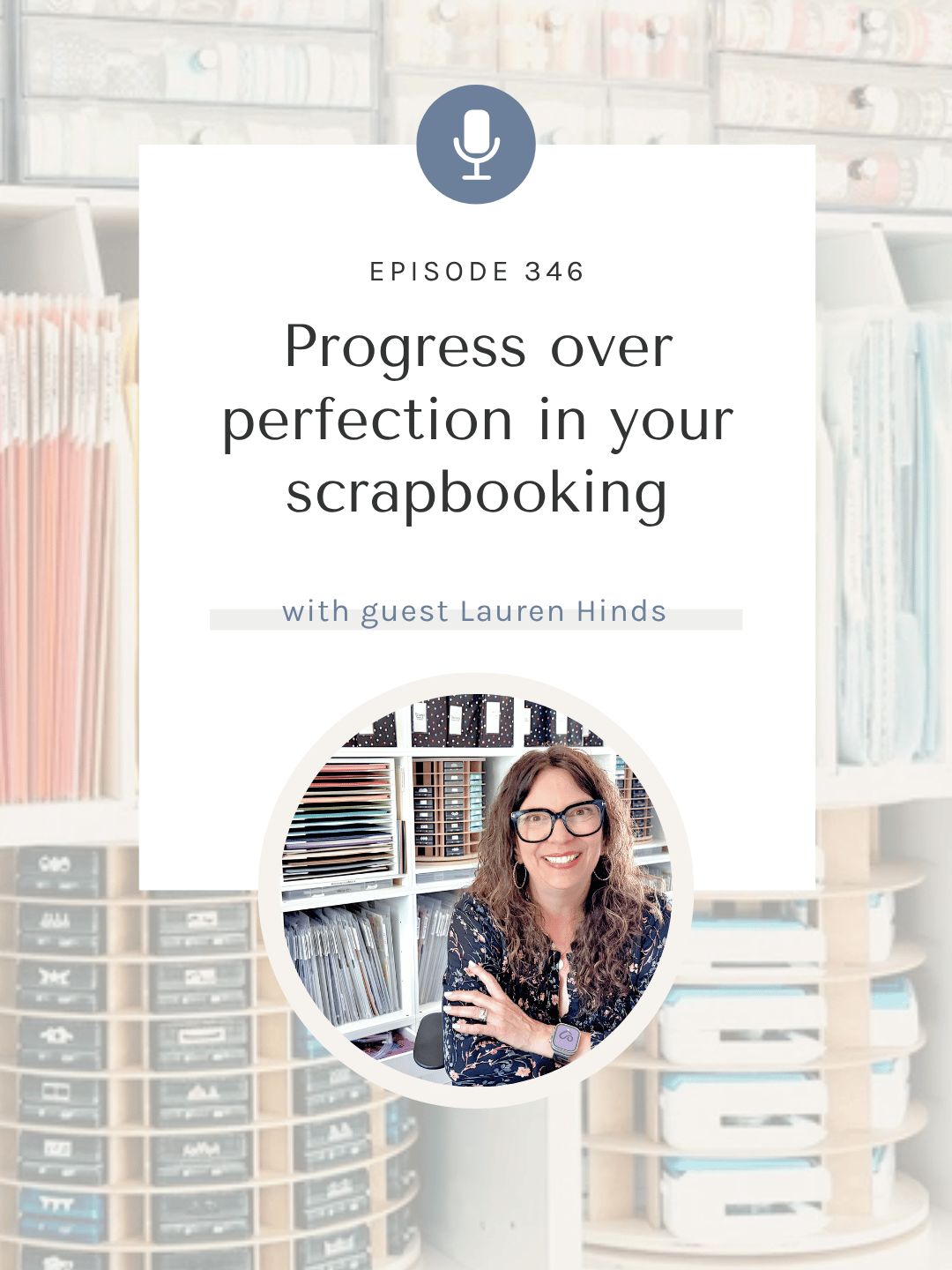
Lauren Hinds is a Southern California scrapbooker, Creative Memories advisor, and the creator behind Craft Some Joy. She joins us to share the organizing systems and planning tools that have helped her move from feeling overwhelmed by unfinished projects to actively working on multiple albums at once. Lauren’s approach centers on a philosophy she calls POP, which stands for Progress On Projects, and a set of practical strategies for fitting scrapbooking into real life.
- She shares an out-of-the-box tip for organizing embellishments: using A5 ring binders with small page protectors to sort stickers, die cuts, and ephemera by theme rather than by type.
- Lauren also opens up about why her family’s preference for chronological albums led her to adapt the Library of Memories approach into something that works better for how her family actually uses their album
- Lauren’s Photo Folders system transformed how she manages printed photos by organizing them into labeled categories, making it easy to grab exactly what she needs for any layout.
- Her POP philosophy has become the foundation for her monthly meetups, live crop events, and even her 10-minute timer approach to fitting scrapbooking into busy days.
Links Mentioned
- Lauren on Instagram: @craft.some.joy
- Lauren on YouTube
- Photo Folders
- POP Planner
- Album Maker Academy
- Creative Memories
- Creative Memories Trimmer
- Simply Tidy Storage
- Library of Memories
- Pop Crop
Lauren Hinds: [00:00:00] one of my biggest recommendations is get everything out of your head. Of all the things you wanna do, you have to have one place to put all of that. And as soon as you can get it into one place, then you can step back say, " What is thing I'd like to finish?
Jennifer Wilson: Welcome to Scrapbook Your Way, the show that explores the breadth of ways to be a memory keeper today. I'm your host, Jennifer Wilson, owner of Simple Scrapper and author of The New Rules of Scrapbooking. This is episode 346. In this episode, I'm chatting with Lauren Hinds about her systems for organizing photos, planning albums, and making consistent progress on scrapbook projects.
Lauren shares how she's built a whole philosophy around progress over perfection, and the practical tools that help her finish what she starts
Hey Lauren, welcome to Scrapbook [00:01:00] Your Way.
Lauren Hinds: Thanks, Jennifer. I am so glad to be here and in your community. This is amazing. Thank you for the invitiation.
Jennifer Wilson: Likewise. Yes. I'm excited to chat and learn more about how you think about things. I think we have a lot in common. Um, but can you start by sharing a little bit about yourself?
Lauren Hinds: I'd love to. So, uh, my name is Lauren Hinds. A lot of people know me through my business online presence as Craft Some Joy. And I am the proud mom of four adult children, um, still out there finding their way. So proud of them. And I've been married to my hubby, John, for almost 33 years. I had to count it up. How many years has it been now? Uh, 33 years.
Jennifer Wilson: Yeah.
Lauren Hinds: And we live in Southern California. In fact, I'm a Southern California native. Um, and we live in Monrovia, which is in the [00:02:00] beautiful foothills of the San Gabriel Mountains, so we get a lot of wildlife. Some folks know a lot about our local bears here. So.
Jennifer Wilson: Very cool.
Lauren Hinds: Been fun, yeah.
Jennifer Wilson: Yeah, what a lovely area for sure. So Lauren, I always like to ask our guests about some of their favorites. Do you have a favorite recent layout or project?
Lauren Hinds: So I, I really had to think about this, and I, you know, I create pretty much several times a week I'm working on some kind of a project. But if I had ... It, it said layout or project, and so I'm gonna go for the project.
Jennifer Wilson: Sure, sure.
Lauren Hinds: I am really excited about, uh, a project that I'm creating called Album Maker Academy. My latest focus is on a travel, a global travel edition for the Album Maker Academy. And why I'm so excited about it is [00:03:00] because for the first time I feel like taking kind of all those questions we have as scrapbookers, forward one more step. So I've been focused on, you know, how do we organize the big picture, all the things we wanna do. But now this is specifically each album project, take it step by step from start to finish. And to me, that just brings me so much joy. Because that's where my heart is, is, you know, getting people from start to finish. So, um, that is really my latest and most favorite to be working on.
Jennifer Wilson: Now is that already available?
Lauren Hinds: It is in the works.
Jennifer Wilson: Okay. Okay.
Lauren Hinds: Yet. It's coming soon. But I, I ha- I'm getting all the pieces in line, so it's all in my head and notes on [00:04:00] paper and hopefully launching a little later this summer. Yeah.
Jennifer Wilson: Sounds great. Yeah, yeah. Awesome.
Lauren Hinds: Thank you.
Jennifer Wilson: Now, is there something new that you're excited to do, use, or try? This could be in scrapbooking or even in your everyday life.
Lauren Hinds: Okay, so I, uh, can I give you two answers?
Jennifer Wilson: Yeah, we love answers.
Lauren Hinds: All right. So I actually just learned how to make sourdough bread.
Jennifer Wilson: Nice.
Lauren Hinds: Uh, it, that, that has been a fun journey, and I, I think bread-making is definitely a creative process. Because there's a lot of variables, a lot that you have to learn, and I am still a baby beginner, but my, my family has been enjoying the process.
Jennifer Wilson: I bet, yeah.
Lauren Hinds: Uh, so.
Jennifer Wilson: I am a two-time sourdough failure myself, so.
Lauren Hinds: Oh, gosh. It's not easy. It's not easy.
Jennifer Wilson: Yeah.
Lauren Hinds: In, in the crafty world, I, uh, Creative Memories just actually [00:05:00] came out with something called the Layout Studio. I don't know if you've heard of that, but.
Jennifer Wilson: Not.
Lauren Hinds: Magnetic Uh, two-page, you know, it opens up to two pages.
Jennifer Wilson: Oh!
Lauren Hinds: Grid.
Jennifer Wilson: I did see that. Yes.
Lauren Hinds: And you can stand it up, and it has all these little mag- magnets. And I have been using that more and more. And I'm finding I like it because I don't have very much space where I actually create. Especially on a live stream or something like that. And so I can stand it up, bring my cutter out, you know, do my cutting, then lay it back down. And so it's just, it, it's a process to learn it, but I'm enjoying it.
Jennifer Wilson: Wasn't there a pro- a product like that kind of, you know, 10, 15 years ago? 'Cause I remember Noelle on the Paperclipping Roundtable talking about something very similar, not from Creative Memories, from a totally different brand.
Lauren Hinds: Yes, there is another brand and, ah, the name is escaping me, but, [00:06:00] uh, a similar.
Jennifer Wilson: Yeah.
Lauren Hinds: Uh... So it is very similar. Of course, I think Creative Memories, you know, they always go over the top on their product design, so Um.
Jennifer Wilson: That's, that's why they work. I use, I use a Creative Memories trimmer and it's the only one so far that hasn't failed me yet, so.
Lauren Hinds: Mm-hmm.
Jennifer Wilson: I'm really enjoying it.
Lauren Hinds: Yeah, yeah. Something fun.
Jennifer Wilson: Very cool. Yeah, no, I can see that, especially, you know, when you're trying to... You start getting piles of stuff and, and you wanna just tuck it out of the way, but still see, referencing what you're working on. I can see that being really helpful.
Lauren Hinds: Yeah. Something new. Out of my comfort zone, for sure.
Jennifer Wilson: Yeah. So can you tell us a little bit about how you got started in scrapbooking, and then how that evolved into a business for you?
Lauren Hinds: Oh, sure. So, uh, you know, it, it's interesting because when you were saying, you know not only how, how I started scrapbooking, but also this kind of goes [00:07:00] hand-in-hand with Creative Memories. Like Creative Memories was the entrance piece for some people. I think we all kind of have this soft spot in our hearts for the very first class we went to, right. Or, you know, the first introduction, the first time we saw someone take pictures and put a sticker with it. Oh my gosh, that's so cool, and then paper. And so I like to tell the story. I, I started in the early '90s. My mom, I came, uh, over to her house one day, and she had all these colored Post-its, and she was trying to do something, like actual Post-it pads, you know.
Uh, she was trying to do something fun with her photos. And then she said, "You know, I got invited, uh, I, I found out about this lady, and I got invited to go see. You wanna come with me?" And I said, "Oh, sure. I'll go." Well, again, it was that moment of first seeing, oh [00:08:00] my gosh, we can be creative. We can have fun with our photos and put stickers and paper and use these fun scissors, you know, 'cause back then it was all scissors.
Jennifer Wilson: Mm-hmm.
Lauren Hinds: All these shapes and, you know, edges. And, uh, so that, that was my first introduc- that was my first class. I'm still great friends with the person who I had my first class with. So she, and, and in fact, she became my upline, um, a little while later after I had my first daughter, I remember her chasing me around saying, "You really, you really need to try this as a business." And so I did when my kids were younger. But I think a lot of us know that's a tough time, you know, especially with four at home. Uh, and, and so I did do workshops, you know, ran my business, but I found it was, it was difficult. Because of, um, you know, just having, the family life, you know. [00:09:00] And it doesn't get, even when they get older and go into high school and middle school, it was even busier from, you know, sports and scouts and all those things. So in, uh, 2019 when things did kind of start settling down with the kids, I thought, "You know, I'm gonna try this YouTube thing." And in late 2019, I decided to post my first video. It was October. I thought, "Well, that wasn't so bad." I was a little nervous, and it wasn't front-facing at all. Like, I did not show my face on the camera, and I thought, "Okay, hands only.
This is good. I can do this." so I started creating more videos in 2019. And I thought, "Wow," you know, I remember, and I remember exactly where I was when I got the very first comment on my video. Like, I was like, "Oh my gosh, somebody left a comment for [00:10:00] me. How exciting." And then 2020 happened.
Jennifer Wilson: Yeah, I was thinking what, what interesting timing there.
Lauren Hinds: Interesting timing, right? I thought, "Well, I'm just gonna make more videos then." You know, we're all kind of stuck at home, and I really like this scrapbooking thing, and I'll share what, you know, how I scrapbook and how I approach products. Because I felt like there weren't a whole lot of people talking about simple pages. You know.
Jennifer Wilson: Mm-hmm.
Lauren Hinds: It was a lot of very complex pages.
And I, I was like, "You know what? I don't scrapbook that way." I scrapbook very simply. So, uh, little did I know that would lead me to my business. And, and my YouTube channel grew. And I found, wow, people ordered with me. You know, they found out I was a Creative Memories advisor, and they started signing up to be on my team.
And so it just kind of snowballed after that. [00:11:00] And then later, kind of as I saw that progress, I started realizing that I had something a little bit more to give than just saying I was a Creative Memories advisor. And that's really where my heart is. And it's with organizing. I have a passion for organizing and helping people organize. So that just fell into the scrapbooking space. I feel like that's a lot of what people know me, uh, know for, about me, is if you feel organized, if you... You know, people have said, "Oh, I got my whole craft room organized after I met Lauren online," you know, or something like that.
Jennifer Wilson: Very cool. Yeah.
Lauren Hinds: Yeah, and, and that makes me feel so good to be able to help people in their space and with their projects.
Jennifer Wilson: Well, let's, let's dive into that organization topic a little bit more. Is there a particular storage solution that you would be completely lost without?
Lauren Hinds: I have to, I have to give [00:12:00] myself a plug really, uh, uh, um, if that's okay. But the one thing I really feel changed the way I scrapbook is a product, um, that I created, it was back in 2019, uh, called Photo Folders. And what I realized is I spent a lot of time, you know, with boxes of photos or, or, you know, the little pouches.
This is when we used to print photos. Okay, Jennifer, first of all, remember we still to print photos?
Jennifer Wilson: Yes, yes, yes.
Lauren Hinds: Back in the day, um, when we, you know, take our roll of film and get them developed. And so I still had a lot of photos, and I realized that I would re-look at everything. I couldn't remember this stack, what was exactly in this stack. It could have been October of, know, 2003, but I didn't know what was in that stack. [00:13:00] And so I just made this folder, and now I have them professionally printed, uh, because I can't live without them. And now each subject, I, I look at my pictures as categories, you know, I think as an album maker. Categories for topics that I'd want to scrapbook. So now all my boxes, all my photos, all my boxes have folders of photos, so I can just look down the line. It's kind of like, like if you opened up a file drawer, right? And.
Jennifer Wilson: Sure. Yeah.
Lauren Hinds: File do I want?" We did the... I did the same thing for my photos. So I can see, you know, this is the Hinds family in 2005, uh, October Halloween pictures. You know, something like that. And I, I think if I had to not have that, I mean, you could use Post-its and tags and things like [00:14:00] that, but I love being able to just grab that little folder.
Jennifer Wilson: How would you handle, like, the random photo you took of Grandma's living room, but it didn't really go with anything else?
Lauren Hinds: Right, and that's a great question. So those are all what I categorize as miscellaneous photos. So they would still be, say, in a, in a month or in a year. Uh, but I just call them miscellaneous. And what's really fun is sometimes I'll take that folder and I'll make a page just with all those miscellaneous photos. 'Cause there might be like a one-off in there, something fun to talk about or that has a story.
Jennifer Wilson: Yeah, certainly if it's worth saving, you know, it might have a story that goes with it. Um, but it doesn't necessarily have, uh, an event or a larger circumstance that connects it, so.
Lauren Hinds: Or doesn't need a whole page, or it doesn't need to be two pages even, so.
Jennifer Wilson: Yeah, yeah. Now, are there any of your organization [00:15:00] strategies that you feel are, like, really more out of the box than, than typical?
Lauren Hinds: So here's a fun one that I just realized about myself lately, and it's actually working. I've been using this organization tip, um, I think for about a month now, and I really like it. And what I realized is that I... going smaller, going smaller actually helped me organize better. And so, okay, so what do I mean by that? I found these A5 size little ring binders. So if you know A5, it's approximately, what, like, a seven by nine. So it's not a full, you know, the big binders we're used to or even, know, I was even going bigger, like, big 12 by 12 storage binders or [00:16:00] by 12 storage pockets. You know, I- everything was big. And what I realized is when I got to a point where I was like, "Oh, I need a sticker," or, "I need a die cut," or, "I need a little piece of ephemera," I wasn't pulling these giant binders off my shelf because it would just overtake my whole space that I was creating in.
Jennifer Wilson: Yes.
Lauren Hinds: So I decided to start moving things into these little binders that I could just hold in my hand. So can you picture it? Is it, is it kinda coming to life?
Jennifer Wilson: Oh, totally. Yeah. No, I've had little binders like that just from even the office supply store just for like, I think one of my original planners was even in one of those binders. Um, yeah. No, that sounds really fun.
Lauren Hinds: And I've, I've really been enjoying it. So I have categories like, uh, know, my seasons, of course, spring, summer, fall, winter. I have travel and adventure, love and relationships, [00:17:00] family, friends, and pets, everyday life. And so if I'm working on a layout and I go, "Oh yeah, um, I'm working on a birthday layout, let me grab birthdays and celebrations," and it's in my hand.
I can hold it over my layout. It doesn't take up a lot of space. I flip through these cute... And, and let me tell you, the A5 planner world has the cutest, like, little four pockets, and half pockets, and full pockets, and even have sticker sheets, like releasable sticker sheets.
Jennifer Wilson: Yes.
Lauren Hinds: Yeah.
Jennifer Wilson: Love those.
Lauren Hinds: I do too. All in one place of, oh, I've got, you know, die cuts over here and, stickers in another binder.
Like, I'm really trying to categorize. So that I have a visual I can just flip. And see everything that could enhance my page all in one place, if that makes sense.
Jennifer Wilson: [00:18:00] So this strategy in particular allows you to merge die cuts, chipboard pieces, and stickers all by theme rather than having those separated in your space. That's, that's currently how they are in my space, is very separate.
Lauren Hinds: Yes. Yes. And I found I wasn't using it.
Jennifer Wilson: Yeah. Yeah. I'm curious why you didn't choose, like a lot of people use like the four by six photo boxes, the really small ones, um, for this similar type of thing.
Why was the binder really calling to you more than a box?
Lauren Hinds: So the binder, because of all those different sizes.
Jennifer Wilson: Okay.
Lauren Hinds: It has like the little, um, uh, they're like little page protectors. Imagine, you know, page protectors on a little small scale. So there's one with literally eight pockets. Four little pockets on the front, four little pockets on the back. So say I have a laser title I...
and it says happy birthday or surprise, or I've done a die cut that I didn't [00:19:00] use. It can just slide right into that little pocket instead of getting lost in some box. Like, to me.
Jennifer Wilson: Sure.
Lauren Hinds: Having, you know... Oh, and here's another thing, Jennifer, that I've discovered about myself. I'm a vertical girl. I talk about this when I talk about organization. Are you a vertical or a horizontal? And I find I'm more of a vertical organizer. So if I'm looking for something, I tend to go, like I- my binders are vertical, right? So I can grab that vertical piece, pull it out, flip through it, put it back in the vertical space. Rather than horizontal, like say drawers or, bins, things like that, even the boxes.
I find for me personally, that's harder.
Jennifer Wilson: I can, I can see that, yeah.
Lauren Hinds: Find out what kind of a person, what kind of an organizer are you?
Jennifer Wilson: I think if you look in your space [00:20:00] at the things that actually get put back and the things that maybe get piled up, which is often the horizontal things, you have to take a bunch of stuff, say, out of the deep basket in order to see what's underneath it, and then you're like, "Oh, now I gotta put all this back in," or you're, you're trying to, to rifle through things, so.
Does that mean you also have, like, filing cabinets? And do you do any vertical storage that way?
Lauren Hinds: I, I have the cubbies from Michaels, like the Simply Tidy cubes. And so there is vertical in project folders also.
Jennifer Wilson: Okay. Okay.
Lauren Hinds: So I label those on the side so I can easily scan my cubbies.
Jennifer Wilson: Mm-hmm.
Lauren Hinds: See what's in there too.
Jennifer Wilson: Awesome.
Lauren Hinds: So really my drawers are really just you know, for like tools and things like that.
Jennifer Wilson: So it sounds like we are often thinking about these things. Um, and I know we share a similar philosophy on the benefits of planning, like taking that intentional pause. Like, let's not just dive in so that we don't feel overwhelmed, [00:21:00] because we've all been in that place where we, we buy all the things and then we lay it out in front of us and they're, you're like, "Now what?"
So what advice do you have on choosing priorities, whether it's within this week, this month, or even this day? How do you recommend someone start prioritizing things when we wanna really do all the things all at once?
Lauren Hinds: It's so true. We do. And I did. And one of my biggest aha moments was, And, and also a question I get asked a lot is, "Where do I start? I wanna do all.
Jennifer Wilson: Mm-hmm.
Lauren Hinds: These things. Where do I start?" And some people say, you know, start with the most recent project, or start with a project that has a beginning and an end.
And, you know, there's a, a million different answers to that question. And then I realized you don't have to pick one.
Jennifer Wilson: Mm-hmm.
Lauren Hinds: You can start on several. As long as you're organized and you've taken the time, [00:22:00] just like you said, step back and see your bigger picture. And for me, that was, I when I was in the muck of it and I realized I kept repeating, like rifling through my photos or where was I?
I can't remember if I scrapbooked, you know, which album I scrapbooked last. Because I, I'm not anywhere close to being done. I have lots and lots of projects. And life happens, right? So there might be something that takes you away from creating for several days or several weeks or several months. And I needed a place to put everything, and so that I'm gonna kinda dive into a little bit.
My, my pop planner is where I started putting everything. And it's evolved over several years, uh, into a system. But that's kind of one of my biggest recommendations is get everything out of your [00:23:00] head. Of all the things you wanna do, you have to have one place to put all of that. And as soon as you can get it into one place, then you can step back say, " What is thing I'd like to finish? What has a deadline?" Maybe you have, you know, an elderly person in your life that you really wanna celebrate their life before they're gone, right? Um, or you have a graduation coming up or a retirement coming up, right? So sometimes there's timely deadlines. Um, or something that you're most excited to work on. And here's another thing that I realized also is, uh, I used to put off working on my photos right now as they're happening. And, about two years ago, a little more than two years ago, I started what I call my monthly meetup, where I also have a, a dedicated, uh, time every month at the end of the [00:24:00] month to work on that month's photos. So that's even a thing that I would recommend is, um, make a date with yourself. Because if you don't take the time in the moment, those stories are so fleeting that you're gonna forget the, the conversations you had, the wonderful walk you had with your dog or, you know, just a new friendship or meeting someone or a funny conversation that you had with your kids or, you know, all those things. You... To me, scrapbooking is also capturing those moments, those those fleeting moments. And so I do encourage people to work on current projects. But then also, if you have a plan, that bigger perspective, you can then jump from that. Like have that as one date a month that you can do [00:25:00] that. Work on current, then what other project, uh, is something that you'd like to work on?
And as long as you have strategy and a plan, you can jump around from project to project, and that's what I absolutely love to do. I'm working on 2010, 2019, my current family 2026 albums right now. Those are my three projects that I'm working on, and I'm getting ready to start my vacation album with Album Maker Academy.
That's one reason I wanted to do that. So that's gonna be four projects. But I can keep track because of some of the tools I have. I know exactly.
Jennifer Wilson: Mm-hmm.
Lauren Hinds: What pages I finished. I know exactly what pages I wanna do next, or I should do next, right? And if I wanna jump from whichever album to whichever album, I can. That was a long answer, sorry. [00:26:00] Mm.
Jennifer Wilson: No, it's all good. I wanna underscore the part about setting the date with yourself to work on current photos. Because I think if I had to give like a number one tip, it might be that, that the more you touch your photos, the more kind of internal motivation you're gonna keep generating to work on other projects.
I think it's when we get away from that, because it, 'cause it can easily get away from us, um, that we then we start to feel disconnected. Because we feel that, that kind of backlog sense when it comes to our photos. So even just, you know, once a week, once a month, jump in there, do what you can. That's gonna kinda keep the ball rolling with staying connected to scrapbooking.
Lauren Hinds: Absolutely. Absolutely. And could I also add one more thing here too?
Jennifer Wilson: Yeah.
Lauren Hinds: Jennifer?
Jennifer Wilson: Yeah.
Lauren Hinds: I also, one of the things this last year has taught me, I've started just kind of going online and doing what I call 10-minute POPs. And POP is P-O-P, progress on projects. That's all it is. Not [00:27:00] perfection on projects. It's progress on projects. And even if you have 10 minutes, sort some photos, write a story down, organize some paper. You know, you got some new products in, take a minute, put them in a folder, label the folder, or, you know, wherever you keep your happy place, your happy things. Ten minutes, set a timer. I encourage you, set a timer on your phone and just do 10 minutes. Because six times of that, you've got an hour, and it just can snowball and snowball. So progress doesn't have, have to happen in a 3 day long retreat or in, you know, 10 hours in your scrap room. It can work in very small increments.
Jennifer Wilson: Now this pop concept has become quite a theme across everything you do. Um, it sounds like you have both products [00:28:00] and experiences that you've built around it. Can you talk a little bit more about that?
Lauren Hinds: Yes, I love... So a- and I c- and I have so much fun talking about POP because it's, it really is, it's about progress. And I have, um, like I mentioned earlier, my POP planner, which was a long time coming, and it started sharing that, uh, on YouTube. And I, you know, just kind of this system of how I was writing things down, putting it all in one place, and understanding my bigger goals.
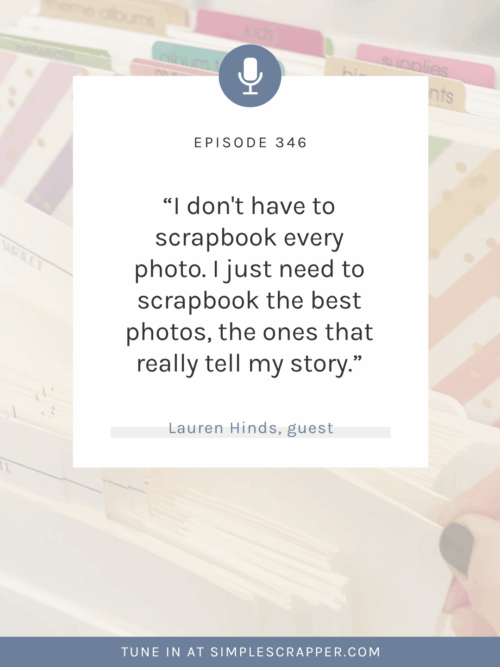
You know, if I had to get out of my head and write down every single album I ever wanted to create, I wanted one place to put that. And I realized over time what I had first created was really too complicated, and it did tie into [00:29:00] Library of Memories. Because I thought, "Library of Memories, I love this concept." And, so I had put Library of Memories in my pop planner. And as I evolved over time and really got serious about my album making and finishing projects, I knew for myself that, um, Library of Memories wasn't quite the right fit. Because I enjoy chronological and I enjoy theme. I en- I love seeing how my, uh, family evolves over the years. And, uh, I also love bigger projects like say my kids' school books or baby books or travel albums. Those are my big ones. Or home renovation projects. And so I Or the pets we love, right? I love that. So there's still, ties into the Library of Memories, [00:30:00] uh, concept, but I use that more in my theme category, if I have enough photos that deserve their own theme. Then I have my family chronological albums. But what I realized is, the biggest thing is albums, I don't have to scrapbook every photo. And I think of us, especially if we learned in Creative Memories or came from Creative Memories or, you know, the original thought on scrapping, "I have to scrapbook every photo. And that was a big aha for me to say, "Oh, no, I don't need to scrapbook every photo.
I just need to scrapbook the best photos, the ones that really tell my story." Uh, so it's more of a highlight reel. I like to call it a highlight reel. Some things like a travel album, yes, maybe I'll do more. So the pop- that pop system, the bigger picture for me kind of [00:31:00] now is categorized into chronological and theme. So I have a place to put all those things. And then my photo folders, I've organized all my photos so I can easily grab a folder. And say, "Okay, these photos go this layout." I'm just gonna grab them out of my box. Or if I like to make page kits, you know, a lot of us like to, you know, grab our supplies, put them in a folder. Well, my photo folders go in my page kit with the supplies that I wanna use to build that page also. And so over time, my, my planner got more streamlined into just chronological theme. It got more streamlined into what are really the forms that I come to over and over and over. And I have this philosophy of organize, simplify, and finish. So [00:32:00] the organize is you've gotta organize your photos. You have to know, especially this translates into digital. So now we're looking at our camera rolls, right?
Jennifer Wilson: Mm-hmm.
Lauren Hinds: Scroll, scroll, scroll. Even that, what photos am I gonna print? And I print them, and I put them in a photo folder. So now again, I have my, my strategy. But first you have to look at your photos and decide. Then my second tool, I call it an album map. The album map help- helps me see my whole album at a glance.
And it's just little pencil notes. I always use a pencil 'cause I like to erase and move things around. Pencil notes on a map that is, you know, represents an album that I want to create. What feels so good is when I finish a page, I'll put a big X through that page. You know, ooh, that one's done, right?
So if I have [00:33:00] 30 or 40 boxes, I know exactly how many pages I finished. And then from there, you know, you do the actual creative part. So pictures, album map, and then create. And to me, I tend to be more on a simple side. I love what I call quick cuts or just blocks of color on your page and, you know, just those fun little finishing touches. So I have products developed around that too. But that's kind of my, my big system. And then, I'll just add one more thing. I ha- I, I couldn't do every month, I, I do a four-hour live stream Pop Crop. And again, it's going back to our conversation, setting a date with yourself. So that's where I work on whatever new products that come out or something fun [00:34:00] or a new design concept or a new tool or a new punch or something like that, that's Pop Crop.
And so I have that with my Pop Stars, and we have, uh, Pop Sketches and all the, all things Pop in there. So that, there we go. I'm done.
Jennifer Wilson: I lo- I love it. I love it. But I have, I have follow-up questions for sure. So, um, a lot of our listeners will be familiar with the Library of Memories system. This is a kind of a four category and subcategory system, uh, created by Stacy Julian. We've talked about it a lot on the show over the years. Um, so y- you did keep those albums for a few years, is that correct?
Lauren Hinds: I did. I did. And I still have pieces of that that I'm working on. So I still have the Pets We Love.
Jennifer Wilson: Okay.
Lauren Hinds: A place called home, which is my family renovations. Um, and I do have one called Portraits of Us, which [00:35:00] are, like family portraits over the years. And the people we love, which are kind of celebrating, um, certain meaningful people. But I also realized, which and, and so I love the perspective Stacy gave on your whole photo library. Like, that was priceless for me. Like, taking a step back and going, "What are these amazing, you know, things that we can talk about through our albums?" And that will always remain kind of in what I do. But I also realized for me personally, and I had conversations, I encourage you to have conversations with the people that you are scrapbooking for and your family, you know, if you have that. I had a conversation with my husband and I said, "What do you think if I just stopped doing chronological albums?" He didn't like it. [00:36:00] Because he is one that will go and pull an album off of our shelf and say, "Oh yeah, when did we, you know, redo the patio?" Or you know, When did this event happen?" And he loves and pulling an album off and flipping through those pages for a certain year. So I realized for our family, that was definitely something I wanted to continue. I just had to simplify it. I had.
Jennifer Wilson: Oh, sure. I.
Lauren Hinds: To say not every photo.
Jennifer Wilson: So it's so interesting that, um, would you say you scrapbook kind of everyday moments as well as bigger moments?
Lauren Hinds: Absolutely in my current, um, in my current, like my 2026, I absolutely love scrapping everyday moments. And here's the thing, Jennifer, you know, scrapbooking changes as our family evolves.
Jennifer Wilson: Mm-hmm. Very true.[00:37:00]
Lauren Hinds: Yeah, my kids are grown. I hardly ever get pictures of them unless, you know, we all go out to dinner or something. So the everyday moments are special for me. Are- they're special. So if my son happens to go on a walk with my husband and my dog, I'm gonna snap a little picture and write a little story about that. That's an everyday moment for me, and I do love, love that. But I incorporate that into my more current albums. For my older albums, when I go back, like say 2010, that's when ... Remember when I was saying, like, I have a folder of, like, miscellaneous pictures.
Have a full page or a full two pages? I'll try to go back, and, and this is why I really suggest, uh, writing things down. Oh, and that's another, another little thing I have are, uh, tell the story cards. So if you remember things, you can just write that down [00:38:00] and stick it in the photo folder. And because I've know for myself, going back to 2010, when I pull out the miscellaneous photos, sometimes I'll have to go and say, "Do you remember, you know, what was going on here?" The, the memories, the stories don't come as fresh. Hey, we're all getting older, right?
Jennifer Wilson: Certainly.
Lauren Hinds: Um, so I try- I still like the idea of everyday moments. It just doesn't have the richness of the story, unfortunately, because time has passed, unless I wrote something down.
Jennifer Wilson: I'm curious when, let's just say you have a new photo, a new story that you're wanting to tell, um, does it automatically go in the a- annual album unless you have a theme album that, that it would f- fit better in? Like, how do you make these decisions about where it goes? I think that's kind of one of the big challenges overall of if you have different album systems that are side by side, how do you then make a [00:39:00] choice?
Lauren Hinds: Right. So here's the question I ask. Uh, does this, photo help tell the story of our year? Or is it large enough to become its own project? And so does it help us tell the story of our year? What's interesting is a lot of photos do, even the small everyday moments.
Jennifer Wilson: Mm-hmm.
Lauren Hinds: And, and also, also remember there are photos we don't need to do anything with. They can just either... You know, I, I have an ABC method. Do you mind if I share that? So.
Jennifer Wilson: Sure, go ahead
Lauren Hinds: My ABC method for photos is A. A is album worthy. Remember A, album worthy. B is They're a photo that you don't necessarily want to scrapbook. They're not album-worthy, but you don't wanna get rid of it or delete it. Get rid of it meaning trash it [00:40:00] out of your box or delete it off your phone. So think of that as box it, B, box it. Bin- you know, like put it in a, put it in a storage. C are the blurries, duplicates, the, you know, 10 photos of the same thing. You really, you know, you could cut that down. Save two, not 10. Um, and that is, uh, C is get rid of it, or you might wanna call it can it. C, can.
Jennifer Wilson: Yeah.
Lauren Hinds: Put it in the trash. So if you look at, um, you know, A, album-worthy, going back to your, your question of how do you decide where it goes, I even back that up and say, first of all, is this photo even album-worthy? And if it is album-worthy, then you make the decision. Does it go into my family? Does it st- tell the story of the year? [00:41:00] Or is it part of a bigger story, like say a retirement or a travel, you know, a theme. The hard one for me, here's, here's a good example. The hard one for me is pets. Because we, we love pets in our house. And so, you know, do you put all these cute pet photos in your, your yearly book? Or do you pull them out and put them in a, in an album for them, right? 'Cause, you know, hey, pets deserve.
Jennifer Wilson: I might say both on that one.
Lauren Hinds: Uh, uh, yeah, and that's exactly what I was gonna say, Jennifer, is it, it can be both. So again, maybe for the family album, it's a, it's the highlight reel. Just remember that. It's the highlight reel. But you have 10 photos of, you know, we just got a new kitten.
Jennifer Wilson: Hmm. Awesome.
Lauren Hinds: I can't stop taking photos of this new kitten.
Jennifer Wilson: I bet, yeah.
Lauren Hinds: And especially, you know, we have a, I have a dog, and, and the introduction. So it's, you know, it's a process. And I can't stop [00:42:00] taking ph- photos. Well, I'm not necessarily gonna make two two-page layouts in my family book of these two playing together. I would put that in my pets album, though. Does that make sense?
Jennifer Wilson: It does. It does, yeah.
Lauren Hinds: Yeah. So, so it can be, it can be both, but again, I always try to treat my family album as the highlight reel, if that makes sense.
Jennifer Wilson: You know, it, it, it does. Everything you say has made sense so far, so.
Lauren Hinds: Okay.
Jennifer Wilson: You've done, you do, you have a...
Lauren Hinds: I've been out at, at it for a long time.
Jennifer Wilson: Yeah, you have some good systems for sure. Um, one thing I would add to your ABC system, though, is maybe like an A+ or something because, or an F. Because I prioritize, um, photos that I would frame. Uh, separately from photos that I would scrapbook.
And sometimes they're both, but often they're actually not. It's just, like, the most beautiful photos that have no story behind them, but these are the ones that I [00:43:00] really wanna celebrate on the wall. Um, and so because, you know, I have to find them somehow, um, those get my five stars, and scrapbook ones get three stars. So.
Lauren Hinds: Oh, I like that. Yeah.
Jennifer Wilson: Yeah. Anyway.
Lauren Hinds: F for frame it.
Jennifer Wilson: Yeah.
Lauren Hinds: Album it, bin it, can it, or frame it. There you go.
Jennifer Wilson: I like that. Yeah.
Um, going back to Creative Memories a little bit, I, I did not gr- I grew up knowing about it, but that's not how I started in scrapbooking. I actually started as a digital scrapbooker and then transitioned to paper when my daughter was born 15 years ago. Um, like literally on the dot, like I was transitioning over the course of my pregnancy from digital to paper.
It's, yeah. Even my, my, her like little baby album, it's half digital and the, all the stuff that I documented after she was born turned to paper within the same album. Um, that's an aside.
Lauren Hinds: That's so fun. Well, there was a huge digital pu- push too.
Jennifer Wilson: Oh yeah, yeah, for sure.
So but I'm [00:44:00] curious for those who, who maybe did get their introduction with Creative Memories but have stepped away from the brand for whatever reason or, you know, of- oftentimes there's even stepping away from scrapbooking. What would you say is new and different in 2026 versus say 2006?
Lauren Hinds: Oh my gosh, yeah. What a transition we've been in. And, and here's the thing, you know, I absolutely love the creative process, and I always want to celebrate, people's decisions on what brings them joy creatively. And, uh, and, and so a, a lot of people were like the, the lingo was, "I had a CM Nazi for an advisor," right?
Like, you, you couldn't, you couldn't use any, you know, anything but.
Jennifer Wilson: Yeah.
Lauren Hinds: CM, and I'm so not that person. And I think that's been a huge shift for the, the brand and the company as a whole is, find what [00:45:00] makes you happy, in the way of album making. And, and they've changed a lot of their products kind of to go along with that. They've made simple, what they call Simple Page Kits. So that's how they help brand-new beginners. Because, you know, I think what's kind of sad is that, um, the youngers, I call them a younger generation, they're not as excited. My, my daughters, I have, you know, a, a 25 and a 29-year-old, they're not excited about scrapbooking. They're trying to make the entry point easy, so they've created Simple Page Kits and Fast to Fab pages. And even album kits now. That's one of their latest launches this year are kind of pre-designed base pages for you, and then you get to add your.
Jennifer Wilson: Mm-hmm.
Lauren Hinds: Photos and layer some, paper and stickers and different things on top. But they've done kind [00:46:00] of the work of figuring out the base layouts for you. So they've realized not everybody scrapbooks the same, and I think that's been a huge shift. You know, and you don't have to do it their way.
Jennifer Wilson: Yeah. Yeah.
Lauren Hinds: anybody's way. You do it your own way.
Jennifer Wilson: Certainly. Yes.
Lauren Hinds: Um, but I, I, I also have to say, you know, their albums to me are just the best.
And, and I'm- know this about myself too. I'm kind of a matchy-matchy girl. So I love that their albums today are still the same albums they had 25, 30 years ago. And they are s- they held, hold up beautifully. I still have some of my very first albums, and they look so pretty on a shelf. They have a, a customizable spine product that they, um, just re-released.
So [00:47:00] all my albums have, you know, custom spines, and I can just glance. It's ... I, I think it's that vertical thing again.
Jennifer Wilson: Mm-hmm. Yeah
Lauren Hinds: Love looking vertically, you know. And I even, I even choose the same font, you know, 'cause I want my fonts to look the same. My- all my family albums are black and, you know, different colors for other things. My kids are red.
Jennifer Wilson: I get it.
Lauren Hinds: You know. I'm, I just like that.
Jennifer Wilson: Yeah. I was doing some photo books over the years, like just some annual books, and then one year the software I used, they changed all the fonts, and I'm like, "No, this is unacceptable." I, you know, I want these to line up on the shelf and look the same, and they just don't. Yeah.
Lauren Hinds: You get it. You get it. Yeah.
Jennifer Wilson: I do.
Lauren Hinds: That's me right there.
Jennifer Wilson: So I'm, I'm really curio- I n- I mean, I, I know the albums have long been like this is one of the reasons that people love them, and they've, like, it's kind of the, the backbone literally, of the system. Um, and I've noticed [00:48:00] a lot of younger scrapbookers, so like, you know, as you said, you have adult children in, you know, who are finding their way in the world. And I think they learned from their moms and grandmas, um, that this is maybe a, a good way to start scrapbooking. And so I'm seeing kind of a, this resurgence of, of the albums beyond maybe the core community, and I think it's really fascinating.
Um, but I'm curious, could someone who maybe has their layouts, their 12 by 12 layouts in binder albums, could they use the top loading single pocket pages to convert their albums and then, like, save a lot of space? Or are the dimensions not quite right to do that?
Lauren Hinds: They are perfect because that's a lot of what we, we do now. We s- we scrap on 12 by 12 pages.
Jennifer Wilson: Yeah.
Lauren Hinds: And then slide them into the, the pocket. So the pockets do, um, it, uh, take a 12, uh, a true 12 by 12 page. The one [00:49:00] thing I would be a little cautious about is, how much ephemera, how heavy are.
Jennifer Wilson: Mm-hmm. How bulky.
Lauren Hinds: Right?
Jennifer Wilson: Yeah.
Lauren Hinds: Yeah, I mean, some of us really like to go for that, and, um, they ... Creative Memories recommends, you know, about, it's always an about two inches wide. So for some of us, that means 40 pages, but for others, that might mean 10 or 15, especially sliding them into the top-loading pockets.
Jennifer Wilson: Sure.
Lauren Hinds: If they're bulkier.
Jennifer Wilson: Okay.
Lauren Hinds: It would be it's a great way to convert, and I, I can't tell you how many people have said, "Yeah, I'm done with, with ring binding because they don't last," you know, or, or something like that. And it gives you that consistency, too. Their albums are gonna be around forever, I hope.
Jennifer Wilson: I've, I've been very disappointed. I invested in a one whole brand of albums, and I have now since replaced them with another brand. Because [00:50:00] they didn't last, even just minor opening and closing. It's, I... You know, my family looks at stuff once in a while. I take it out to film something once in a while.
It's not like they were getting heavy use, but the spines all cracked and started peeling, and it's... Yeah, it was very, uh, surprising and disappointing, so.
Lauren Hinds: Mm-hmm, mm-hmm.
Jennifer Wilson: Yeah, no, thank you for sharing that. Is there anything else we haven't covered that you would love our audience to know about how you think about scrapbooking and, yeah, what advice you would have for them?
Lauren Hinds: Let's see. I would definitely recommend making a date with yourself, and I think we both just.
Jennifer Wilson: Hmm.
Lauren Hinds: Were like, "Yeah, yeah. Yeah.
Gotta talk about that." Make a date with yourself. And, and I feel like even for myself as the creator, as the organizer of, you know, the groups that I host, my, my pop membership and my monthly meetup membership, it puts me in, [00:51:00] personally, in the right space, too.
'Cause some- there are times where I'm like, it's the end of the month, And ugh, do I really, you know, wanna go through my camera roll for July? And, you know. By the end of that workshop, I am pumped and jazzed, and I wanna make more pages.
Jennifer Wilson: Mm-hmm
Lauren Hinds: If I didn't have that on my calendar, if I didn't have that commitment, I would not be making the progress that I'm making.
Jennifer Wilson: 100%
Lauren Hinds: I, I mean, I, I really... I feel so strongly about that. And of course, just like your community, Jennifer, it's a community. It's w- so wonderful to see. You know, we meet on Zoom. It's so wonderful to see people's faces. We do page shares. They get to... You know, I do giveaways, and, uh, I encourage people to post their pages in my Facebook group. And it's just such a wonderful [00:52:00] thing to be part of a community. Wherever you find that community, jump in and make a date with yourself, because you will be so happy you did.
Jennifer Wilson: I totally agree. Thank you so much, Lauren.
Lauren Hinds: Are so welcome.
Jennifer Wilson: Can you remind, our guests where they can find you online? And is there anything else new or coming up that you wanted to tease?
Lauren Hinds: Oh gosh. Um, well yes, so I am all things craft.some.joy. And, I wanna kind of, I, I also kinda just wanna put this out there is I love the idea that you can be creative, but you can also give yourself the flexibility to get projects done and to move forward in a simple way.
Jennifer Wilson: Hmm.
Lauren Hinds: So you don't end up just with stacks and stacks of pretty layouts, that you actually...
There is... I, I don't know if you would agree, there is something truly magical when you put the finishing [00:53:00] touches on an album and you put that on your shelf.
Jennifer Wilson: Certainly, yeah.
Lauren Hinds: It's a magical feeling, and that's really what I would say. Give yourself that allowance to, that, that progress over perfection, done is better than perfect. Just keep making the progress. So that those pages have a home and you can share that, uh, with the people that are meaningful in your life. So the, the teases for, Album Maker Academy, I can't wait to get that out there because it really is embodied everything I've talked about here. Taking the bigger projects that we put all that down and, you know, for me, it's my pop planner, but now we take one tab in that and we're going start to finish, and we're gonna get that album done in a really simple easy way.
Jennifer Wilson: I love it.
Lauren Hinds: [00:54:00] Yeah.
Jennifer Wilson: Yeah, it sounds terrific. Yeah, no, thank you. I appreciate you spending time with me today.
Lauren Hinds: I love it. I'm, I'm happy to be here, and so happy you reached out, Jennifer. Thank you so much.
Jennifer Wilson: And to all of our listeners, please remember that you have permission to scrapbook your way.
Sign up to receive email updates
Enter your name and email address below and I'll send you periodic updates about the podcast.
How to Subscribe
The best way to listen to Scrapbook Your Way is with a podcast player on your mobile device or with iTunes on your computer. You can subscribe via Apple Podcasts, Google Podcasts, or by searching for “Scrapbook Your Way” in your favorite podcast app.