
Kelly Wardlow is an engineer-turned-designer outside of Philadelphia who brings an analytical mind and a deeply personal mission to her digital scrapbooking practice. As the creator of Connection Keeping at Sweet Shoppe Designs, Kelly designs the kits and templates she actually uses to document life with her four kids in a 200-plus-page family yearbook each year. Her origin story as a designer is rooted in working with adoptive families and the neuroscience behind why scrapbooks help children build identity and connection.
- Kelly’s catch-up templates, born out of needing to keep pace with her own yearbook after becoming a designer, have become her favorite product and a daily tool for her own scrapbooking.
- Her engineering background shows up in everything from optimizing pocket page layouts to building Photoshop actions, and she draws an interesting parallel between analytical thinking and pocket scrapbooking.
- The conversation covers her eclectic design style, how she uses Google Sheets to organize her entire release calendar, and why novelty is the fuel that keeps her creative work going.
- Kelly also shares the story behind Connection Keeping and how Trust-Based Relational Intervention taught her that scrapbooks can help children with trauma develop a stronger sense of self.
Links Mentioned
- Kelly on Instagram: @connectionkeeping
- Connection Keeping
- Sweet Shoppe Designs
- Adobe Photoshop
- Adobe Photoshop Elements
- Adobe Illustrator
- Adobe Lightroom Classic
- Affinity Designer
- Google Photos
- Project Life app
- Collect app
- Ali Edwards:
- Krista Lund
- Amanda Yi (Pretty Full collab designer)
- The Nifty Pixel
- TBRI / Trust-Based Relational Intervention
- Canva
- Jennifer’s photo workflow video
Kelly Wardlow: [00:00:00] I set up my whole year ahead of time. Like, hey I got my work done. I have this chunk of time," I set up all the whole year. And I make cards that have the dates on them, like week one and then the date underneath it. I make those every year, and so I'll use that and I'll put it up for the whole year. So that I only need smaller chunks at a time to fill in and be done.
Jennifer Wilson: Welcome to Scrapbook Your Way, the show that explores the breadth of ways to be a memory keeper today. I'm your host, Jennifer Wilson, owner of Simple Scrapper and author of The New Rules of Scrapbooking. This is episode 349. In this episode, I'm chatting with Kelly Wardlow about her journey from engineering to digital scrapbook design and the personal story behind her brand, Connection Keeping.
Our conversation covers how she creates family yearbooks, designs kits she actually uses, and why scrapbooks can be a powerful tool [00:01:00] for family connection
Hey, Kelly. Welcome to Scrapbook Your Way.
Kelly Wardlow: Hi, Jennifer. How are you?
Jennifer Wilson: I am well and excited to chat with you today. Can you start by sharing a little bit about yourself?
Kelly Wardlow: Sure. Um, Kelly, I, I live outside of Philadelphia, and I have four kids from 12 to 21. My husband and I have been married for almost 25 years. We got married right out of college. And then... I, I don't mean to say that 'cause I'm afraid it makes me sound old, but I figured. Um, and so right now, one's in college, one's going to college, one is just about to start high school, and one is going into sixth grade.
So we kinda have the gamut of everything. And yeah, I mean, I guess I used to be an engineer, and after being an engineer for two years, I went back and got my degree in teaching, and I taught, uh, seventh and eighth grade math for a couple of years. And then I've been [00:02:00] stay-at-home mom until I started designing and a couple other jobs here and there.
Jennifer Wilson: Very cool. Do you think that like kind of your background as an engineer, a math teacher, that more analytical brain influences how you approach scrapbooking and designing?
Kelly Wardlow: 1,000%. And I think, and I always, I would love to make a correlation between how many science and math-minded people pocket scrapbook compared to, like, traditional.
Jennifer Wilson: Yes.
Kelly Wardlow: I feel like there's just so much about how to fit everything and how to still make it look pretty, but, like, you really have, like, a formula kind of aspect to it.
So.
Jennifer Wilson: Mm-hmm. Yes, yesterday I had an interview with someone who does, uh, Project Life, uh, as a collage on, you know, a solid, uh, piece of cardstock, and she was talking all about the math aspects. And I'm like, I think we could do a whole episode just on the math of pocket pages and scrapbooking, and how do we figure things out to make sure it's all gonna work.
Kelly Wardlow: I feel like that's it. We just try to, like, optimize it 'cause, [00:03:00] you know, then there's rule of threes, and we wanna keep in all of the beautiful stuff. But yes, mathematically working out is just... I love when I can find a formula or, like, I make an action or something in Photoshop that I can then repeat it. It's, like, a little joy for me.
Jennifer Wilson: Very cool. Very cool. So Kelly, do you have a favorite recent layout or project, and why is it special to you?
Kelly Wardlow: Sure. My favorite thing is I created it for myself, so I think that's why it might be my favorite and that it's working. I made a whole bunch of catch-up templates. So before I started designing, I'm pretty much a recent designer. I didn't start until maybe 2022. Like 2020 and 2021, I would dabble and just try to make things here and there, mostly for my own scrapbooks. But in 2022, I became a designer, and I didn't realize how much time it took away from my scrapbooking time. 'Cause we make a yearbook every year. And so all of a sudden now I had less time. [00:04:00] So these catch-up templates are kinda like plug it all in, and you can change the colors, and you can just add...
It's almost like a regular template. You can add different elements and things like that, but a lot of it's already on there, so I don't have to keep looking and finding things. So I... It has, like, revolutionized my, like, family scrapbooking. And so when I created them, I was like, "Oh, other people might like it." So I've... I think it's definitely my favorite. It's like my baby almost in that now I'm using it every day, and I think in my mind I picture other people, and I'm hoping that they're using it all the time too and getting the same kind of joy from it that I got.
Jennifer Wilson: Very cool. Yeah, we'll definitely link that in the show notes. They're, they're really fun.
Kelly Wardlow: They kind of stink though in that I don't know enough about other programs as much as I do about Photoshop Elements and Photoshop, and so then recreating the ability and the functionality.
Jennifer Wilson: Mm.
Kelly Wardlow: Of things outside of those programs is something I would like to do. Because in this day and age, it [00:05:00] is expensive to have a full, Adobe license or, you know.
And so I'm hoping to try to figure out ways to recreate that in programs that other people can use.
Jennifer Wilson: How are you finding that they come into Affinity?
Kelly Wardlow: That is a great question. And I've-- And
Yes. So like, I like Affin- and I, I have it on my iPad and, um, again, it's more just like looking into it. I.
Jennifer Wilson: Yeah.
Kelly Wardlow: And it, this kind of rolls into, I used to do a lot in Adobe, um, just even Adobe Acrobat to create things.
Jennifer Wilson: Mm-hmm.
Kelly Wardlow: So that people could use it and have, like, anyone could do it without a program. And.
Jennifer Wilson: Mm.
Kelly Wardlow: It, it's frustrating when you have all of the functionality, functionality like of Photoshop and you can do anything, and then trying to go to something that struggles. Where like, I think Affinity Designer and-- they have that kind of functionality. So when we're not in the summer anymore, that's on my list of things to do.
My goals.
Jennifer Wilson: Yes.
Kelly Wardlow: Work in [00:06:00] that, um, fully understand Illustrator 'cause it's so awesome, but I'm like only, like, not even proficient yet. And those are the two goals I have for this 2026/2027 school year.
Jennifer Wilson: You know, Illustrator is like the absolute hardest one to learn, and I, I feel like I can barely use it. But recently I was trying to work on a logo for an- another project and I'm like, "Okay, I need to know how to do this one thing." So I ask Claude, "How do I do this one thing?" And Claude tells me, and I'm like, "Oh my gosh, I didn't realize it was that easy," and now I can do that one thing in Illustrator. So it's like having a little, you know, a tutor on, on the side.
Kelly Wardlow: I do it all the time. I use, and it's funny, everyone has their favorite, and I should use Claude 'cause I heard that they-- Claude is really good with automation. Like, you can kind of teach it to do a whole bunch of steps. I honestly use ChatGPT often, but.
Jennifer Wilson: Mm-hmm.
Kelly Wardlow: Use it to help me with my actions.
Like, when I'm making a Photoshop action, sometimes I'll get caught or something, or it's not working [00:07:00] consistently across the board, and it'll help me.
Jennifer Wilson: Yeah.
Kelly Wardlow: And I,
Jennifer Wilson: Yeah.
Kelly Wardlow: I feel bad. I, don't know how I feel completely about AI, and.
Jennifer Wilson: Oh.
Kelly Wardlow: I'm here in this, like, complex, like, "Oh my gosh, you're amazing, but also you can't take all our resources." And so I go back and forth.
Jennifer Wilson: Correct. It is. It is a challenge.
Kelly Wardlow: It's nice to hear other people are in the same boat.
Jennifer Wilson: So I mean, as, as similar as, as a business owner, as business owners together here, I like to think of it as if I'm using this to improve my business, I can then use that to contribute more to the world. Um, in the ways that I want to make the world better. So that's, that's my personal justification for the negative sides.
Kelly Wardlow: Yes. And I, I always go back to the... Have you ever heard of the thing where, you know, someone will do all this wonderful things to help the environment, but maybe they have a private jet and it kind of completely.
Jennifer Wilson: Yeah.
Kelly Wardlow: Outweighs that? So just taking it off of [00:08:00] Google or something so I feel like I can save some resources there, and then if I don't feel so bad when I use it is more helpful.
Jennifer Wilson: Yeah. Yeah. But yeah, Illustrator, the toughest one for everyone, I think. So.
Kelly Wardlow: You know what I've been doing? I've been doing, like, small bite learning. Like.
Jennifer Wilson: Mm-hmm.
Kelly Wardlow: If you went through my Instagram feed, it has a lot of, like, neuroscience and, like, parenting things, but then all the rest are, like, little tips on Illustrator. And I, like, save them and I try to, like, like little bite size.
You know, like how do you eat an elephant, one bite.
Jennifer Wilson: Yeah, yeah.
Kelly Wardlow: At a time kind of thing.
Jennifer Wilson: For sure. Yeah, no, that's interesting 'cause I like, the more that I think about it, I was like, yeah, that, that's one skill that I would like to really develop. I just haven't ha- I guess haven't had the time yet to be like, "Okay, we're gonna do this."
Kelly Wardlow: Especially with pattern making, I feel like I've maxed out all of the tricks on Photoshop. Like, I can do it.
Jennifer Wilson: Yeah.
Kelly Wardlow: Like, I'd use different patterns and I can move it over. I even bought this awesome thing from Etsy. It was, like, four bucks and it gives you all the different, [00:09:00] kind of sketches of patterns, and then you can put your pattern in and then move it over quickly, and it makes it so much easier.
But I feel like Illustrator, just the, the way you can change colors and all of the things, I feel like it's the gold standard. I need to stop trying to force Photoshop to be the gold standard of it.
Jennifer Wilson: Makes sense. Makes sense. So I mean, uh, yeah, going back to one of our icebreaker questions here, is there something new that you're excited to do, use, or try, um, in addition to learning Illustrator inside of your scrapbooking or in your everyday life?
Kelly Wardlow: Right. So definitely Illustrator in that, but as, like I try to set like goals for myself, but one thing outside of designing that I've been doing is somatic exercises. Have you ever heard of that?
Jennifer Wilson: Okay. Yeah. Uh-huh
Kelly Wardlow: It's funny because my husband and I, he's an also an engineer. We met in college and, you know, both engineers, so we have very similar mindset.
So I wouldn't classify us under like what some people would say is [00:10:00] like crunchy granola action. But we had, um, through our children, went to this place to help them with, especially they had a lot of digestive issues, and literally what we had been to all of the specialists and doctus- doctors didn't fix it, and we went just to this holistic, an MD still. And she had him do an elimination diet, and we added stuff back in, and it literally fixed so many of his problems.
So realized that science is backed up to these things, and sometimes it gets a, it seems people have a certain connotation for it, and honestly, I feel like it's just the science hasn't always backed up a lot of it, and I've been.
Jennifer Wilson: Mm-hmm.
Kelly Wardlow: Reading more and learning, and we've been benefiting from it. So, uh, learning more about somatic specifically. 'Cause we had done a lot about, food and health, things that way, but now looking into that to help us with our nervous system regulation and all of those [00:11:00] things.
Jennifer Wilson: Yeah, one of my friends says that like if there's something that you wanna try, um, i- if it's, if there's no possibility of it hurting, that it could only help, like what's, what's the, what's the loss there? So, uh, you might as well see if it's going to, to make a difference
Kelly Wardlow: I think that's awesome. I feel like, was it Pascal or-- I think it was Pascal, that he has, like, in-- if you take a philosophy class, he has a thing like that. Like, if it, if it wasn't-- if there's nothing negative, why wouldn't you try it and chance that it could help? I think that's awesome.
Jennifer Wilson: Yeah, yeah, 100%. So your brand is called Connection Keeping, um, and you're currently at The Sweet Shop, I think as you've mentioned earlier. But you really started this with a mission in mind. Can you share the origin story behind your brand?
Kelly Wardlow: Sure. Um, around 2021, I-- we have four kids. And we're a, a whole house of we call it neurospiciness, but like neurodivergence. And [00:12:00] a-- have a fair amount of trauma. Um, two of our children came to our family through adoption, and my husband and I became... We taught other parents trauma-based parenting techniques.
So we were trained, and it's not like we're official therapists or things like that, but we were trained in this, it's called TBRI, it's Trust-Based Relational Intervention. And we were kind of, you know, we had to do like 12 weeks and go for like a three-day retreat to kind of learn how to embody that in everything we do, and then we would hold classes for groups of parents.
And in that, in that program, the TBRI, one of the things, and it's like the one that's not even about very much, is like make scrapbooks for your kids. Literally.
Jennifer Wilson: Yeah.
Kelly Wardlow: It was like, you know, like how to be curious, like figure out what the behavior is trying to tell you. All these like very neuroscience-related behavioral issues, and then it [00:13:00] literally just had a line that was like, "Make scrapbooks." Why is it like that? And so we started to research that, and so I tried to make these Adobe, like on, like on Adobe PDF you can insert images and text, like once you create them in Adobe Acrobat, like the full version, not the reader version. And so I would make a whole bunch.
Jennifer Wilson: Yes.
Kelly Wardlow: Of those and give them to our parents so that they could make scrapbooks.
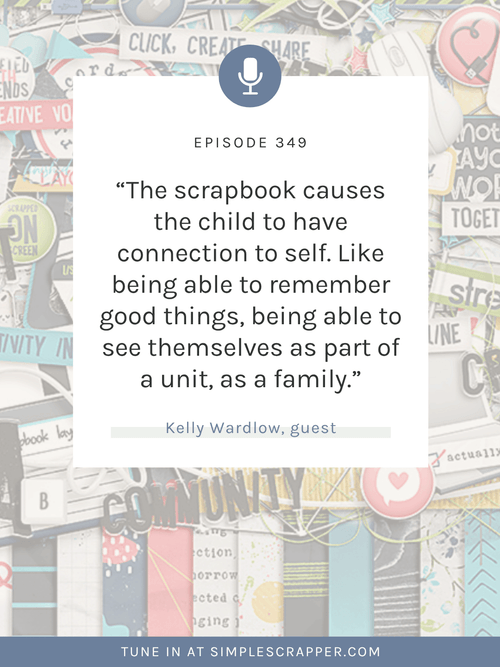
You can't see me, but I'm holding up quotes. Like pretty much just like an eight and a half by 11 page that had space for their, um, pictures and for their words. And then as I went on and on, I would make them prettier with like frames, and they could still put the picture in, if that makes sense. And so it was this whole idea of the scrapbook causes the child to have connection to their selves.
Like with trauma and different nervous system issues, like being able to remember good things, being able to see themselves as part as, of a unit, as a family, to see, um, how they've been taken care of, how they were [00:14:00] successful, how they h-how they created things. Anything that can help them with their form of identity was helpful, uh, to all children, really.
And so, I mean, and as memory keepers, I'm sure you've felt this, like we can go by and all of a sudden see our teenage kid looking through their scrapbook. You know, like it's a sense of comfort. It's a sense.
Of warmth. And so Connection Keeping was set up, and at the time the website I had had things about it, was set up to set up a relationship with parents and kids that was connecting. And that the parent as the memory keeper, but working alongside the child to talk about their memories and continue like the process of just remembering all of the great times together.
Jennifer Wilson: So I mean, you were a scrapbooker before this, so it sounds like it kind of really deepened your own relationship with scrapbooking and having this kind of, uh, greater importance behind it.
Kelly Wardlow: I think originally when I started, 'cause I originally used to paper scrap [00:15:00] the way in like 2000 and... My daughter was born in 2005, but a couple years before, my in-laws had a 50th anniversary, uh, 25th anniversary and their 50th birthday parties, and I made them like a huge.
Jennifer Wilson: Mm-hmm.
Kelly Wardlow: Physical scrapbook. And I think it was just pretty much like, "Oh, here's an event.
Let's scrap it. Here's an event. Let's scrap.
Jennifer Wilson: Yeah.
Kelly Wardlow: It." And I think it changed into not only is it for remembering, but like connecting and us to have like an activity together, something that brings us closer together as we talk about all those things that were, that we shared.
Jennifer Wilson: Yeah, no, I mean, it's-- I think there's, over the past, I don't even know how to quantify it at this point 'cause I have no sense of time anymore. Over the past many years, there's been this kind of, increasing, value on these smaller stories that we're documenting, you know, particularly with, you know, things that we might call Project Life.
Um, you know, you mentioned that you do family yearbooks, and I think that's just [00:16:00] made everyone realize how, how valuable our hobby is t- to, you know, to ourselves and then of course our families as well.
Kelly Wardlow: And I think the reason for it, especially with Project Life, is that, you know, you'll always have the birthday parties, the graduations, all of that will... A lot of people, you know, scrapbook that. But for a long time, our youngest son, and because there's like a nine-year gap between my oldest, they kind of, everyone treats him like their baby.
Like, he's very much, like, has so many, the poor kid has so many people telling him what to do. Um, but he used to say prisaschool instead of preschool, and he used to say it all the time, and it delighted my older daughter. And so, you know, it's in our scrapbook with a QR code of him saying, 'cause we were like, "All right, where are we going?"
And so we have that, and now, you know, we didn't know when all of a sudden he just started saying preschool and it just disappeared. We had no more.
Jennifer Wilson: Mm-hmm.
Kelly Wardlow: Prisaschool. And so.
Jennifer Wilson: Yeah.[00:17:00]
Kelly Wardlow: As an adult, like, I was sad, but I just remember my daughter being, like, heartbroken, like, "Wait, this isn't gonna always stay?" And I'm like, "No, we grow." And I really like the fact that Project Life honors all of those little things which are just a much, you know, just as important to who we are as the milestones.
Jennifer Wilson: Yes. Yes. That reminds me that my, my kiddo used to say, "Mommy," and then all of a sudden it turned to Mom, and now of course it's the, the ex- all caps exclamation point text Mom. Like, why did you not respond to my text, you know, immediately? Um, but when did mommy go away? I still call Daddy Daddy, like, you know, we have to wait for Daddy to get home, even though my kid is 15.
Kelly Wardlow: And it's funny because all of a sudden, like it'll happen once, they'll say it by accident and you're like, "Man, I wish I could have kept that in a box."
Jennifer Wilson: Yeah, no doubt.
Kelly Wardlow: Well, I saw in one of your things that you were going to a lot of, um, tournaments for volleyball.[00:18:00]
Jennifer Wilson: Yes.
Kelly Wardlow: My whole life, my daughter that's going now to college is gonna play lacrosse in college, and we have spent the past four, no, like five years of going to lacrosse tournaments, like throughout the whole summer and in the fall. And I thought of you when you said that, and I was just like, we have had so many fun things happen on those times because we had one-on-one time. And so I love that in our scrapbooks we can remember all that, where there was so much other going on besides just the lacrosse, and.
Jennifer Wilson: Oh, 100%.
Kelly Wardlow: I just really appreciate that.
Jennifer Wilson: Yeah, we love to, like, find, like, new parks and, like, botanic garden type places when we're going to tournaments. 'Cause there's always, like, some downtime. And then they also do some team travel, so sometimes my husband and I are, you know, able to actually go and do some things just on our own, which doesn't happen very often 'cause all we do is travel to volleyball tournaments.
Kelly Wardlow: That's awesome. We have never had that, and I feel like that should be across the board in all sports to help.
Jennifer Wilson: Yeah, it should be required for sure.
Kelly Wardlow: [00:19:00] Yes, to revive parents after, you know, traipsing through place and place and place.
Jennifer Wilson: I'm curious, before we get to like... Actually, we'll, we'll talk more about your personal scrapbooking, but I need to, I need to, I wanna come back to the sports question 'cause this is something that I'm very curious about. Um, but looking through your shop, your design style is very eclectic. Do you have, like when you're designing, do you have these mental bins in which you're categorizing, "Okay, this one's gonna go in, in this style," versus, "This one's gonna be, you know, more like this"?
Kelly Wardlow: I think a lot of it comes back to the fact that I've only been scrapbooking, do scrapbook designing for... So if you really say 2022, you know, it's only been four years. So there's that whole before that, like using stuff from different people, I think just finding my own style. I think the thing that's.
Jennifer Wilson: Mm.
Kelly Wardlow: Consistent across all of my designs is I try to make it look somewhat realistic.
Like when you post a page that you made with Project Life and, you know, like, like a [00:20:00] kit or something that you got from Ali Edwards, and it, there's depth and, you know, real items, I just love it. I, like that is the look that I adore, but I also have no patience for you know? So I love.
Jennifer Wilson: Yeah.
Kelly Wardlow: Digital that looks realistic.
That is my joy. And so it's always the balance of that. And so when I do things that are sports-oriented, you can see they're much more utilitarian and maybe a little bit more messy. And then honestly, I love having different styles. Like I love, I, like I go by a whim. Like having novelty for me helps my brain like really soar.
So, you know, every year I make this month-long, like I'll, every year I put out a different month kit. But then each year I try to have a specific theme in mind. So this year it's all bold and kind of more doodly. Like, and more, you know, not as much texture, [00:21:00] or if there is, it's very realistic and kind of more on the lower level so you could print it out. Where the year before I did all solid colors each time, and that was more messy art journal-y. And then the year before that.
Jennifer Wilson: Okay.
Kelly Wardlow: It was like calmer colors. And so I think if I can be excited about something, it helps me be more prolific in my designing. So I don't necessarily keep to it all looking the same as much as I keep to it all being something that I'm interested in.
Jennifer Wilson: Yeah, no, and that, that's, that's gonna keep you excited about being a designer, and I know it's, you know, it's not always an, an easy thing to do. It's, it's a lot of work that, that y'all put into to, um, that particular job. Um, are there particular things that you enjoy creating more than others?
Kelly Wardlow: That is a great question. I think my monthly kits are my favorite. Because I use every single one of them. So a lot of [00:22:00] times, uh, I f- everything kind of fits into the categories of what you would think of as a life b- a yearbook or a Project Life kit. Or something that's very much based on a subject, so like a sport or a thing like that.
It's, it's just now that I'm getting into more art journaling stuff, and it usually happens, like at Sweet Shop, they do collabs, and it's really encouraged.
Jennifer Wilson: Mm-hmm.
Kelly Wardlow: So that designers work together, so you get some, like an... They always call it your baby, so you get a new one. And so as I've been doing that, it's been helpful to see how I can then change and do something.
Like I just did one, um, with Amanda Yi that was called Pretty Full. And it was just all like pretty things and just like cute and bright colors, and you know, it didn't necessarily have a purpose for any like one subject or like a monthly thing or anything like that. It was just for when you have like beautiful pictures from gardens and things like that.
And so I actually really enjoyed that [00:23:00] because it, it was different than what I would normally do because it was out of my normal I do this and I do this.
Jennifer Wilson: Well then I, and it's also like kind of a huge, um, like skill builder to be doing things outside of your comfort zone, to be trying different approaches so that in the future when you wanna do something specific, you have that greater toolbox of, of how to do those things.
Kelly Wardlow: And honestly, Jennifer, I think you just like answered my q- the question because I think my favorite thing to design of all things is something new. So anytime I can find.
Jennifer Wilson: Oh.
Kelly Wardlow: Something that's like, "Oh, I've never done that before," or like in that one, and it's funny that you said that because the Pretty Full one, I made like a viewfinder, which like I've been seeing pop up everywhere, but it was so much fun, and I was like, "Oh, you could do it this way, and it could be horizontal," or...
You know, I just had a... I like being sparked and having new ideas, so, um, anything new is fun. And I do love word art. Anything that's word art related because at, in my scrapbooks, I use them all the [00:24:00] time, so real like not just word bits, but like word art. Things that... I don't know if this happens to you, but like in your, you know, yearbook, your Project Life, sometimes there's pictures that it's hard to embellish. Because it's just kind of a moment. And so I love when there's a word art that would fit with it, and that you can put and then embellish around the word art as a way to draw attention to the photo when there's not like a specific way to embellish it, if that makes sense.
Jennifer Wilson: Yeah, I mean, I would say I use Word Art on every single page, and oftentimes I'm like, "Oh, did I go a little too far here?" But, you know, I just, I look, I'm either looking through a sticker sheet or looking through my drawer, drawer of die cuts, and I'm like, "Okay, what, what fits the feelings that I'm having, and let's see how many we can get on there," because it, it adds more to the story be- even beyond the journaling.
So I definitely use a ton of that.
Kelly Wardlow: I think it, I think as scrapbookers, I had a, a, a two or three-year period where I just wanted to buy so much, like, [00:25:00] house decor that had words on it, and my husband was like, "Nope, no more words. Nope. We're not picking anything that has a saying or something on it." And I was like, "Wow, I tried to word art my house." So.
Jennifer Wilson: You know, it's... Okay, so I've, I've noticed this, and it's so interesting 'cause I remember the time, like, I don't know, this was like 2017-ish when like, when typography and word, word d- decor was becoming more and more popular, but starting like on, you know, on Instagram and Pinterest. But then I would go to the stores, and I couldn't find it.
Like, I was like, "Where's all this really cool stuff that I'm seeing online?" And nowadays I go into the store, and I'm like, I'm almost like rejecting it because I'm like, "Why is everything now the same? In all this like beautiful typography, where's something that's like more interesting and unique?"
Kelly Wardlow: I think you hit that on the, head in that now it's kind of ubiquitous. Like, it's so much all over that it's harder to be enjoyed. But it, but sometimes, like we have one in our house that's [00:26:00] in our kitchen, and.
Jennifer Wilson: Mm-hmm.
Kelly Wardlow: I read it every morning, and it's very, like calming.
Jennifer Wilson: Yeah.
Kelly Wardlow: And settling and stuff.
So I don't... I feel like it's a balance of which way. And just like everything else in this world, it kind of, the pendulum swings, you know? Like, there's none, and then it's everywhere, and then, like, finding the magic medium in the middle.
Jennifer Wilson: For sure. So how do you keep your ideas and plans organized? You mentioned you kind of have a yearly theme around your core collections. Um, how are you keeping track of everything?
Kelly Wardlow: So I love all of the Google, resources. So I use Google Sheets mostly, not Docs as much, but I have, like right now, even while we're talking, I have my Google Sheets that I open every day. It has like the list of things I've done, like by date, and then it has, um, I keep all the, ideas that I wanna do in the future on a separate tab.
Like, I literally have like 15 tabs. Like, they don't fit at the bottom of my very big screen. And so [00:27:00] I keep it all organized in Sheets. And then organized within that, and that helps me to be productive. So I'm a big fan of... I know, and I think my whole life is like a contradiction. Like, I love novelty. I love anything new and changing, but I also work well if there's a framework that I can then be creative in. So having.
Jennifer Wilson: Mm-hmm.
Kelly Wardlow: So like on my... Like, I have all through 2027 the dates of releases. And it's, I have to admit, Sweet Shop, 'cause I was a part of a couple of other stores which were fabulous, but Sweet Shop always releases on Friday, so I know what to expect, and it's just that once a week, so then it's easy for.
Jennifer Wilson: Yes.
Kelly Wardlow: Me to plan accordingly.
So I put all the dates down, and then I put in my monthly releases, and then I kinda go from there. And then as far as all of my resources, like all of the kits I had from before I was a dine- designer and all of the commercial use stuff. Literally everything is separated by, um, topic and then [00:28:00] within topic, like subtopics. So that I can find.
Jennifer Wilson: Okay.
Kelly Wardlow: Things. So I'm, I'm a great mess of being like a mad scientist crazy and also having a very strong structure of my data.
Jennifer Wilson: Yes. Yes. I mean, we have this giant spreadsheet, we call it the master plan every year for, like, all of our themes, um, throughout Simple Scrapper. And, you know, we're always... I always wanna change at least one thing every year to keep it interesting, not just for our team, but for our members. So that they can have a different experience, you know, approach things differently.
So I, I get it in terms of try- in terms of trying to find the balance between having things very well organized and also having that novelty so that, you know, life stays interesting.
Kelly Wardlow: It'd be great with a community because then you can even see where interests are increasing and j- just like the word in the, in the decor, you know, like, "Oh, this is really big right now," or, "This isn't. And you can kind of then spark with new ideas because you have people [00:29:00] bouncing ideas off each other, which is really incredible
Jennifer Wilson: Oh yeah, 100%. Yeah. We're currently planning for, um, we do this thing every year called the Planning Party in November, and so I ask the members, "What topics do you wanna go into more depth on?" And like, not just like, you know, how to think ahead for next year, how to think about what worked well. That's, that's the core of it, but the nuances of, you know, how do you really get motivated, not just like setting a timer, but how do you really get motivated when you've been in a slump and gone through challenging times?
You know, how do you balance, um, the, the joy of certain like approaches to scrapbooking that might be some consider fussy, but you really love it, and the time it takes to do that. And the fact that you wanna continue to get things done, but some things do take a lot of time. So we're really diving into some of those kind of sticky situations.
Kelly Wardlow: And I think it's such a value add, that you've created in that sometimes those are the things we don't have time to do. [00:30:00] Like, we end up staying in a system.
Jennifer Wilson: Mm.
Kelly Wardlow: We've always done because often.
Jennifer Wilson: Yes.
Kelly Wardlow: As parents, and if you have time to scrapbook, a lot of times you're the primary parent.
It doesn't mean always, but like a lot of times you are. So, so many things are so dependent on the cycle of your kids, what they need, the cycle of jobs, like everything like that, that if a system isn't broke, sometimes you don't think about, "Oh, how can I make this more efficient?" Or, "How can I make this more exciting?"
Or any of those things. So to, to be a part of a group that is always thinking about that, trying to bring us back in, keep us on task.
Jennifer Wilson: Mm-hmm.
Kelly Wardlow: Like that's fabulous.
Jennifer Wilson: Awesome. Thank you. So you mentioned earlier that you are often designing things for yourself. So how does your personal interest and approach to doing family yearbooks, you know, Project Life style, come out in your products?
Kelly Wardlow: That's a great question because I remember the first store I went to, I, I had been creating stuff for myself and they were like, "Why do you have so many papers?" Like, "This is not necessary." And I was like, "It's [00:31:00] totally necessary," because as a project scrapbooker, just take my monthly things and I just bring in the papers like willy-nilly.
Like, I don't even think... Like to put, you know, when you're, you're setting it up and you have your picture spots and then you have your open spots that'll have paper. That you'll embellish.
Jennifer Wilson: Mm-hmm.
Kelly Wardlow: Or put another picture on or you might put journal cards or words, you know, around it. I try to make all of my papers coordinate. And have 'em...
A, a lot of times I may make only like 20 papers, but then I'll give the customer three or four of each, like a, like each style in a different color. Or maybe one with more texture or one, um, mostly I do different colors, but like a little, the pattern big compared to small, things like that. Because then I just bring them in and to make my scrapbooking quicker I don't even think about it.
I just kinda throw 'em in. So my papers in general are always... Like there's always at least like I wanna say 60 to 90 [00:32:00] papers in my kits. Because I just use them 'cause it's a whole month and because we have so many kids. I always have four layouts for each month, uh, for each week. You know, so in a whole month it's a lot and I just need a lot of different options. So that's one thing. And then lots of word art. And I like, uh, brackets, corners, uh, stapled papers, things and scatters. I love scatters because I like to layer on my Project Life pro- you know, pocket scrapbooking layouts. And so those are the items that I always love, but other people love flowers and things. So I try to make sure it's robust in that you can do a whole month and not have repeats.
Jennifer Wilson: Nice. I love it. Yeah, I've been, uh, after kind of a 15-year hiatus in digital, I've been working on a digital kind of Project Life thing this year. And I have never before done exactly what you described. I really start with just the fun design part first, and then I'm [00:33:00] just adding photos and journaling on top of that.
Whereas in, in paper or anything like that, I would start with the photos and the plan and how it's all gonna come together, and then I'm adding the layers of creativity after. And it's, it's a totally different kind of brain process, and I'm, I'm really having fun with it.
Kelly Wardlow: And you know, I never thought of it that way, 'cause I think I... That's how I scrap is how I used to do it with paper. So that's interesting.
Jennifer Wilson: Yeah.
Kelly Wardlow: And now you've got me curious. I'm like, "Well, maybe I should try doing it the other way and see." Yeah, I, I feel like I'm very lucky in that at Sweet Shop Designs, like, we'll have a week of releases, so we'll get to see what everyone's releasing, and you can use that.
So I might have a template come out, but I might use, you know, like the Nifty Pixels kit or something. And so I can.
Jennifer Wilson: Mm-hmm.
Kelly Wardlow: Like, because then I'm using their other stuff for when I'm scrapbooking. So that it could be a product from both of us, I get to scrapbook in different ways. Because, because I design for myself scrapbooking, get sometimes caught in a rut like we were talking about.
Jennifer Wilson: [00:34:00] Yeah. Yeah.
Kelly Wardlow: Its nice to change it up.
And so now I'm gonna think about, like, maybe finding something that I absolutely love, putting that on a page, and going with it. But I'm gonna be honest, Jennifer, like a lot of times I go for speed. yes.
Jennifer Wilson: Sure, sure.
Kelly Wardlow: I definitely think I'm like 70% like, "This has to get done, and I want it to look..." And then like 30% I want it to look nice, but I'm not looking...
Like, I don't feel like... I feel like since we have, like my pages are, my books, our books are like 200 to something pages, right? So I figure it's more quantity.
Jennifer Wilson: How are you approaching your book this year, and has it, like, evolved over time?
Kelly Wardlow: So yes, and all of my books look different. And before I became a designer, I was trying to find out which way I liked. So I actually started out, our... We went from... So I just finished 2025, and I totally thank my catch-up templates it, because I really just busted out, like, the whole second half of the year pretty quickly [00:35:00] because of them. And so that was fabulous. But I have, you know, 10 yearbooks, and in the beginning I started out with the Project Life app, and then I had already had Photoshop Elements, like, at home that I used for website design, um, like to make items for it. And I then started to add stitching, and I would take my Project Life, you know, the layout I would make and bring it into Photoshop and then do from there and move on.
And then I started to do different kinds of layouts, ones that looked like pocket protectors, ones that didn't. And so I've kind of gone through. It- they're pretty much all set now where it's, know, a pretty common, um, Project Life page. I, I actually make one that's a little bit different. You know how, like, your digital pictures aren't four by six? The actual, like.
Jennifer Wilson: Mm-hmm.
Well and these days it, they're not even consistent because it depends on what setting you have on your phone that day, right?
Kelly Wardlow: it 1,000%. And oh my gosh, like, because I will forget and maybe someone else can, like, [00:36:00] learn from this. You can take-- I have a new iPhone because we have so many kids, like, they, they let us update. um, you can take raw pictures in your iPhone. Does everyone just know this?
Jennifer Wilson: Mm-hmm.
Kelly Wardlow: And I didn't know that?
Well, I didn't know. So I can take it into Camera Raw and, like, edit them, and I've just been enjoying that little feature for the last couple of months, but I digress all the time. I appreciate your, uh, going on the rollercoaster of my conversations.
Jennifer Wilson: No, it's all good. It's exciting.
Kelly Wardlow: But, um, that-- So my favorite template is one where they have that, I don't know if it's 5 to 3 or whatever the ratio is. I made one that fits it so that whatever framed in my camera's photo screen is what that picture would show up completely, if that, if that makes sense?
Jennifer Wilson: Nice. Yeah, yeah.
Kelly Wardlow: And it gives me more spots, and so now they all look like that. They always have stitching, and I know not everyone's for it, but, like, for me, it just makes it feel, [00:37:00] like, more realistic looking, so I always do stitching.
And then as far as the, the themes or the style, I try to change that every year. I try to make it so.
Jennifer Wilson: Mm-hmm.
Kelly Wardlow: That one year to the next year looks cohesive but different. Like, cohesive in and of itself, but different from the previous years.
Jennifer Wilson: And is that, does that correspond to how you're approaching your overall kind of collection theme for the year?
Kelly Wardlow: Yes. I think.
Jennifer Wilson: Okay.
Kelly Wardlow: And I don't know which one inspires which one, so I- it's kind of just a both. I know that I like a cohesive theme, so this year was bold. Last year was called black and white, but it was, like, black and white and one color. Which was actually kind of fun to do because then I had to get 12 colors that all worked well.
It was like making a big palette and then breaking off into smaller.
Jennifer Wilson: Mm-hmm.
Kelly Wardlow: Palettes as we went. And the year before that was one of the f- first ones I created for myself, and it was all more calm colors. I think what I try to do is make that cohesive. Because I'm a huge [00:38:00] fan of put in the pictures that even don't look good. So, you know, like, the picture that's... for some reason, it's a little foggy in an area.
Jennifer Wilson: Yep.
Kelly Wardlow: They're moving and it's blurry. We put all of those in. And so sometimes having a very cohesive background, it's okay if your picture isn't super gorgeous, if that makes sense. Like, my favorite pictures.
Jennifer Wilson: It does, yeah.
Kelly Wardlow: Do you know Krista Lund?
She is a photographer, and she's an avid scrapbooker, and she pocket scrapbooks. But because she's a photographer, her pictures are always, like, gorgeous.
Jennifer Wilson: Yeah.
Kelly Wardlow: They all match. Like, she'll do, like, a... Like, she won't have, like, the full week, you know. She'll have all from, like, one moment, and it's in a pocket scrapbook.
And even if there was literally just, like, outlines of the picture, it still would look good. Because her photos are so beautiful. But I am not... Like, I know that that's not my skill. Like, I do not do well with that, so I try to make the, the theme of whatever month it [00:39:00] is pretty strong so you can see that, and so you don't take away from the pictures.
But it's okay if there's a picture that's not so great, or if you have a QR code here, or this is just writing. It can kind of... Very, uh, eclectic, like you said, kind mix.
Jennifer Wilson: Yeah, and I think that really helps. I think it helps to recognize kind of what overall s- like style and impact you're looking for. Um, because, you know, obviously there's even, even with just digital Project Life, there's a million different, um, kind of aesthetic approaches that you could take. And if you look at, you know, what other people are doing, it's not even just do you like those products, but do you like the, that style of photography, and does that look like the way you take photos?
'Cause that will impact the overall kind of look and feel of how it's gonna come together. Um, and yeah, I think it's important to kind of, i- if you're not feeling satisfied, to kind of evaluate both aspects.
Kelly Wardlow: And I think you have to just be honest with yourself. Like, I think it's always.
Jennifer Wilson: Yeah.
Kelly Wardlow: The question of like, I want it to look like this, but am I gonna do it if I have to [00:40:00] take the time to do this and curate this or have to d- you know, I probably wouldn't. So if I have to make it, we're in that sweet spot like where the Venn diagram like overlaps of I get this done and I really like the aesthetic.
Jennifer Wilson: Yeah, I mean, like, I would love to have more photos from my actual camera, but I'm someone who doesn't like to take stuff with me. I'm like a, I bring my phone when my husband is driving 'cause I literally don't wanna carry anything else. And so, like, to bring an actual, to, to bring a camera that has to then go in an even bigger bag than my normal purse, I just don't wanna do it anymore.
Kelly Wardlow: No, I'm the same. When I do take my DSLR, I literally use it as my purse. I just put, like, the stuff in the side, like, if I had to.
Jennifer Wilson: Yeah.
Kelly Wardlow: But.
Jennifer Wilson: Yes.
Kelly Wardlow: Mine is so old now because.
Jennifer Wilson: It is. Yeah, mine too.
Kelly Wardlow: I got new lens, but my actual base is so old that in, like, the next couple years, it's probably not gonna be great anymore.
Like, it's already had to get fixed a couple times. It's, [00:41:00] well, I think I was... So it's over, like, 17 years old, the one I have. And so, which makes me feel really old. And so I feel like it's just kind of going away. Like, now that I can do raw in my camera, it's such a small amount that, yeah. Sometimes with the camera pictures, I almost feel like the AI assist is too much. You know.
Jennifer Wilson: Yes, it is. Oh my gosh.
Kelly Wardlow: It? Yeah. And so I feel like if I can get that to, to get rid of that, I would totally get rid of my full camera completely. But sometimes for portraits, I don't need it to look so crisp and clear, which is gorgeous, but not always the look you're looking for.
So I'm holding on still a little bit.
Jennifer Wilson: Yeah. My, I was trying to calculate in my head, I got my camera, the DSLR, in like 2009 or 2010, so it's as about as old as yours too. And I did like, I, it fell off a bed once. I'm gonna blame my daughter, but I'm sure it was my fault. Um, and it was never the same since. And even [00:42:00] at that point, it was too old to be re- repaired.
And so like I can use it, but I just can't use it for anything that requires squares, like taking pictures of scrapbook pages.
Kelly Wardlow: Oh.
Jennifer Wilson: Like, you know, a bookshelf or like things where lines are important. Like people, it's, you really can't tell a difference. But anything that's actually requires alignment, not so much.
Kelly Wardlow: I, I have to tell you this because it blew my mind, and I'm curious 'cause I feel like we're-- I, I think you're younger, but we're, like, very similar in the, you know, in our timeframe. My daughter in college, so she's 21, they have her friend, and they make her take all the pictures 'cause they just adore it.
She has an actual digital camera that gives like, that almost, you know when, like, the digital cameras were, like, too black, and it was, like, too, like, there would be, like, almost orangey hues, and then it has the little, like, date and time at the bottom?
Jennifer Wilson: Yeah.
Kelly Wardlow: So the pictures aren't actually... Like, the pictures are worse quality than their phone pictures.
Jennifer Wilson: Oh, [00:43:00] sure.
Kelly Wardlow: They love It. And it's just that, like, weird how eventually, again, the pendulum's gonna swing the other way. They just love how that's, like, a totally different look than what they've always had with their phones, and so they are all about it. oh-
Jennifer Wilson: Like we were with it when Instagram came out and we were doing all the filters and frames, and now all the photos from my daughter's first year are like yellow tinged.
Kelly Wardlow: And square.
Jennifer Wilson: Yeah, and square because I took them directly in Instagram.
Kelly Wardlow: Yeah, same. N- it's completely the same. And so yes, we, we feel like I think there's something about, like, some things will always be true. Like the DSLR where it takes such, like, a rich picture and you can see all the depth and you get all the light, will always be in style, but then other things will go up and down.
So maybe you and I will end up getting a new camera one of these days.
Jennifer Wilson: Yeah, I hope so.
Kelly Wardlow: The first time you let your daughter take a picture with it? I was like, "Okay, put this around your neck. Don't drop it. Hold it like this." Like, [00:44:00] I was so worried.
Jennifer Wilson: Oh.
Kelly Wardlow: When I finally let my kid use it after not letting them use it for such a long time.
Jennifer Wilson: 100%, yes. Um, yeah, I'm pretty sure I let her use the broken one versus... I do have a mirrorless, but I don't, I don't love it, uh, so it doesn't really ever get used.
I bought it for video only, so.
Kelly Wardlow: And does it work well for video?
Jennifer Wilson: Um, it works well for video that's not live. It's, it's one of... It's of the era where it had a 30-minute timer, like a 30-minute shutoff, and so it shuts off at 30 minutes, so you really can't use it for live streaming. I think I have some sort of workaround, but I just, I just gave up on all that. So.
Kelly Wardlow: No, I hear you.
Jennifer Wilson: Anyway, that's an aside.
Kelly Wardlow: But it's one of those things that's a shame where like, you know the technology could do more, but it would take so much effort to figure that out. So it's like cost-benefit analysis. Like, is this worth it? Should I really be doing this? No, I'm just gonna change and use what this other thing that I know will work.
Jennifer Wilson: Yeah, for sure. Yeah, and to make [00:45:00] it, uh, to be less perfectionist about it. Like, I can still, um, show my scrapbooking when I want to. Um, with other things it does not have to be perfect. I am my... I'm not a YouTuber. Sometimes I make YouTube videos, and sometimes I make videos for the members, but I, that's not, like, my overall kind of, uh, platform, so.
Kelly Wardlow: You know, I think because I only do digital and when I did real we didn't take picture... Like, it wasn't as much of a thing to take pictures of your layouts. I didn't realize all that would encompass. Like, you spent all this time making such beautiful colors, but like, depending on the lighting and the color of the room or the time of day, like, wow, it could change, like, your whole feeling of your page. So kudos to you for handling that.
Jennifer Wilson: Yeah, I like take pictures in my guest room, like around 3:00 PM. It has to be like a slightly overcast day.
Kelly Wardlow: Oh my gosh, overcast days are my favorite. Like, 'cause I make my own CU items, so like.
Jennifer Wilson: Mm-hmm
Kelly Wardlow: Or things I cut out of paper and bring them [00:46:00] out. I like save them all in a box and I wait till the overcast day to go outside to take the picture.
Jennifer Wilson: Nice. Nice, yes.
Kelly Wardlow: That's the tip of the day.
Jennifer Wilson: For sure, for sure. How do you keep your photos and stories organized and ready to work on your annual book?
Kelly Wardlow: Oh, and definitely like something that I could not live without is we use Google Photos and I have my daughter... Like my daughter in college, she'll send me, like once a week she'll pick hers and then she'll like send them to the Google Photo section that we have, like the album that we have. So I can always have a section of these are from Kenzie, like what she's doing at college kind of pictures in.
Jennifer Wilson: Yeah.
Kelly Wardlow: Our yearbook. And, um, I love Google Photos because if you're not s- like I can open it up, you know, it goes by date, so I know what happened every day, which, you know, in pocket scrapbooking is super important. So like everything's already organized. I don't have to look through... Like they literally in Google... Have you ever used [00:47:00] Google Photos?
Jennifer Wilson: I have, but I don't use it as my, my primary system.
Kelly Wardlow: They, they separate it by day, so like I know what day. So I can... It helps me, and I don't know if you're a pocket scrapbooker, I look through the week to see how many photos I'm gonna use. 'Cause I might have like, my b- my way to get over my bad pictures is to take like 10 pictures of everything. So I'll have so many pictures.
Jennifer Wilson: Sure.
Kelly Wardlow: And I'll go through and be like, "All right, I'll take one of those, one of those."
And depending on h- what number of pictures I have, I know how many pages or what I'm going to do. So I really love Google Photos for that because... And my husband's and my, my older daughter, their, all their pictures go in there, so I have acces.
Jennifer Wilson: Mm-hmm.
Kelly Wardlow: To everything, and I can then plan accordingly for when I'm gonna do that week. So I really like that.
Jennifer Wilson: Yeah, I like how they do that automatically. At the Lightroom, I use Lightroom Classic. The regular Lightroom apps, including the one on my phone, will break things down. But in order to see week by week in [00:48:00] Classic, you have to create like smart albums to do that.
Which is fine, but it does, it, it's quite a bit of work to create 52 smart albums for every year, um, if that's how you wanna see your photos.
Kelly Wardlow: And do you do it in Lightroom, I know so that you can, like, batch edit everything, but then you ever take things into Photoshop, or do you do Lightroom and you print them out and then because you're you know, physically scrapbooking?
Jennifer Wilson: I will take them into Photoshop if I want to do something like swap heads.
Kelly Wardlow: Right? Always.
Jennifer Wilson: Uh, but it's, it... Or something that's, like, really weird, like a really weird correction that I'm not... But, but Lightroom is even so powerful today that I, it's very rare that I need to take something out of it. Um, when I'm, I'm doing digital right now in Affinity. For a, a couple of different reasons, so I'm usually just actually, I'm exporting it on my phone and then sending it to my computer. Just because I, I want it to be really easy and not necessarily have to, [00:49:00] like...
I'm trying not to be perfectionist about it. I'm trying not to be like, "Okay, I need to narrow down all my photos and then pick the ones." I'm doing it the opposite. I'm like, I'm picking the photos that I care about by the stories that I care about. And forgetting about all the rest. Like, yeah, I sometimes go in and delete things, but instead of trying to narrow it down, I'm just trying to, like, pick the cream that's at the top, so.
Kelly Wardlow: I really like that 'cause I feel like story-based scrapbooking then is so, um, motivating. You know, 'cause like you have a whole story to.
Jennifer Wilson: Mm-hmm.
Kelly Wardlow: Tell, so you have like a vision and a power where I literally go where the story is our life. So I kind of look at the.
Jennifer Wilson: Mm-hmm.
Kelly Wardlow: Time period and then pick those that way. And so I don't think I could do it without.
Jennifer Wilson: Yeah
Kelly Wardlow: Google Photos, but I never even thought about the fact it's because I do the whole thing in Photoshop. Like I'm scrapbooking the whole page in Photoshop, so.
Jennifer Wilson: Yeah
Kelly Wardlow: It doesn't matter how I bring the picture in, I'm gonna edit it in Photoshop, not beforehand, so. And I, I have access to Lightroom, and I've never used it because I think I've always used like [00:50:00] batch processing on Photoshop. So.
Jennifer Wilson: Mm-hmm.
Kelly Wardlow: I wonder now, like with the flow. That would be such a great, I would watch that video. Like if you videotaped your flow, I think I could totally watch like a whole series on everybody's like workflow. And how they do It because I feel like I would learn so many, "Oh, this is better. This is better."
Jennifer Wilson: I actually do have a video on that. So I will include that in the show notes for the episode, and I will send it to you after. I, uh, it's... The video is old now, but I, I don't think there's anything about it that's actually outdated in terms of how, how I do things.
Kelly Wardlow: That is awesome. I'm gonna watch it.
Jennifer Wilson: Yeah, yeah. And I think that it was, in terms of why I was attracted so much to Lightroom back in the day when I started, was because of the slider-based editing.
Like, yes, I could edit things in, in Photoshop, but I, I just never... It, it always felt very clunky and troublesome to me. [00:51:00] Um, and, you know, even doing like, doing like a Camera Raw edit in Photoshop, that's really was like, that's, that would be something that might be, you might be attracted to if you're taking raw photos with your iPhone and being able to bring up the Camera Raw dialogue that then has the sliders that pretty much are exactly like a Lightroom, so.
But, you know, if you have a system and it works for you, that's what really matters. That's what I always tell everyone. It doesn't matter how you're getting to the end result. If you know what you're doing and how to do it, and do it again and again, then just do that, because that's much easier than trying to learn a whole different process.
Kelly Wardlow: Totally, unless the process is so helpful. I think it was three years ago I learned, do you ever make something in a Crockpot and you have to use forks to like undo it? You can just use your hand mixer.
Jennifer Wilson: Mm-hmm. Mm-hmm.
Kelly Wardlow: And it does it in like three seconds. Literally when that happened, I, when I, when a friend of mine told me about it like three years ago, I told my husband, I'm like, "We're having pulled pork every day because this literally revolutionized my whole life."
So if there's any-- I'm always looking for the hack. Like if there is something that [00:52:00] you do that I'm like, "Oh my gosh, that's genius," then I can add it into my, like my workflow, I, it would make my day or life or week.
Jennifer Wilson: Yeah. You know, it's always simple things like that. Like, I recently started using, like, gloves more with, like, mixing. Like, I make a two-ingredient dough with, like, flour and, and yogurt, or even just, like, cutting up chicken and marinating it. It's like, oh my gosh, like, this is revolutionary to use gloves because then you're not trying to, like, just get it off your hands, and then the chicken's always slimy, and it... I love to cook, but I, for some reason I never thought that that would be a helpful part of, of my cooking.
Kelly Wardlow: Oh, that's... I agree with that completely. We put, like, aluminum foil under... We, like, have breakfast for dinner and because there's a lot of us, like, I just bake the bacon on trays.
Jennifer Wilson: Oh, yeah.
Kelly Wardlow: Do it all at once. And so, like, I remember originally, like, not, like, lining the tray and being like, "This is ridiculous." And so I, I think any hack like that is perfect.
Also, I am so excited.
Jennifer Wilson: Oh, yeah.
Kelly Wardlow: To try that, [00:53:00] um, Greek yogurt flour dough. It- I've had.
Jennifer Wilson: Yeah.
Kelly Wardlow: Like, weeks now, and I'm like, "Ah."
Jennifer Wilson: It works really well for bagels, like pizza crust. Um, I've seen some people make kind of like more like a pita bread out of it. Um, yeah, it works much better than I ever expected. It also works really well with cottage cheese instead of, uh, the yogurt.
Kelly Wardlow: Yesterday I made cottage cheese blondies. They were actually.
Jennifer Wilson: Oh.
Kelly Wardlow: Delicious. And it, have you ever gotten a recipe and it said almond flour, which we almost always have 'cause we have allergies in our house, and we didn't.
Jennifer Wilson: Mm-hmm.
Kelly Wardlow: I've used oat flour and I was like, "Oh, it's not gonna work." And it was so good.
Jennifer Wilson: Oh, good.
Kelly Wardlow: That was my highlight of the day yesterday.
So.
Jennifer Wilson: Nice, nice
Kelly Wardlow: We're big fans of like adding protein. Even though we have one kiddo who can't have dairy, which makes me so sad. But.
Jennifer Wilson: For sure. So how, when, you know, with a busy life, busy family, how are you actually getting your project done? How does that happen for you?
Kelly Wardlow: Like, with intention. Like, [00:54:00] I can't It is not... so first of all, I feel very blessed in that my kids love the yearbooks. They, all.
Jennifer Wilson: Mm-hmm.
Kelly Wardlow: Them, even I have one who's, like, a little grumpy. But even he loves when, especially he particularly likes the QR codes. Like, he'll like going with his phone and watching all the QR codes. And so they all love it. And so sometimes it's just about, like, "Hey, Mom is gonna be upstairs, and I need to catch up on my..." Like, I- it's easier for me to tell them, "I need to catch up on our scrapbook," than if I say, "I have to get some work done." They understand, like, "Okay, this is important." So.
Jennifer Wilson: Yeah, yeah.
Kelly Wardlow: Have to set apart...
There was a great magical time in my life when all four of my kids first went to school, and 'cause my youngest was supposed to go to kindergarten right when COVID hit. So.
Jennifer Wilson: Oh gosh.
Kelly Wardlow: Like, that, like, oh my gosh, after, at, at that point, see, so five... [00:55:00] Like, I had been home, and we had even homeschooled for a while, for like 15 or 16 years with kids.
Like, you know, I mean, longer than we were kids, but, like, you know, like, someone home. Like, at some point, someone was in school and somebody was home, and that's how we were living. And so it was finally gonna be the year of, like, I can get everything done that I need to get done, and then COVID hit, and we had to do home...
Like, we had to do school at home with all four of my kids in one space. And so I was like, "No!" But then that year after felt magical because I wasn't working yet. You know, I, I, like, did part-time volunteering at a place, but, like, I wasn't working yet, so I had all this time. Like, I got, like, every Monday I would scrap the week before.
I had, like, everything tied in the bow. The house was the cleanest it's ever been. But then that only lasted for a year. Before then, I started working and doing other stuff. But, um.
Jennifer Wilson: Yeah.
Kelly Wardlow: I have to intentionally set it so that, like, I am at least... I think now the, I set up my whole year ahead of [00:56:00] time. Like, hey I got my work done. I have this chunk of time," I set up all the whole year. And I make cards that have the dates on them, like week one and then the date underneath it. I make those every year, and so I'll use that and I'll put it up for the whole year. So that I only need smaller chunks at a time to fill in and be done. Or, I don't know if you ever do this, like, then I'll just put in the pictures and the journaling, and then I'll come back, like, six months later and then I'll embellish it.
Like, I kind of just try to.
Jennifer Wilson: Mm-hmm.
Kelly Wardlow: Keep up whatever works, and sadly it's not even consistent. I'm changing it all the time. Like, sometimes I can get this much done, sometimes I can do this. Sometimes I'll have a week that was, like, amazing, like you said, with a story, and I'll, like, do that week. So I'll, like, be missing two months.
I have this one week done and then another two months after. So hodgepodge. I'm sure that helps no one.
Jennifer Wilson: And no. Well, no, and I, I think it helps normalize that, um, [00:57:00] scrapbooking happens in the time that we make for it, and that it's, it's a, it's gonna look different for everyone and in everyone's different season of life. It's always gonna be evolving. And the thing is, if something's not working for you, you have to take a look and see, "Well, okay, what can I shift to try it a different way and to give yourself permission?"
Maybe it's, maybe it's timing. Maybe it's, you know, the format you're working in. Uh, maybe you need something more portable, or maybe you're need something less portable. It's, you know, there's always gonna be different circumstances, and you have, you know, as we say, permission to do it the way that works best for you
Kelly Wardlow: I totally agree with that. And I-- that's why I feel like the Project Life app can be so wonderful, even if you're using it in part.
Jennifer Wilson: Mm-hmm.
Kelly Wardlow: Because, like, I don't know about you, but I have spent a lot of time in car lines or waiting.
Jennifer Wilson: Mm-hmm.
Kelly Wardlow: For kids. Like, like over an hour a day for most of my life, you know, spending somewhere just waiting, and so having it on your phone is really nice.
I just don't enjoy it as [00:58:00] much anymore, so I've moved on. So I've lost that time, but that was like my one efficiency hack, was that I was able to do it when I could back in the days when I used the app.
Jennifer Wilson: Yeah. But even like managing photos. Um, I'm-- I was really excited yesterday. I saw that the Collect app is coming back. Like it hasn't been updated in seven years, but now they're working on it, and I-- that was... I, I think it was fin- it was a kind of discontinued or forgotten about the time that I had started wanting to use it.
But in terms of like one photo, you could write a caption and export that as a literal Project Life card was kind of one of the most genius, you know, simplicity strategies, and I'm really excited to see what they do with it. Um, even if I don't actually use the export, I'm excited about being able to kind of curate.
These are the photos that I wanna use. These are the words I wanna put, and then I can then transfer that to whatever I'm gonna put it in later.
Kelly Wardlow: So I have it in my one, maybe two scrapbooks. Like I have a l- and what I used to do is just regular Project [00:59:00] Life, you know, um, per week, right? But then I.
Jennifer Wilson: Uh-huh.
Kelly Wardlow: Would save at the end was almost like month in review, and it was the one favorite part of every day.
Jennifer Wilson: Nice. Very cool.
Kelly Wardlow: So then I think actually it probably made more work, but I loved it and I loved the way it was, the way it, they set it up, that it was almost like a Polaroid.
Like everything about it.
Jennifer Wilson: Yeah.
Kelly Wardlow: You said that. I had no idea it was coming back.
Jennifer Wilson: Yeah, so I'm excited. I think that's gonna be, or at least I hope is going to be a, another fun tool that's gonna help a lot of scrapbookers.
Kelly Wardlow: And I feel like they could... Now they can add so many things to it. You know, you can really... I feel like it shouldn't be too hard for them to make it more functional too. Like, not just
Jennifer Wilson: Yeah. As long as it has, like, those basic features, 'cause I have tried so many other things just to get that simple, I want a photo and a caption on a white background with nothing else. Please just give me this, and nothing else will do it. Um, other than something like Canva or Photoshop, which that, I don't wanna do that.
I wanna, like, I don't wanna make it myself. I [01:00:00] can, but I don't want to.
Kelly Wardlow: You like have to deal with it. Right, I totally agree.
Jennifer Wilson: Yeah.
Kelly Wardlow: It's so great for like, you know, a Day In The Life and a Week In The Life because you can just.
Jennifer Wilson: Yes.
Kelly Wardlow: And take that picture, you know, like and have it all set. And, you know, just put in the title.
Jennifer Wilson: That would be amazing. Yeah.
Kelly Wardlow: And you don't have to do much. It's just kind of all done for you. So I love that.
Jennifer Wilson: Mm-hmm.
Kelly Wardlow: I am so glad. And I just remember there was two fonts that were available on it, and I just always used the one, and I forget now, 'cause like you said, it was so long ago. But.
Jennifer Wilson: Yeah.
Kelly Wardlow: To hear this. I will also jump on that bagwa- bandwagon.
Jennifer Wilson: Very cool. Kelly, this has been such a delightful conversation. Thank you.
Kelly Wardlow: Thank you. I, I just also loved being introduced to your whole community, and so I really loved learning about you and all that you do. You're really making a difference in the scrapbooking community, and I really... I, I was just excited to get to know you.
Jennifer Wilson: Thank you. Thank you. Can you share where our listeners can find you online? Anything else you might have new or coming up this year?
Kelly Wardlow: Sure. Um, you-- [01:01:00] I have, uh, a website at connectionkeeping.com. But it's, it's taking a back burner. But you can always find me at Sweet Shop Designs under Connection Keeping.
Jennifer Wilson: Sounds good. We'll include those links in the show notes to the episode.
Kelly Wardlow: Thank you so much, Jennifer
Jennifer Wilson: Yes. Thank you for spending time with me, and to all of our listeners, please remember that you have permission to scrapbook your way.
Sign up to receive email updates
Enter your name and email address below and I'll send you periodic updates about the podcast.
How to Subscribe
The best way to listen to Scrapbook Your Way is with a podcast player on your mobile device or with iTunes on your computer. You can subscribe via Apple Podcasts, Google Podcasts, or by searching for “Scrapbook Your Way” in your favorite podcast app.