
Bre Randon makes around 250 digital pages a year. Sara Case pulls two stories at the end of each month, and if those two layouts get made, she’s good. For the second half of our two-part series leading into the 2027 Planning Party, I’m joined by Simple Scrapper staff and creative team members to talk about how each of us decides what counts as enough. The answers range from tracking hours to tracking nothing at all, and none of us do it exactly the same.
- Peggy shares what happened to her scrapbooking time after she retired, and why the result surprised her.
- Sara explains why she stopped scrapbooking holidays she dreads, and Bre shares the one-event-per-month challenge she uses to work through her back catalog instead.
- Helen talks about realizing she can only pivot between two projects in a year, and how knowing that number became a guardrail.
- The group compares how they check back in throughout the year, from weekly check-ins and time tracking to a goals list that stays a draft on purpose.
The Panel
- Helen DeRam
- Peggy Collins
- Monica Moriak
- Breon (Bre) Randon
- Jen Johnson
- Melissa Magnuson-Cannady
- Sara Case
- Jennifer Wilson
Links Mentioned
- SYW352: Finding Your Best Scrapbook Format
- SYW156: More Consistency in Scrapbooking with Peggy Collins
- 2027 Planning Party
- Project Life and the Project Life app
- Ali Edwards (One Little Word, Week in the Life, December Daily)
- Katie Pertiet templates
- Shutterfly
- Makse Rhythm Planner
Peggy Collins: [00:00:00] how you're gonna leave something so that you can return to it with ease. How are you going to find your way back to a routine when it's been broken for some reason? Planning Party's a great time to stop and think about that and brainstorm that with all of us. Because there's a million ways to do it. There's no single answer. But having that in your mind can be really powerful for sustaining yourself through an entire year of creativity.
Jennifer Wilson: Welcome to Scrapbook Your Way, the show that explores the breadth of ways to be a memory keeper today. I'm your host, Jennifer Wilson, owner of Simple Scrapper, and author of The New Rules of Scrapbooking. This is episode 353. In this episode, I'm chatting with Simple Scrapper staff and team members about defining enough in our scrapbooking. We also talk about what we've each let go of and how we find our way back when life gets busy
Hello, [00:01:00] everyone. I'm excited for another group conversation tonight. This is the second part of a two-part series as we prepare for the 2027 planning party. This is kind of a companion episode. Last time, we talked about things that, , relate to decisions we make in our head, things that we have to make by logistics and analytics, and we talked mostly about formats.
But tonight, we're gonna go inside. We're gonna talk about what we feel on the inside. This is the heart episode, and we're going to focus this around a specific topic of defining enoughness, uh, in our scrapbooking. Uh, to kick things off, I would love for our group to go around and give us an idea of kind of how much you scrapbook in a year on average.
And I'll go ahead and give, like, a caveat here is that these are, uh, staff members and creative team members, so they are already probably scrapbooking a lot more than the average person. But I do think that there is gonna be, [00:02:00] uh, still a variety and a breadth here, um, that will, that will come out in the conversations.
Um, so kick things off, Helen
Helen DeRam: So just kind of doing some quick math in my head. I probably do... So I do 12 by 12 layouts. I would say I do maybe 30 a year. And this year and for the past couple years I've done, um, seasonal interactive albums. And so I do four of those that encapsulates the whole season. Um, those are approximately six by eight size.
But again, they're interactive, so they kind of fold out, and there's a lot going on with those. I think that's the main part of my scrapbooking. There might be some other random things I'll finish off, you know, a, another little mini book or a project. Maybe add one of those in for the year. [00:03:00] Um, but that's about where I'm at.
Jennifer Wilson: Sounds good. Peggy, what about you?
Peggy Collins: So I'm the one that counts hours, so I try, uh, to hit-- So I'm looking at last year's number. I did about right at 190 hours over the course of the year. That sorts out to be slightly under four hours a week, um, and that's about what I try to shoot for through the year. Um, that translated into about 30 12-by-12 layouts and 34 6-by-8 layouts and some other odds and ends and, uh, divided protectors and things like that.
Jennifer Wilson: Wonderful. Monica?
Monica Moriak: Yes. Um, so a couple years ago I was probably close to 300 12 by 12 layouts a year. I'm digital. Uh, and the last couple of years has been a harder season for me, and I've picked up doing some, uh, more album, like more physical, uh, travel journals. I did the Aligned. So I [00:04:00] probably am down to, I think this year I'll probably hit between 50 and 60 12 by 12 layouts.
And, um, I'd say I completed two journals that have like somewhere between 60 and 80 pages in them. So there's a lot of words, a lot of photos, a little bit of extra.
Jennifer Wilson: Sounds good, Monica. Bre, what about you?
Breon Randon: Um, so like Monica, I am digital and I count a page as anything that is one side of a page in an album. So that could be one s- if I do a double page layout, that is two pages for me. I, 'cause I just can't, I, I figure whatever I am doing, I mentally just need to be, you know, whatever's one side of the page I would be looking at.
So that could be a journal page, a 12 by 12 page, you know, an art journal page. Um, as of a couple years ago, I was averaging about a page a day, but I have over the last couple years tried to take that down a little bit. I'm averaging at about 250 a year, [00:05:00] um, now because I found that I was doing, um, I, I just don't necessarily want that volume.
And you know, again, 100 and 105 of those are Project Life a year. So that's, you know, I do a double page about a week, and give or take that is generally... And if I don't finish Project Life, I have sh- basically shifted that output usually to, you know, an, a regular 12 by 12 page. So it's like if one or the other is getting done, at the end of the day, I end up with about, you know, 250 pages a year at this point.
Jennifer Wilson: All right. Wow. Melissa, what about you? Uh-oh. She clicked the wrong button. All right, so Jen, and then we'll come back to Melissa.
Jen Johnson: So I am also digital and, um, like Bre, I count kind of one side to be a page. So I do a mix of Project Life and regular layouts as well. And in my heyday, I was doing maybe, like, 120 a year, and I was [00:06:00] pretty happy with that number sometime. It, it, it was just, like, kind of around that number. Sometimes more, sometimes less.
Um, and now I've done 78 so far this year, which is kind of more than I have the past couple of years. I think kind of the theme for a, a few of us sounds like is we're kind of slowing down a little bit in the past c- a few years, and that's definitely been the case for me.
Jennifer Wilson: Yeah. Yeah, I think, uh, a lot more intention. I think that's gonna come out in, in some of our conversations tonight. All right, we have Melissa back here. Uh, what about you?
Melissa Magnuson-Cannady: So I was just trying to do some quick maths 'cause I don't, I don't know, I don't think I track maybe as well as maybe I should or could. But, um, it looks like so far this year I've done maybe 40 to 50 square in the Project Life app. Layouts, and then another like 40-some, maybe 30 in six by eight, um, for two different projects.
[00:07:00] And then, um, well, we'll see. I'm planning to do December Daily, and I'm super excited. We'll see how, how that turns out like this, this, you know, physical year. And but I imagine I do like a couple hours every week, but some weeks are less, and then some weeks I try to make up for it, you know, maybe later just based on travel and life and things, um, in this season of life for me.
So I don't know. I, I think that's maybe accurate. It, it sounds more impressive than I imagined. Like once I opened up the app to see how many papers were in those folders, I was like, "Oh, well, shoot. I've been, I've been busy I guess."
Jennifer Wilson: Yeah. Awesome. Okay, Sara.
Sara Case: So this is gonna be a big guess, 'cause I don't track at all.
I find tracking very stressful, so I don't. Um, but I probably do six to 12 layouts, I guess, per month in my album. So that doesn't mean I'm doing that many a month, but I do a year-long album.
Jennifer Wilson: Mm-hmm.
Sara Case: Divided by month, and there's [00:08:00] probably six to 12 layouts in each of those months.
Jennifer Wilson: Nice.
Sara Case: If anybody can do math in their head, you can work that out. Sometimes it might be a little more. A couple years ago, uh, my daughter and I went to Disney for Christmas 'cause her show choir was performing, so I did a two six by eight mini albums, so I obviously did more. This summer my entire family went to Australia for three weeks, so July in my album this year will be much bigger than normal. But I find I'm actually scrapbooking more now than I ever have, but I think that's probably because my children are older. They're 17 and 19. So I don't have as many pictures of them because they're beyond letting me do that, but I have more time to do it.
Jennifer Wilson: Yeah, yeah. And you're scrapbooking almost exclusively at eight and a half by 11 now, right?
Sara Case: Yeah, all eight and a half by 11. Because they fit, the albums fit on my shelves.
Jennifer Wilson: Yeah, yeah. No, that's, that's a fair point. Yeah, we discussed that a lot last episode as well. Um, [00:09:00] I do ... I go to a retreat every fall, and I do, like, 25 to 30 layouts at that retreat alone. And then I probably do maybe 10 or 12 other ones, like stuff for Refresh and Stash Bash, um, just random things that I wanna do.
And then there's always at least one project that I end up finishing throughout the course of the year. And, and then maybe some sort of everyday life pages, but I, I can't really add those because that's not something that I do every single year. So this year I've done maybe eight to 10 full spreads that are done. And at the end of the year it would be, like, approximately 24 spreads I guess, like two spreads per month.
So yeah, I mean, maybe 30 to 40 layouts a year. All right. So enough. Let's, let's start with our definition. So how do you [00:10:00] know when you've done enough in your hobby? Is it hours at the table like Peggy? A number of pages or stories within a timeframe? Is it about finishing or is it a feeling? So how do you find a sense of enoughness? How do you know? And heck, do you, do you feel that's that, do you feel like you do enough?
Breon Randon: Well, I'll take a shot. I mean, I don't know, it's not exactly a scientific process. But, um, so it- the beginning of, well, you know, Planning Party, I always have big goals, big dreams, right? And, um, but over the last couple years I've kind of determined that, um, again, that I was telling some stories that were, maybe they were duplicates and some things were, like, that were happening just 'cause I scrapbook as a way of life, right?
Like, so I'm like, "Oh, cute picture," and then sometimes I was doubling some of that up. So I got a little bit better about in my Creative Hub actually, like, noting when I've told a story, and then that sort of kind of branched out. And, and led to a little... You know, like we always do with organization, you can get a little deeper and start, [00:11:00] like, overthinking some stuff.
But I did kind of pull back a little bit and was realizing that, okay, so if my output is about 250 pages, you know, upwards to 300 depending on what I'm doing for the year. Um, you know, if... What is that? You know, about 20 stories a month, give or take, right? 20 to 30 stories a month. And when I was looking at the end of each month, I try to review my photos and I try to review my journaling, and I go back and I pull out the stories that I think are important.
And when I was looking at that, I was like, "Wow, the math kind of works out." Like, at the end of the day I might not have finished albums, but in general, I am writing down about 30, maybe 40 stories per month if I go on a vacation or something like that. So that helps me know that, like, while I may not always be choosing - judiciously, um, in what list I'm pulling from per month to get that finished album, I am at some point the math should work out, right?
Like, [00:12:00] that if I'm doing about that many layouts per year and I am writing down about that many pa- like, stories that I want to scrapbook per month in general. I'm at least vaguely on target. Um, that at some day I will, you know, even though I don't scrapbook chronologically, that if I keep plugging away at these various lists, at some point the things will get done that I wanna get done.
And I don't track, um, in order to be stressed out, but it does let me know because, and I'm sure we'll talk about this later, you know, you go through your ebbs and your flows. Like, but if I get to, you know, three quarters through the year and I've just had a really rough year and I'm looking at it and I'm like, "I've done 30 pages," like, ooh, ooh, maybe I need to do it even if it doesn't feel good.
Like, it's kind of just a reminder that, you know, maybe I should refocus and at least try to get back into something that brings me joy. And, you know, and if I can't, that's okay, too. But, um, yeah, that's kind of how I think it's enough. I write down my stories, the math seems to work out in the end, and I feel like as long as I'm picking [00:13:00] from that list, I have done what I need to do.
Jennifer Wilson: How long have you been able to maybe, like, keep up this pace, if you will?
Breon Randon: I don't know, 15 years, 16 years.
Jennifer Wilson: Okay. Okay
Breon Randon: Maybe more. I don't know. I feel like I scrapbooked more when I was younger, like, like Jen was saying. Um, but again, you know, you have a kid, things get a little harder as far as, like, I mean, you know, I'm, I'm squeezing it in in between her games and her, her, her school stuff and everything too.
And you know, obviously date nights with my husband and all that kind of stuff too. So I mean, but it does help that my family is a very creative family. So I mean, we do this kind of stuff together, and I'm very blessed and, like, very lucky that my whole family values what I do, and they participate in it.
And so I think that that, it is very much a way of life for me. It's not like I'm just sequestered, hiding by myself. Like, I mean, my kid comes in and scrapbooks. My husband comes in and he's like, "Ooh, I have video to add to your page." And like we... It's all kind of just a family endeavor in that way. So I [00:14:00] wouldn't expect that it, if I didn't have that kind of support, I wouldn't expect the output that I have.
Does that make sense? Like, I mean, everybody's just kind of into it, so it's not like I'm removing myself and kind of hiding away and like, "Oh, I gotta get my head down and get my scrapbooks done." We're all just kind of hanging out together and making stuff. He's sculpting, and she's painting, and I'm scrapbooking, and everybody's sort of just doing their thing.
So it's sort of just our, that's what we do, and that's been, that's been my life since I've known my husband, since we were, you know, 21, 22. Like, so we've all just been making stuff together for a couple decades.
Jennifer Wilson: Cool. Yeah, no, that's amazing.
Jen Johnson: That sounds like the happiest artsy little commune that you guys have going on. I just like, I love it.
Peggy Collins: Sounds like paradise.
Breon Randon: I ca- I, I don't know. It is and it's not though, because like I looked over on my hall, like my upstairs bedroom hallway yesterday, and not only was there confetti, there was also plaster, and then there was copper wire. Like, I was like, "You guys, I need, [00:15:00] I need somebody to clean this. Like, I can't, it cannot just be me."
And the, and the Shark, you know, the, the Shark vacuum does not swirl up stuff. So, but yeah.
Jennifer Wilson: I'm pretty sure our table downstairs has, like, various, like, hot glue sculptures. The hot glue also have been used to, like, make weird things with ribbon. Uh, nail polish, Legos. Um, there's something else, too. Jewelry making. Like, all of that on this one s- well, like, one circular table all at once.
Breon Randon: Yeah. I was gonna say, and that's like we haven't gotten into the paint of it all yet. Like Jay, my husband, looked over on his desk the other day and he was like, "Abby, why is there so much paint by my computer? I don't even know where this came from." And I'm like, "Yeah." But I figure that's the way you know you, you are in a good place.
Jennifer Wilson: Sure. Yeah. Okay. So I mean, that's like, that's the sense of enoughness is like mess can defi- can sometimes define that enoughness.[00:16:00]
Breon Randon: Yeah. Yeah. Too much mess means we're done. Like, but too much mess means maybe we've overdone it.
Jennifer Wilson: Sure.
Helen DeRam: So I was just thinking, um, I s- I do scrapbook every day, mostly. Um, pretty regularly throughout the year. And so my output, is not like Bre's or anywhere near it. But I feel like I do enough for me. Um, and I think it's just getting my stories told. And I think that's kind of one thing I wanna improve on is I don't feel like I have a good, you know, list of stories to tell.
I'm always just kind of like looking through the latest pictures, and I'm maybe going back, you know, in this, into the season to look. Um, I like the challenges where, you know, it's something that's a, a, a farther back story or a bigger story. So you know, that makes me get those stories told. Those are a little bit [00:17:00] harder for me, just like finding the pictures and where are they and all that.
Then, then, then I'm spending my time doing that. Um, but you know, when you guys are saying like, "Oh, I do 300 pages," I was like, "Oh my gosh, I'm not even near that." And I sort of felt bad for a minute, but then I was like, "No, I'm very happy with, you know, what I have at the end of the year and the albums that I have and, you know, what's in my closet and what I can look through." So, so I think I feel good with my sense of what I have is enough.
Sara Case: Yeah, Helen, it's interesting you say that because, um, twice a year I organize a big in-person retreat, four or five days for about 30 women. And some of them can churn out 50 layouts over those days. And I am ... And for many years, sometimes I would do two layouts over that same period of time.
Helen DeRam: Yep.
Breon Randon: That's me too, same.
Sara Case: "Right, I am not getting enough done.
I'm not getting enough done." And then I went through a period a few years [00:18:00] ago where I did very little. I pretty much I even took a step back from the design team here, like I just wasn't doing anything. I wasn't in a great place. And then I came to the sense that, you know what? It doesn't matter what they do. It doesn't matter. They're never gonna look through my scrapbooks. My kids aren't gonna look through their scrapbooks and say, "You don't have that many."
Helen DeRam: Yeah.
Sara Case: So now I'm at the point of at the end of each ... Well I, I organize all my pictures as they're coming in, and at the end of each month I go in and I pull out two, two stories. And if I get those two layouts done for the month, I'm good. Generally, I'll get more. There are some months I get way more. But as long as I get those two layouts done for a month just so that I have a good overview by the end of the year, it has taken a big weight off. I just don't feel the stress of it anymore.
I'm like, "Yep, two layouts a month. That kind of shows what we did this month. I'm good."
Helen DeRam: Yeah, that's great.
Jennifer Wilson: I love that perspective
Peggy Collins: I'll chime in here. Um, as Jennifer mentioned and I've mentioned a, [00:19:00] a million times, I count time. Um, and so we can probably- we even have a podcast episode about that if we wanna dig it out and link to it. But, um.
So it's been interesting, though, the, the new piece of information that I haven't talked about on a podcast is that I retired, and I genuinely thought that I would massively increase that number.
Like, I really genuinely thought it would be eight to 10 hours a week. Didn't, didn't think there'd be any issue. I can't do eight to 10 hours a week. I don't have the attention span, I don't have the energy for it, I don't have the creative juice to a- to do more than what I was pretty much already doing working full time. So I, I had dropped down to about, I think, the last year I worked the entire year, I think I did three and a half hours a week. But I came-- I, I didn't initially set a higher goal because I didn't really-- I, I was grounded enough in reality to know that I didn't really [00:20:00] know what I was getting into. But I, I thought in the back of my mind it was gonna be a whole lot more. Um, and it turned out to be almost exactly what I had been doing before. Um, so I think that's an interesting thing to consider, and I don't feel like, "Oh, bummer, I really, I, I really should be doing more." It really genuinely feels like that's the right amount of scrapbooking. Now, it's not the only creative stuff I'm doing. I took up a new embroidery hobby, 'cause guess what's not very portable for travel?
Scrapbooking. So I picked a new hobby up so that I could take it with me on some longer trips. And I've been doing a little art journaling. And, you know, so I'm, I'm still d- I'm doing more hours of creative things during the week, but I'm not doing more scrapbooking. And I'm actually fine. It's all fine. Um, so I think that that's-- sometimes you, you might look at somebody cranking out a whole bunch more work, and maybe that's not your creative process.
[00:21:00] Like, that's not being that efficient or, or... And in fairness, uh, both Monica and Bre are, are, are digi. I think that's a different animal for how much you can crank out. I think paper takes longer. I don't, I haven't found the magic way that you can do that a whole lot faster. So I think that's also the comparison game doesn't really work in that context either. But it's interesting. Like, I c- go to a retreat, I don't get nearly as much done as other people do. I just don't get that much d- I don't have enough creative juice to do that. So it's interesting to me to realize that it's not just a matter of how many minutes you have available. There's more to the formula than just the actual time in the chair.
Jennifer Wilson: And I think that's a good reminder when we are like maybe telling ourselves like, "I'm waiting for this break. I'm waiting for this vacation. I'm waiting for this time to open.
Peggy Collins: This retreat.
Jennifer Wilson: That's when I will," you know, dot, dot, dot. And it, it doesn't necessarily always work out that way as you describe. We hear that a lot from the teachers in the [00:22:00] summer.
They're like, "Ah, you know, I'm finally off. I'm gonna have all this time." And yes, there, there is more time available for scrapbooking, and they do get a lot done. But it's, it's maybe not, uh, the same as they imagined it might be.
Peggy Collins: Right. It's not this tidal wave of productivity that you suddenly can get humongous amounts of things done.
Jennifer Wilson: And I guess one other side point I wanted to make is that when I'm doing all those layouts at a retreat, it's because I prepped them into very specific page kits. I've got all the photos. Sometimes I have things cut if there's like, you know, maybe I'll save the fussy cutting for there, but I'll have maybe have some papers cut. I've maybe sometimes printed journaling out. Definitely the photos are ready. So it's like, it's a little bundle ready to go. Um, and I, I wouldn't be, I wouldn't be able to do it otherwise.
Peggy Collins: Yeah. I think you have to kind of count that in your evaluation of what ti- you know, that's not an insignificant amount of time to prep for a retreat like that. That's can be many, many hours and [00:23:00] w- several weeks in advance to get all that stuff ready.
Jennifer Wilson: Yeah.
Breon Randon: So it's interesting, Peggy, 'cause you said the difference with digital, between digital and paper, and I have been consistent between when I was hybrid digital or paper. It's the same for me across the board. I take a really long time to make digital layouts.
I take four or five hours to make a digital layout, or more. 'Cause I'm tweaking fonts and I'm tweaking shadows and I'm t- so, and that's just a me thing. I don't think you have to be doing that. But I have been, I find that I can, I can waste the same amount of time on a digital page as I can on a scrapbook page, and I can procrastinate just as hard.
I am multi-talented. But I think that also, to your point, kind of crosses over to the whole idea of, like, you only have so much creativity to give, right? That is how quickly mine gets do- like doled out. That is how quickly it drips out. I cannot rush that no matter how. I will find another way to procrastinate it and make it take longer, even if I have a smaller idea, because that's just how quickly my brain lets the [00:24:00] creativity move, right?
And so to Jennifer's point, she's doing these, you know, 25 layouts at a retreat. I have been to those retreats. She has seen me. I have made two layouts over three days, because that, I am in another place, and I c- I am, my creative juices are using all of my brain power to talk to people, because I'm an introvert.
And so I can't make a page. So I just think it's really interesting to see how all of us kind of get, move the needle in different batches, you know? Like, so Jennifer, you're moving it behind the scenes by making up all these page kits, and then you're getting this great big payoff, where I am just very slowly, all the time, doing a little bit every single day without end, and it adds up to a different number.
But that doesn't mean that it's any, like, you know, any more or less creative.
Jennifer Wilson: I think there's something though with, um, I'm imagining like how we're using our time, and I know that you're often multitasking. You're like, "Okay, I'm gonna do some work, and then my little break from work is I'm [00:25:00] gonna do some scrapbooking."
Breon Randon: Mm-hmm.
Jennifer Wilson: Whereas maybe o- others of us are not using our breaks in the same way.
Breon Randon: This is true.
Monica Moriak: I think that's the ease of digital, right? When I... So when I was doing 300, Uh, I got started on layout a day, and I just didn't stop.
Uh, and part of that was I was really pushing myself to get comfortable with the digital and what is my style? Um, and so there's a lot of change that happened. Our family was traveling a lot.
My children went to school. Their high school was a half hour from us. There was a lot of driving back and forth. And, um, a lot of that was me sitting in the passenger seat, and I don't get carsick. So I can bring my iPad because I can scrap on my iPad. I would start a page, uh, put it in the glove compartment, go do whatever, and then on the way home I could finish a page. I worked [00:26:00] on this idea of not if I'm gonna scrapbook, but when am I gonna work on. I would think about what was the story that came up recently, or, oh, I seen these photos. Oh, you know what? I could do... Like, and so I would fall asleep thinking about that, and I would come up with ideas for layouts or, okay, I really wanna include this, right?
I had newer product that I wanted to play with. And, uh, so that, I mean, that was awesome. I've printed a lot of them. I have a lot of printed. Then I, I moved into almost... I b- I feel like I do enough. I would love to do more, but I'm also okay with not doing more. And I, I've told a lot more stories. There's a lot more journaling.
I've even, like, done journal albums, like, where I journal on our trips or the Aligned album because it is kind of fun to... I like playing with stamps and rub ons. Um, and then trying to do some of the other stuff [00:27:00] in there. Some of them are very simple, words and photos, and other things have a little bit more on them.
Um, and those are kind of fun. Uh, I don't do traditional photo books, but I have always been someone who feels like if I'm gonna have photos, I need to do something with them, right?
And a lot of that is... So I have quite a bit of finished pages that are largely photos with a sentiment. You can look at the photo, you can look at the page and get a feel for whether it was a somber page or a travel page or a playful page or just a, you know what, um, we've lost a lot of family, and I'm known for my goodbye selfies.
And I like to just scrap those and play with product and design, and sometimes it's a template. Because I got a new template and I'm like, "Oh, this is cool." Um, I can do a page in 30 minutes, and I can take several hours. Um, [00:28:00] and but I have fun with it. And I think that's why it's enough for me no matter what I do. Um, because I'm doing it for me Uh, and I'm having fun. And even though life is taking me in a different direction this- mostly last year, this year I'm ramping it up more. We'll see how that goes. Um, I'm still completing layout a day. I'm on day 12. I don't think I got that far in May. Um, and I don't know. It- I'm enjoying it, and in the end, my children are welcome to pitch everything or pick the ones they want. Since I am digital, um, for most of my things, they are sitting with the photos in the albums. The kids can recreate, "I want these," and print their own books if they want. They can pick and choose. I'd like to have fewer photos and more just finished pages and stories. [00:29:00] Because I just think it'd be easier for them to look at fewer things in the album, 'cause I'd hate to leave...
I don't wanna leave a big mess for my children. But I think that is inevitable because I'm living life.
Jennifer Wilson: I think one thing that stands out for me, Monica, is that, um, our previous conversation about format and how you've introduced, uh, more variety to your repertoire. And I think that seems to be, uh, feeding your sense of enoughness because you are basing it on what's fun for you, what, what, what is bringing you joy.
Um, and so sometimes, like, we might need to branch out to find that new sense of enoughness, and it, it may not look like quantity at all. It might look like diversity.
Monica Moriak: Yes. And I was thinking about this, um, we have a n- number, including people on here, who do other creative hobbies. Peggy mentioned embroidery. We have people who sew, who do... I mean, just quite a bit of other hobbies. And I generally would say I don't do any of those other [00:30:00] hobbies, but I feel like I'm a very creative person.
I love to bake, and so to me that is fun. That is a stress relief for me. Um, I actually do... I picked up, we dabbled, we were talking about dabbling, and so I've picked up, doodling. I used to love to doodle, and I just love playing with color and stuff. And so that's just something that I just kinda do, no end.
I picked up watercolor again. Um, but I love to entertain. I find that to be very creative because for me, having a theme, using dishes in a different way. My husband and I have a wine club now that we started. I've done, we usually have some sort of charcuterie-like gra- I call it a grazing board because there's all kinds of food on it. But I have a ton of teacups because I have formal china. Because that's what you did 30 years ago. Um, especially growing up outside of DC, uh, we got a lot of formal china. What am I gonna do with those teacups? Nobody sells tea in teacups [00:31:00] after dinner anymore. But you know what? They make really fun charcuterie boards, um, the little cups, right?
And everybody gets a little individual one to go with their wine. That was fun for me, and I find that to be very creative as well, so it's yet another outlet.
Jennifer Wilson: Yeah, it's important to kind of be also acknowledging how you're, like where you're spending your creative energy. And I'm not saying that in like a, a lost kind of way, but we might be feeding ourselves outside of scrapbooking and it just so doesn't, uh, come out in the tally.
Monica Moriak: Yeah. I do think it's really important to think, well, for me, I think the mindset switch to I'm doing this for me. I know for, there's a lot of talk, and I think that's awesome, about what legacy are you living, your before your story, right? I, I
love that. And those things are coming out, right? I, I, s- I have a couple more stories that have come out from a book that I read.
Um, Jen and my morning group have gotten me back into my fiction away [00:32:00] from non-fiction or in addition to, right? And, um, I, there was a word in there and it reminded me of my father and I's, um, homonyms. That I was learning in, I don't know, second, third grade, and we started making index cards.
And for the rest of the li- every time we came up with a new word we're like, "Oh, wait, I think that's a homonym." And I learned the word hied, H-I-E-D, that I'd never hear- heard before. It was in a book, and it means to go fast. I hied it up to the bar. I hied up to the bar. And I was like, "What?" Um, but I had to look it up. But it, I was like, now there's a story. So I will, I will tell that story, and that will be in my group. But not every story will get told. Not every story will be told this way. Our family talks a lot, and I've shared a lot of stories. A lot of the stories that I know are from my parents and family members sharing them with me.
Um, and there's a I now have questions about things that don't make sense, which makes an [00:33:00] interesting story all, and that's where family lore comes from. Because you don't have all the facts, and the people who might know aren't here anymore.
Jennifer Wilson: Yeah.
Monica Moriak: That's, that makes life interesting.
Jennifer Wilson: Any other, like, burning thoughts on defining enough?
Melissa Magnuson-Cannady: So I think I define enough kind of by just when I run out of time. Like, I just, I need to move on to something else. Um, that said, so for the past, like, hmm, three, four years I've been doing, like, pro- in the Project Life app, I tried to do, like, Week In The Life in that, like, one page a day, but that didn't really work for many of my weeks.
So then, like, some weeks I'd have one page, and then, like, other weeks, like, especially if I was traveling, I'd have, like, several. And then just over time I was like, "Oh, I want it to be more reflective." And actually probably Aligned probably made that, where I was like, "Oh, I want to be, like, more reflective in this, like, my kind of everyday life storytelling."
So this year, which [00:34:00] may or may not have been a great year to pivot to something completely new and different, but anyways, this year I have six pages per month, so it's like a month in review. Three of those are pretty much pictures and captions if I can manage it, and then, like, I don't know, two... Well, one, and maybe four pic- more pictures, and then two are more, like, text and information and, like, feelings and schedule, that sort of thing.
And so in that way, like, enough is getting those six pages done.
Jennifer Wilson: Yeah.
Melissa Magnuson-Cannady: Just so that, like, it, I kind of made boundaries for my like, a boundary for myself, basically. Like, oh, here, like, just target this so that, like, some months... So anyways, most months should actually be six pages, so then at the end, like, it theoretically would be, whatever, six times 12, whatever, 72.
If I can do math. Um, and, um, and so that sounds... I don't know. I, I tried it. I think I like it. I'm probably gonna stick with it, although I have a couple months to, you know, definitely figure that out. And then I've got other projects going on as [00:35:00] well, and so I think it's kind of a common, you know... And, and the other projects probably don't have so much of a restraint.
And there is, there is one that's really, like, high on the priority list about the Sweden trip I took that I've mentioned before. Um, that I've been doing in Shutterfly, which- I, I've go- I've gone in, like, kind of dribs and drabs as far as, like, I'll really focus on it for a while, and then, like, I won't do anything with it for, like, months.
Um, but I'm kind of getting to the point where I'm, like, so close, and I just wanna, like, get it done. And so with that, it might be like a time restraint is kind of helpful for me, where I can just be like, "Okay, I, I just really wanna get this done," so, you know, kind of wherever I am right now, I'm just gonna do finishing touches and, like, try to wrap it up.
So I think for me, it's either, like, a time restraint or just, like, when I make the project or when I plan the project, giving my- some sort- self some sort of deadline. 'Cause I can be a perfectionist. I can spend excessive amount of time on things that, like, probably kind of [00:36:00] don't matter in the end, you know?
Like... And so it's definitely something I struggle with, so I think for me, like, helping, you know, the restraints can help me. Especially if I plan it that way. So, and, uh, but anyways, but enough for me, I think, is kind of those sorts of things, and then also a feeling where, like, at least I've done something.
Um, you know, 'cause some weeks I don't do any. Like, it just depends on what's going on. Or maybe I'll think about it, or I'll get in the community, but I won't actually create a page that week. And so it's just really... And that's actually really key too, just to, like, be able to kind of touch the hobby even if I can't quite get, like, a whole page going or even just, like, maybe some of the journaling in, in a different app where I can just copy and paste it later.
Anyways, so yeah, it's, it's hard for me to define enough. It's, it seems like it's multifaceted anyways, so.
Jennifer Wilson: Well, I think one thing that comes out, um, the way you describe how you use the Project Life app and your six [00:37:00] pages strategy is it allows you to, like, check different boxes of, like, when you're thinking about, "This is what I wanna do. Okay, well, I can put this here, and I can do, uh, these everyday stories here, and I can put these feelings here," and then it, like, you create, like, basically, uh, architect your own project, and then that gives you that feeling of enough. Like, I've been able to do all the things that I've been desiring without doing six different projects.
Melissa Magnuson-Cannady: Yeah, I could see that where it kind of becomes a checklist. Like the, the plan, like how I set it up in January is kind of like a checklist built in. I mean, I don't have a checklist per se, maybe that'd help. But basically because I've got different boxes with different prompts or different whatever that I can... that it serves as a checklist for me. So yeah. Good point. Thank you.
Jennifer Wilson: Jen what were you gonna add?
Jen Johnson: Um, I have a couple of things. I think for me, I never feel like it's enough, and that's like I definitely don't feel like that right now. But I also didn't feel like it when I was [00:38:00] making, like, 120 layouts a year, which was plenty. I think because I've always got, like, 10 million stories and photos and things that I want to st- but I'm okay with, like, not having enough.
Like, I'm okay, like, living in that space of, like, there's never enough. So I think, you know, I, I want to kind of impress to people, like, don't think that if you're only doing a certain amount of layouts or whatever a, a year, like that that's not enough. Because we're doing a ton of layouts a, a year, some of us.
And, you know, if you're doing, like, five layouts a year, if you're doing two layouts a year, you're doing more than the average person. You're documenting your life. You're hopefully having fun. Like, if that's enough for you, that's enough. And don't, like, compare yourself to us, especially because, like, we're on at least one team and we have to do this at least a certain [00:39:00] amount a year.
So, like, don't compare yourself. Comparison is, you know, the thief of joy and blah, blah, blah. So I just, like, had to get that out in the world. But I think my enough is I think about I'm still like, "Bre spends four or five hours on a layout," that, like, would make me cry. I'm, I don't, I'm not, like, a fast scrapbooker, but, like, if something is taking me longer than an hour, I'm getting mad about it.
If something is taking me four or five hours, I'm ready to take a hammer to something. Like, that, that does not happen in, in my world. So I just ... I ca- that sounds like not fun to me at all to spend that much time. So, you know, your output versus your time that you're spending on a thing is so- something to factor in a- as well.
So, you know, just putting that out in the world. Don't feel like you have to spend any amount of time or anything, 'cause it varies so much. It's like [00:40:00] whatever makes you happy is what is enough. I, I think for me, I, I like what Melissa was talking about, her kind of number of layouts that she wants to make per month, 'cause I kind of do a similar thing.
Like, my kind of magic number is 10 stories a month. Like, whatever that looks like. It's just vibes. You know, I've said 100 times, like, you know, if it's 10 layouts about my cute cats, like, that's fine. I love it. If it's, like, deep layouts, which it's usually not, then that's great, too. It's, you know, whatever it is.
I think, when I really, like my output started really, really declining was life stuff. And, and 2022 was terrible, and my mom was dying, and we were traveling back and forth, and we moved, and we acquired two dogs. It is... Everything was chaos. I had a sleep disorder that I didn't know that I had. I was getting like four to five crappy hours of sleep a night so of course I'm not scrapbooking, you know?
But I was like really giving [00:41:00] myself a hard time, like for that, and I kind of wish I had been nicer to myself. So also, if you're going through a hard time and you're not scrapbooking, like that's also okay. Like be nice to yourself. And I think the thing that kind of got me out of that was working on my keynote, um, which is just like where I gather my stories, and that can be in your Creative Hub or wherever.
E- and, and not making pages doesn't mean that you're not memory keeping. Because like in my keynote, I have a million ideas for pages that I might not ever make, but like that to me is enough. Like if I'm keeping up with like writing my stories and keeping up with taking photos, like that's touching the hobby for me, so that's enough even if I'm not making enough pages.
Jennifer Wilson: Yeah. Yeah, no, that's really important. I like that.
Sara Case: I think it's also important to note, going back to what you said, Jen, about [00:42:00] sometimes when you're going through life stuff and you just, you just don't have that space to be creative. But when I was going through certain things, and like I said, I took a step back from the design team and I wasn't really scrapbooking, I was still on the Simple Scrapper site, and I was still going to the retreats that I was organizing.
And just being surrounded by those people, even if you're not doing the things, you're still part of the community. And for me, a huge part of ... I've done many, many, many crafts in my life, and this is the only one that stuck, and I really think it's the community. So I think just surrounding yourself with it, even if you're not physically doing a lot. Just being surrounded by people who feel the same way that you do.
And because we scrapbook and tell all those stories, they understand that sometimes it's hard to tell those stories, and sometimes it's hard to be in the mindset and be creative. But just being surrounded by people who get that is a huge thing as well.
Jennifer Wilson: Yeah, I always say every time I have [00:43:00] a podcast recording, let alone one of these with so many of you and your, your great ideas, uh, that's what feeds me and gets me excited to, to scrapbook again and again is, is having these conversations.
Sara Case: Mm-hmm.
Peggy Collins: I also think you can consider being thoughtful about what counts. Like, it's not just the final product.
Like, even if you made something and you hate it and you throw it away, you should still give yourself credit for you, you got to your table and you did something. Or you're doing photo management, or you're doing like Jen is and, and Bre, and you're really keeping solid notes and journaling so that you can create later. Like, give yourself credit for all of that as well. Don't only count the end product, because there's so much that goes into scrapbooking that really doesn't appear as part of the finished product unless you... It appears that way to those of us that know what went into it, but I don't [00:44:00] think your family probably understands what it took to pull that off, and certainly Joe Blow friend has no idea what that took. And so k- remember that also, 'cause I think we can be really hard on ourselves about things that we, you know, we're, we're doing the thing, and it doesn't have to just count when it's all done.
Sara Case: I also found it interesting when Bre said it could take her four or five hours when she's, like, playing with fonts and doing drop shadows, and I almost laughed 'cause I was like, "Oh yeah, that's me taking one embellishment and pushing it around the page for four hours."
Jennifer Wilson: Yes.
Breon Randon: I meant it. I meant it. It's like equal opportunity, right?
Sara Case: And then Jen said, "I would not be able to spend that much time on a layout. Like, I would lose my mind." But I think what we have to realize is that the output, however many pages you do a year, is not important. For some people, I wanna sit there... I've got a friend who will sit at a crop with a can of Coke, and she'll just keep going through Coke, and it's stick, stick, stick, done.
Stick, stick, stick, done.
And I'm like, "How do you [00:45:00] do that?" Whereas other people, I've got another friend who will come, and if she gets one layout done in that whole retreat, that's all she gets done, 'cause she loves to take her time and make sure everything's in the exact right spot. So it's not necessarily about your output, if you've got enough done. It's about how you're feeling about it. And if you are enjoying, if you're enjoying spending 10 hours on one layout, more power to you. Go for it.
Peggy Collins: Yeah.
Breon Randon: Yeah. Yeah.
Jennifer Wilson: Yes. Yes.
Breon Randon: Fussy by choice, not by neuroticism, okay?
It's okay.
Peggy Collins: Of course.
Breon Randon: Fussy by choice.
Monica Moriak: Speak for yourself, Bre.
Breon Randon: I mean, okay, fair.
Jennifer Wilson: All right. Let's transition to letting go. It's kind of coming at this problem from another direction. Is there anything that you've chosen to let go of a- as part of your hobby, and are you considering it, like, gone for good or gone for just right now?
Sara Case: I have discovered over the past couple years that I love making six by eight albums. [00:46:00] I love taking classes where they're made, and they're finished, and they're gorgeous, and I hate putting pictures in them. I hate it.
Peggy Collins: Fair.
Sara Case: So I let it go. I'm like, "I am still gonna do these classes. I'm still gonna build these albums", and then I just give them away. I'm like, "Somebody take them out of my house." And I am A-okay with that. Because I'm loving the building of them. The other thing that I've let go of that is definitely not for good is a lot of mixed media. And that's just the space and time that I have right now. I just don't have anywhere to lay it out to dry, and I don't have space to go in my basement anymore 'cause of the way that we've rejigged our basement.
And it's just not something that works for me in this time of my life. I know it's something I'll wanna come back to, but I've just went, "It's fine for now. I can do other things for now." So there are things that definitely I love doing that I want to come back to but just don't work right now, and other things that I've said, "I worked so [00:47:00] hard to make this work for me, and no, I just really hate it, so I'm not gonna do it anymore." And I think you have to go, "You know what? I enjoy certain parts and not others," and it, that's quite okay. It's fine
Jennifer Wilson: Well and there's something to be said about those, those types of album classes where you are learning new techniques that then you can apply elsewhere, even if you don't wanna then complete the album in a, in a traditional way. Um, 'cause I know that I have done that, and I have several fully completed foundations of, with nothing in them, but I learned a lot from the process.
Sara Case: Yeah. And sometimes it's just the joy of taking the class with a whole bunch of other people online and know you're all doing it and having a good time, and it was a fun weekend of creativity.
Jennifer Wilson: Yeah.
Peggy Collins: Spending time with great instructors usually. They're, they're a lot of fun and fun products and Yeah.
Breon Randon: Yeah, I'm with you guys. I love that stuff, but I, even back, you know, 20 years ago when we were all doing those, like, mini albums and stuff, I could never find anything to put... Like, the photos never matched right. And that's, like, [00:48:00] one of my number one things is, like, make... Like, I love color theory and stuff like that.
So I'd get all done with these albums or page kits or whatever, and I'd be like, "Yep, they're just sitting there." And then I had to be like, "Okay, it's fine. I, I am with you." I would give them to my sister-in-law who scrapbooked or whatever, and I'm like, "Ah, I mean, it was fun. It's good. Like, let it go.
go
Peggy Collins: Yeah.
Sara Case: Yep.
Monica Moriak: I would say what I let go is the feel- is the, um, the need to hit, to s- cover certain stories or do however much I need to do. Like, I let go of a lot of the shoulds that I was feeling. It kind of goes back to, am I having fun? Why am I doing this? What is... Why, why am I here? Well, you know, what, what is it that I get out of it? Um, I'm not... I love all... I love the pages I make. I have a lot of fun just playing and figuring things out. I mean, I like taking a template that's got hundreds of layers on it [00:49:00] and then seeing what I can do with it, right? If you look at my pages, they will have far fewer layers and far fewer items on them. But, uh, I think it's, I think it's fun to take a template and see how many different pages I can make out of it. I think five is my max right now. Um, and that clearly depends on the template. But, um, I, I took years to figure out what my style was, and now I'm, like, all in on this is, this is fun. Like, I have a linear basic, a basic linear style, and I love the challenges.
I'm on the cr- creative team. I love the challenges. Even some of them, I would say, "Oh my gosh, what am I gonna do with this?" And then I'm like, "Okay, how do I make this fit me?" Because there's someone else looking at Spark Magazine or in our, our community that also is first thinking, "I don't know, what am I gonna do with this?
Oh, wait, I can interpret it differently than what was initially [00:50:00] presented." And that's kind of the fun part, and I love that kind of... That creativity just brings me a lot of joy. And so my, I let go of having to do some number. I'm okay with the fact that last year I think I did 30 layouts. This year it's gonna be much closer to 100, um, digital plus whatever other types of things I've done. And, um, I don't know, I'm having fun with that.
Jennifer Wilson: I'm really fascinated by this because in our conversation tonight, I'm, I've been thinking that my sense of enough-ness might be improved by having more of those boundaries, by like maybe bringing in more shoulds. Because I've kind of, I definitely have had, uh, taken a lot of permission over the years to do things my way, as one should. But sometimes I do feel like I want to challenge myself by making sure that I'm doing certain things, I guess. Or [00:51:00] setting a l- a, a number of layout goal and trying to, to work towards that. So I mean, it's a different perspective, but.
Monica Moriak: Right. Well, I
think it all depends upon what your boundaries are, right? So I, I definitely have boundaries and guardrails, right? Um, first of all, my design style is, is linear. There's a very ... You could, you could argue there's definitely some, um, boundaries around that. But, uh, a lot of my boundaries are I'm generally a kit scrapper.
Jennifer Wilson: Mm-hmm.
Monica Moriak: So I'm gonna make something from a kit. Or I mean, if you've ever seen Katie Pertiet's templates, they're essentially mini kits. Uh, you just need some paper, but it comes with enough, um, mixed media on it that you could kind of make your own background papers if you needed to, just add a color block behind it. Uh, and that was actually, that became really fun when I was ... Years ago when I set that boundary. I'm going to be a kit scrapper. Here's the kit. And it's not 100%, but it's probably 75, [00:52:00] 80%. All right, here's the kit I'm gonna use, so how can I design whatever I'm doing with what's in this kit?
Jennifer Wilson: Yeah, so that's a letting go of, distraction, other products, by, by setting those rails for yourself. Yeah, you can make decisions faster.
Monica Moriak: You-- I can make a page... There's a 30-minute masterpiece challenge that Katie Pertiet, and that you have f- you have 15 minutes to think about how you're gonna design something, and they have five, like, minimum-- they, like, they set five recipe-type things. Include this, do this, do this with. And then you have 30 minutes to create it and submit it, and nobody's truly timing you, but they do-- like, you do kind of time yourself to see how quickly can you make it.
And if you started setting a timer and think... There are times when I realize, okay, you've been pushing this around for a while now, pick something and move on. I'm gonna scrapbook again. N- these aren't art showpieces. They're not, they're n- I'm not applying for any award, right? These are for me. Do I [00:53:00] really wanna spend more time on this, or would I like to be done? And I'll pick another photo, another story, another product, and I'll do it again.
Breon Randon: I-- You know what I think is kind of interesting, though, Jennifer, and you were saying something about boundaries as far as, like, maybe you need more of them. And I think that, I think the whole sense of enough thing, though, is, like, in one sense you can be like, "Yeah, of course, I should be able to do things my way or whatever," et cetera, et cetera.
But it's also, like, these things don't inherently have to be bad, right? Like, I mean, just because you have a boundary doesn't mean it has to be a negative thing. Like, it can... Like, as long as you're not punishing yourself with it and, like, abusing yourself if you don't meet X, Y, Z goal or something. Like, again, this is a hobby. Um, but it is good to know how your brain works, and if you're a person who, you know, if you're an obliger like we're always talking about or whatever, like, I mean, just because you set these guardrails for yourself does not mean that they have to inherently be something that's stressful or upsetting or anything either.
You could just be like, "Hey, this is a fun challenge I wanna s- give myself." Like, if I want to do... I mean, I [00:54:00] have done those, you know, 30-minute challenges and stuff in the past, and I have found, like, in general, they're not for me. Or if I do something like that, I tend to make sure I'm going into it knowing I'm gonna be doing more of a graphic style page or something like that, that I know I can comfortably get done in that timeframe without feeling upset.
But, like, you know, hey, to your point, maybe saying, "Hey, if I haven't done 30 pages by this far in the year," it's a good mental check-in. It doesn't mean that you have to be like, "You have not done enough, and you are a bad scrapbooker, and I'm taking away all your rewards, and you can't have s- spark anymore and tack with it."
But, I mean, like, it... You know, knowing, like, "Hey, this is a point where I can check in and say, 'Hey, you know, maybe I need to reframe some things. What's working? What's not working?'" Um, you know, I have a-- I'm having a hard year. That's what's not working, and this doesn't matter. My number doesn't matter, or maybe I should lower my number.
But these are, like, pit stops along the way, and we can give ourselves grace while also saying, "Hey, what is working, and do I care about this goal anymore?" That doesn't mean that they're bad.[00:55:00]
Jennifer Wilson: Yeah. Well and I think that's one of the kind of the underlying things of The Planning Party is it's not, we're, we're not trying to create a rigid structure or a checklist for you to follow. We're trying to give you some self-guided direction. 'Cause if we don't know where we're heading, we can't go anywhere, you know? It's, it's putting the map in front of you, and you get to choose, you know, which turns you're gonna take along the way.
Sara Case: One of the other things that I let go of a few years ago that I feel like every scrapbooker goes through the stage when they first start that you must scrapbook every birthday, and every Christmas, and every Easter, and all those big events. And I so dislike those big events. Christmas Day pictures are terrible.
They're always terrible. The lighting is horrible. You know, Easter, the children are running around. I never get a nice picture of them collecting eggs because they're backed onto me, and I'm in Newfoundland, Canada, and I'm telling you, we do not have 20 ... Well, whatever it is in the States. 20-degree weather is hot here.
So and we don't have those beautiful [00:56:00] days out running around in the grass. It just, it doesn't happen here, so we have horrible indoor pictures. I don't want to scrapbook those, and I always felt like I had to.
Jennifer Wilson: Mm-hmm.
Sara Case: That was part of being a scrapbooker. You have to document those really big, specific points. And at one point, I just went, "Why am I doing this? Every time I have to pull this out and scrapbook Christmas, I dread it. I'm gonna stop. I'm just gonna stop." And I think that's one thing that especially new scrapbookers need to know, is that you don't have to do anything. You don't have to do those. I love scrapbooking the everyday pictures. Those are the ones that I really enjoy, and that's what I've decided. I'm just, I'm doing those. Like, I'm too old to do things I don't like anymore. I do not have time for that in my life. I'm just gonna do what I enjoy. And if that means that if that means that people's birthdays aren't in my scrapbooks any more, I know when their birthdays are. It's fine.
Breon Randon: Well and you also don't have to do [00:57:00] everything all the time either. Like, and I think that that's kind of the flip side of that coin is that, like, I am with you, I don't enjoy doing those things. But I do have a personal challenge for myself that I have to do one event per month. I do a sc- I scrapbook one event page per month, that ends up to 12 a year, of all of my back catalog, because I found I was never scrapbooking any of those things.
And in my personal story, I do wanna have some of that represented, but I don't have to scrapbook every Christmas either, and I don't have to scrapbook every Easter or birthday. And so if I do 12 layouts a year, I am at some point hitting a Thanksgiving, a Christmas, a wedding, or something somewhere. But I don't have to do it all the time. And I think, um, to get to my thing that is, like, the thing I let go of is I don't have to do everything all the time. And so that includes things like December Daily and Week in the Life. I love those projects, but I have found that it was-- it's kind of like you, you pick up these [00:58:00] projects once, and then the next year now you're doing Day in the Life and you're doing Week in the Life.
And those are great, and you love them, and then you're like, "Okay. Well, now I'm doing December Daily, Week in the Life, Day in the Life. Oh, look, and now I'm doing October Daily, December Daily, Week in the..." And you can't-- And before you know it, like, you are doing nothing but 30-day projects that, like, somehow...
And you don't know how to, like, let go of it because you've now done eight years of December Daily, and you can't dig out of that hole. And you're a completist, and it's gotta be on your shelf, and it's gotta look good. And I have decided that I can let go of that. And I am-- I love all those projects, but I can get in there.
I am very much a, well, 360, let's do, let's do the whole, like, do the whole thing. You gotta complete everything. And that is a really dangerous thing to be in, because then it leaves you with never any wiggle room to try anything else ever. Because before you know it, you've done... Out of my 250 pages a year, well, if 30 of them are Decem- you know, 25 of them are [00:59:00] December Daily, and then you get an October Daily, whatever, you're looking at literally half your output for the year is these couple projects that never change.
I mean, well, I mean, the things change, but you're already locked in. At the beginning of the year, you have already locked in how much of your stuff is already being done. And it's like, okay, well then maybe I don't have to do Week in the Life every year. Maybe I can do it every three or four years, and I can see something that really changes and have it on the shelf next to it.
And I'm-- So that was kind of my realization. You know, I's, I'd kind of been working through that over the past five or six years. I always started December Daily every year because I'd get excited, and I'd do a couple small pages, and I'm like, "You know what? I'm in the mood. That's cool." And then I don't do it anymore.
And then sometimes I go back and I finish that one, and I feel good about that. But it's not something that I feel like I have to do every year until the end of time, forever and ever, amen.
Sara Case: Bre, I love that that you want to do, like you pick one event a month. So eventually you'll get Christmas done over [01:00:00] and within five years, and you'll get Easter done within a few years. That's a great idea. That's something to think about for sure.
Jennifer Wilson: Like, another way of looking at it though is that if you do want to do those projects, that is going to take space on your plate, and you then have to consider, okay, the other things that you want to do. Do they really fit? Do they really make sense? Are you, um, what is it that you want to have as the outcome?
Um, and if it's all those projects, that might be how you scrapbook, period. And there are, there are people who are like that, and that's great. But your sense of enoughness can't then be saying, "Well, but I'm not doing layouts." And then you're like, oh, you feel bad about that, but you're choosing to do these other things that do take time and energy and, and are documenting your memories.
Breon Randon: Yeah. Well and that's that duplication that I was talking about. It's like that's great, I'm always gonna do layouts, but when I start adding all these projects in, you're looking at when I'm keeping a story list, I'm like I'm actually spending a lot of time including a little bit of this in here and a little bit of this in here, and that's fine sometimes if I [01:01:00] wanna do that, if I wanna have a year where I'm like, I'm in...
I think something big's gonna change at Christmas this year. You know? Will, will Santa come this year? You know, how's things going? We're gonna do this project again. Um, and but I don't always have to be doing all of them. And you have to be able to, you have to be able to pivot if that's the case. You can't be doing layouts and Project Life and December Daily and Week In the. I mean, there's literally we're humans, we can't... There's only so much.
Jennifer Wilson: Yeah, no, and that's, that's exactly why I've decided to do five December pages a year rather than 25. Because that's how many I would get done every year, and then I'd have to finish the rest later. So why don't I just plan to do five, make it maybe a little more, um, you know, holistic. Like, let's do a full page of just all the decoration stuff.
Um, make it fun, and then that satisfies the itch without making it a bigger thing than it needs to be for me.
Helen DeRam: Yeah. For me, I, I let those go, December Daily and [01:02:00] Week in the Life a few years ago, and I still feel like I may do them again. I did them for many years, and I love what I have. Um, but I think the big thing for me was figuring out I can really only pivot on two different things for a year. So, like the 12...
I'd mostly do 12 by 12 for Spark, and then I'm doing my, you know, Aligned seasonal albums. And so I have to pivot back and forth throughout the month between those two, and that's... You know, I only have so much desk space, so I have to, like, switch, and then I've got piles of things. And, um, when I was trying to, like, slide in Memory Planner, which I still love, it's like, I couldn't.
It's just too much. I can, uh, you know, learning that I could only really do those two things, um, and then that, and then that would be enough, and it wouldn't make me crazy. And I would feel like I was getting something done rather than feeling [01:03:00] bad about what I wasn't getting done.
Just kind of learning what I could do and what my, you know, what my real bandwidth is and not the, not the one where, you know, my imaginary world where I have all this time to do all the things.
Peggy Collins: Ideal Helen is so productive.
Jennifer Wilson: Yeah
Helen DeRam: Yeah.
Peggy Collins: She's like P- She's over hanging out with ideal Peggy, and we can just get stuff done.
Breon Randon: Aspirational, Peggy.
Jennifer Wilson: My imaginary Jennifer ha- keeps up with five paper planners that all have different purposes, even though real-life Jennifer only uses digital tools.
Helen DeRam: Yes. I will say, Jennifer, I did look today at that, um, that planner that you said you were sort of thinking of, the rhythm one. And I was like, "Could I do this too?" I... No. I've never had really a paper planner like that, and so it was fun to think about [01:04:00] for like 20 minutes today. But.
Jennifer Wilson: Yeah.
Breon Randon: Look at every preview for those things. Every time somebody posts one, I'm always like, "This is gonna be the one." I was like, "Girl, no. This is why you bought a lifetime membership to a digital planner thing years and years and years ago." And I always have one spare paper planner here just in case I ever get the, like, the, you know, the you wake up in the middle of the night, you're like, "I need paper." And then I'm like, "No, just keep it there. And then you can use it. And then that way you don't buy any more of these $70 planners."
Peggy Collins: Right. Yeah, 'cause they're also inexpensive.
Breon Randon: Right?
Peggy Collins: I think Helen has a really good que- really raised a good que- a good point with the how many projects can you switch between, because it's very tempting to get three, four, five things in flight in some way, shape, or form. And then pretty soon, you, you really, unless you're really good at juggling, that's, that's a lot to ask of yourself.
It's a lot to ask of your craft space.
It's a lot to ask of your attention span. Like, at some point [01:05:00] you gotta call what, how many things you're gonna put in the air at, at the same time, and I'm, I'm notoriously bad for this. There's always way more in the air than should be. But that's something to, that can really help you hone in on what is enough.
If that's, if you know that you can keep two or three things going at some level, then that's, that's a guardrail that you can use to make your decisions about what's enough. So I think that's a really, uh, good insight to consider.
Helen DeRam: I feel like I used to be able to do more.
Jennifer Wilson: Mm.
Peggy Collins: Yeah
Helen DeRam: Whether it's you know, whatever has changed. I'm older. We're all
Peggy Collins: We're older.
Helen DeRam: Life has changed. My, you know, I live in a different place, whatever, all those things. So it was hard to, to let that go, that I'm not, uh, that I can't, like, now I'm gonna do Project Life pocket pages.
Now I'm gonna do a memory planner. Now I'm gonna do that travel album. And I used to be able to do it, I think, more 'cause I would, like, do it and finish it and move on. But my [01:06:00] finishing of things is a little slower, and so I've changed it. So my finishing things I need to, quote-unquote, "finish" are my seasonal Aligned albums, you know? 'Cause those, I like to work on them in the season, and I don't like them to drag on. So those are, like, have a finish line. But my 12 by 12 pages, there's, those are just being done and put in albums and whatever album they go in. So there's, there's not a finishing thing that needs to happen. Making that transition was hard, and understanding what I really could do and still feel good about it and feel like it was enough. I finally got there, but it took a while.
Peggy Collins: Yeah, it's not always obvious that that's what's going on, I don't think. That sometimes you, you think that you're something, that it's a symptom of something else, and really all it is is that you just can't keep those many ba- that many balls in the air.
Helen DeRam: Yep.
Jennifer Wilson: Well, in reality, like we really could only do one thing at a time, and so when are you going to do that and how are you going to signal [01:07:00] a transition to, to switch to the other thing? Um, some folks like to, you know, uh, structure that throughout a month, like two weeks for this, two weeks for that. Some just wait till they're, you know, they find themselves bored or distracted and then switch to something else because really we, we, we can only do one thing at a time despite how much we think we can really multitask.
Peggy Collins: Right, in any one session for sure.
But like s- you know, I'll have a project that I'm dealing with because I print from outside the house, so I'm working on photos for a project. So right now I'm working on a travel that I, you know, from this year all I'm doing is choosing photos. And then I've got a, you know, another one that's in process and another layout and all that kind of stuff. So you can wind up with a fair amount going. And that you have to figure out where you can, how much of that you can keep going.
Jen Johnson: That is why my thing that I let go of is having separate project albums and I just throw everything in one, which we talked about last week. Um, just throw [01:08:00] everything in one book and, like, nobody knows and nobody cares if I finish Project Life that year or if I finish Week in the Life or if I finish December. I can, like, dabble in all of it and I don't have to finish anything, and it's great. So.
Jennifer Wilson: I'm curious what does choosing to let go create space for?
Sara Case: More creativity. Because letting go of some of the... A lot of the things I let go of are the ones that cause me stress and anxiety. Which then makes you not want to be creative because it's stressful. So the things I let go of allowed me then to focus on what I really enjoyed, and so then I enjoy creating more, which allows me to create more.
Jennifer Wilson: Good point. I love it
Monica Moriak: I would agree with that. When you are thoughtful and intentional on your shoulds, and they're based on your own life, your own needs, your own season, your own des- desires, then [01:09:00] your shoulds become your guardrails. And they're yours to keep or, or pass on or to break, right? Um, the goal is to learn the rules and then figure out where you can bend them and break them. I mean, that's a basic design principle, right? Um, and so I think to me, it's just more freedom, I think, because you're less mental and emotional energy, uh, wrapped up in, "I should be doing this. Everybody else is doing this.
I want..." I mean, I think it flows from a lot of things, but I agree, I think Sara's right on that with, more freedom to be creative.
Jennifer Wilson: This is interesting 'cause it makes me think about how, a- and we talked a little bit about this with, like, story size, um, in the last episode, that sometimes I'll feel like these photos or this particular story, this isn't worth a layout, and so therefore I need to have another avenue to document that. And I'm guessing that Bre doesn't feel that way, [01:10:00] that there's stories of different sizes that all deserve layouts.
It's just what you wanna create and what story you wanna tell. So I, you know, it opens up the question of if I was to only do layouts, I would probably do a lot more, because there's lots of stories that I feel like I have to somehow get out. Um, maybe they'd be smaller. Maybe they'd be simpler. I have no idea.
But, um, that's where my brain is going.
Breon Randon: Well and to that point, like I mean funny, a little bit glib of an answer, but like doing less gives me the freedom to do four-hour layouts, right? Like let's just do the math. I couldn't create the way I wanna create if I, if I added more on top of that. I couldn't... The, the time just doesn't math out right.
And so I would either have to sacrifice getting to do like I like to do things, that have a lot of intricacies and details and stuff, and I would have to change the way that I scrapbook if I did more layouts. I would just have to. If the... You know? And then, [01:11:00] and then at that point I start wondering what is my why and what is the purpose, because if I'm not gonna be able to do it the way I wanna do it.
And like s- And a lot of people are like, "Oh, God, that's so long, and it's too fussy and all that." And I'm like, but for me I'm like, well, where else am I gonna be? Like what else am I gonna be doing? This is what I do. I mean, I mean, yes, obviously I do other crafts and I, you know, parent in theory and I do all those things.
But, um, but.
Sara Case: Parent in theory.
Breon Randon: In theory, no. Hey, I didn't say she listened to me. I mean, I, we got, we got bigger, we got bigger questions when it comes down to that. I'm not sure how m- impactful I should be, let's just say. Um, but yeah. I mean, I'd have to make a trade-off, and the trade-off for me is I would rather do, you know, I c- I don't wanna do one every day the way I used to if I wanna be able to do more complex pages. And so that's my trade-off.
Jennifer Wilson: Fair.
Melissa Magnuson-Cannady: Yeah, I know I, I think I have maybe a challenge with letting go. Like, I, I always just wanna complete things. Um, so yeah, maybe the idea of maybe not having projects and just doing pages, maybe I should [01:12:00] reevaluate that at some point, but not right now 'cause I don't know, I don't think I can deal with changing what I'm doing too much at the moment.
But it's really good to hear about letting go will help, like, s- with creativity and just more space for the things you really do wanna do. 'Cause I'm, I'm also... Like, I'm trying to actually go through all of my crafting stuff and, like, downsize that and, like, just make it more manageable. 'Cause I've got a bunch of things that I don't...
like I haven't used in years. And so, like, this question is kind of like, okay, I'm choosing to let go of some of my supplies, um, hopefully a lot of my supplies, in the hopes that I can then make more space for the things that I actually am really excited about using versus the things that, like, I was really excited about maybe, like, 10, 20 years ago. That, that like...
I mean, and there's stuff from then that I'm super excited about using at some point. But if all this other, like, clutter, I mean, in this case, like physical clutter. But, [01:13:00] you know, it could be probably emotional, like psychological clutter. But, like, if all of that's gone, then I'm hoping that I will be able to, like, focus on the things that are really, really exciting to me.
Not just the things like, oh, I have that, I should really use it. It's like, maybe, but, like, I don't have time. I don't have time for all the things. Um, you know, I don't think anyone has all the times for all the things they wanna do. So, um, just really embracing letting go, even though it's extremely difficult for me.
I don't know, it's probably difficult for a lot of people. But, um, I know it's gonna be challenging over-- I'm hoping to do this kind of over the next couple weeks, um, is to just go through, like, all of my crafting stuff. So, like, all my scrapbooking stuff, all of my yarn and sew- uh, whatever. I don't really do a lot of sewing, but I have some stuff and I've got, like...
I have a little loom that I haven't, I haven't done any weaving in like, I don't know, probably since shortly after I bought it. I mean, so just letting [01:14:00] go of these things, I'm really hoping that it'll make space for what is really important to me and, like, what I'm really excited about doing.
Jennifer Wilson: Well and also it creates space for possibility for things that you don't even know you wanna be doing.
Melissa Magnuson-Cannady: Absolutely.
Jennifer Wilson: All right. So we've talked a lot about how things can ebb and flow. Your time, energy, and motivation can shift day to day, week to week, over the course of the year, depending on what's going on, year to year. Some years are better than others, as we've, as we've talked about. How do you keep, like, checking back in with yourself to find that sense of realignment?
Um, 'cause I think that's one of the big challenges with w- when we're doing the Planning Party, how do you, like, it's not about setting this grand vision, and as I said, it's not about following it to perfection, it's about setting something that then can live with you. So how do you, um, keep coming back to what is enough and what you need most season by season?
Peggy Collins: So this is where the journey planning stuff really comes into play for [01:15:00] me in the community. So when I set up that Journey Plan at the beginning of the journey, that that is where I really start to scope in on what the actual reality of what, you know, that 32, 38 hours that I'm gonna do over the course of those two months, what's, what's realistic, what's my priority, those sorts of things.
And then I'm able to come back to that. And then the weekly check-in is where I really stay on task with, did I move those things forward, did I get my time in, um, and those sorts of things. Um, and without those I think my hobby would be floundering. But that... And it's not that much really. It takes me maybe 15 minutes to put together my Journey Plan if
I'm being very thoughtful, and it takes me about eight if I'm not. Um, if I've really got a handle on where things are at and I can just crank through it. But if I'm... 15 [01:16:00] minutes to do that, and then the weekly check-in is literally, like, a five-minute sort of thing. Copy and paste last week's and update it and make a decision about next week's plan. Um, so just that little investment of time that I'm looking at what my priorities are, I'm, I'm looking at my calendar and saying, you know, part of that journey planning is what else is going on?
Oh, I'm gone for the last two weeks of the journey. How about we get a little grip about exactly how much we think we can get done in six weeks?
Um, all of those sorts of things. And then it happens again on a weekly basis. When I'm doing my weekly refresh check-in, I'm looking at my calendar for the next week, what's the reality of when I can do this, and then think about what I can do during those windows. Mostly I'm focused on what, when the windows are, in terms of the next week, what, what times can I do things. Um, but sometimes I'm designating, you know, specific projects or specific tasks, besides my Monday photo which is always photo stuff. But [01:17:00] other than that, it's, you know, usually pretty open-ended about what I do.
But I am looking-- I am being deliberate, and I think- many people want it to be a romantic, "Oh, I'll just, I'll be inspired, and, uh, I'll be all motivated, and it'll just come. It'll just happen." And I don't, I don't buy it. I, I don't think it happens very often, not in American life or in, you know, in modern life where there's so many competing priorities. Um, I think if you're waiting for some sort of organic, uh, bolt of lightning, then you're probably gonna find yourself at the end of the year going, "Yeah, I probably would have liked to do a little, this a little bit differently." So that's kind of how I get it done.
Jennifer Wilson: Peggy, I'm curious when you do, you know you're gonna be traveling, how do you then account for that, you know, quote-unquote lost time? Do you try to get ahead? Do you try to make it up later? Or do you just say this isn't gonna happen then?
Peggy Collins: So it's one of [01:18:00] the reasons I've kept my time at an average of, I think I'm trying to do four hours a week, and it's an average over the year. So in general, I'm trying to stay caught up to that metric over the course of the journeys. So we have been gone an entire jour- all but an entire j- journey one time. So that did, I did-- But I knew it was coming for months,
so I worked ahead of time. For the most part, I was ahead of what I needed to do. I do, uh, count any kind of journaling that I do to keep, uh, journaling on a trip because those are the fundamental backbone of my
eventual project, and so I do give myself credit for that time. And then I'll often do, like, I give myself credit to review a couple issues of Spark every journey. I found I wasn't actually getting to those, and so I started to give myself credit to review a couple of those every journey. I will do that while I'm traveling. So there's a little bit of time that I can gain on a trip, but not-- I don't do four hours a [01:19:00] week. Um, so yeah, mostly I'm trying to work ahead. Um, I try not to-- Uh, I'm pretty much on target at this point of the year, uh, and we have one more trip. And then the-- The last journey is, you know, the holidays and all of that. I do find it very difficult to get things done during that season, so I try not to be in any sort of hole by Thanksgiving.
Like, I, I need to be at least on target by Thanksgiving, if not a little bit over. So that's mostly how I'm dealing with it.
Jennifer Wilson: So really this approach has allowed you to kind of gamify it in terms of like you're, you find the satisfaction from, from hitting those goals and staying on track.
Peggy Collins: Yeah, I think it's, it's done two things for me. It's made it so that I would always procrastinate doing the notes on the trip, right? "Oh, I'll get
to that. I'll get to that." Well, if I'm worried about making sure I get my hours, I'm, it, I need that, I need those hours, and I get it done. Um, so it's a little bit of that.
It's also a little [01:20:00] bit of, it just frees me up to know that I've done enough, and then I can stop worrying about it. Like, I think if I was taking six-week trips when I was not counting time, I would have, that would have caused a lot of anxiety for me because I would've been like, "Oh, I'm not gonna make any progress on my stuff for all these weeks," you know?
Where if I go into the trip knowing that I've done, you know, most of the year already and I'm on target, then it just really, it was really more a mental game than anything. It wasn't like I started doing a lot more or a lot less time. I was doing that time, but it didn't feel good, and that was really what I was trying to solve for. I was doing the same thing, but I had these lists of projects with these deadlines, and I could not hit them because I was delusional. And I have no sense of what, I, no sense of how long things would take. Like, I don't know. You know, some layouts take me 30 minutes, and some take a, like, [01:21:00] days. And I was just always feeling behind the eight ball.
And somehow, in my brain, if I've put in the time, good enough. I've done what I can, and let the chips fall where they may.
Jennifer Wilson: I mean, that's amazing, I think, in terms of, like, finding that sense of enough-ness for yourself, 'cause that's where we're all gonna have to do that investigation and figure out what is gonna make us feel that sense of satisfaction.
Peggy Collins: Yeah. Yeah.
Monica Moriak: I would say that for me, when I think about the Planning Party and I think this is year nine for me. So I, I ramped up to more details and goals and all these like... Terri Torrez is just phenomenal with her ability to break things out and, and all this stuff. And I, you know, I tried these and I tried systems, I tried paper planners.
I, I tried all of this stuff. And, I've slowly but surely gone back to, um, and you said this a while ago, sometimes there are three lines on the page, and you put down two projects you [01:22:00] wanna work on, and you leave one open because you don't know what's gonna happen the next year. Well, I have close to a decade of my life of, "Oh, didn't see that coming. Oh, didn't see that coming." Right? Like, um, we- And people, be careful when you choose a One Little Word, because it will have a completely different meaning than you started from when you picked it. Because that has been... Like, I'm always thinking about when you talked about your home word for 2020 right? My word today, this year, is clear. And considering what I'm dealing with now, I'm like, "Really?" Like, okay. Um, but so I, I create a draft list of, like, when you talk about the Focus Finder, all these things where we sift, shift, sift, sift, right? We do these things when we're thinking about what, what's on our mind. And so what's really top of mind for me?
What... And I put, like, and I started early on. [01:23:00] I put my entire life. So if I know that we are going to be doing some housework, that goes into this whole plan, because that's going to take up time. It's going to take up energy. And so that might be a couple of weeks where, well, you're not really gonna be working too much on that, so you, you need...
If I have a big trip planned or what have you, right? And I, I added this thing about known unknowns, right? When my father was sick, or, you know, it's like I know I'm gonna have to do some things. I just don't know how much or when. So I just need to keep that in mind. So I create a draft list of goals. It's not really a 26 and 26 or 25 and 25, but it's along those lines.
It's like, what are the different things that I wanna make sure that I am thinking about, that really feel top of mind that I'm interested? There'll be [01:24:00] projects that I might wanna finish. There'll be maybe challenges that are happening. There are travels in there. It's like, well, I know I wanna host at least two parties. Um, and I have an idea when those two parties are gonna be. Uh, and so I kind of put that down there. I know we're gonna remodel. Whatever. Like, that all goes in there. And then I try to regularly, it's in my Creative Hub, I try to regularly look at that and say, "Oh, look at that." You are doing that. Oh, look at that.
You are... Some of these are year-long projects, like cleaning up the passwords, my passwords in my password app. That's gonna take me forever, but it's, it's happening. And so it is.
Jennifer Wilson: Daunting, by the way.
Sara Case: Yeah.
Monica Moriak: Yes, it is. It's part of my clearing.
Jennifer Wilson: I think I have, 1,000 in, in my password app, if not more than that.
Monica Moriak: Yeah, like the 250 that were look- yelling at me that says, "Security risk, security
risk, security risk," tho- those were...
Breon Randon: Are we supposed to do something with [01:25:00] those or... Oh, oops.
Monica Moriak: Yeah. So.
Peggy Collins: Oh.
Monica Moriak: So
Breon Randon: o- I didn't, I didn't say it out loud, Peggy. I didn't say it out.
Monica Moriak: My list is always a draft. Always a draft.
Because I can always add to it, I can always take away from it, right? The whole idea, I mean, instead of a bucket list, what was it?
The life list that they talked about on the dabble, right? Some of the stuff that I'm interested in that might go in there. Like, you know what? I might... I'm kind of interested in, um, on my list of things to check out is curling. Um, we have a curling club near us. And so I'm like, "I'm kind of fascinated by that," and so it's on my list of things to, to look into, right?
Sara Case: Curling is so awesome to watch.
Monica Moriak: Oh, yeah, no, I, I... So, and so I'll, I'll routinely check that, and I'll pick a few things that I'm gonna focus on each journey. And then [01:26:00] we see where it goes. I pick times that I know I'm going to show up someplace, and I'm going to work on some things. So I know Monday nights, um, I might miss a bunch, I might get behind on some things, but if I keep at it, I will eventually get my photos back up where they need to be.
I, I, I've been floating on that for years. In the mornings, I try working on my watercolor, I work through some scrapbooking, I finish up... There's some physical projects that I do in the mornings. Uh, and then I try, I have a couple of more times. I'm like, "You know what? I'm gonna show up." And if I'm working on a project, I'm like, "You know what?
I can make Thursday night when I want to get the printing done, so that I can f- get these done on Saturday morning. I can work on this next step. Like, I can look at that, and maybe I can only make three Saturday mornings a month, but I can... [01:27:00] This month I can do three." And so that's kind of like Peggy's time.
There's times when I can show up and I'm gonna work on things. And then I'm gonna pick it out from... And at the end of the year, I probably do about 60 to 80% of the things are on there. Some of them, I'm like, "Yeah, no, I don't feel like doing them. They were a neat idea, but turns out I don't... It's not gonna work the way I thought it was," or that fell through. And usually there's two or three new things. I'm like, "Oh, this is kind of, kind of... I, I kind of want to try this." And some of it get pushed to the next year. And so that's my new draft goals. And there's probably between 20 and 30 items on there. But that would include spending a weekend in Milwaukee with Aaron and Alex for the State Fair, which I know I'm gonna do.
I'm gonna buy tickets and stuff. But that goes on there, because that's one of those things that's gonna take up time and energy.
Jennifer Wilson: I think it's interesting, like in your example of, of curling, that I think some folks might be hesitant to write something down that [01:28:00] they're just curious about because that kind of, does that make it a commitment? Um,
Monica Moriak: Always a draft.
Jennifer Wilson: No, I, I agree. I think it's, it, it might be a shift in thinking for s- for some people. Yeah.
Monica Moriak: I think that's where letting go of having to have a final. When I just say, "Well, it..." I think it accidentally stayed draft because I was, like, overwhelmed at the holidays, I think, when my dad was sick. And so I said, "All right, you know what? I can finish this in January and February."
And sometimes I still do. Like, I'll go through the Planning Party, I'll do all that stuff, and then January comes and I'm like, "Okay, now we're in the new year. Let me settle through. Let me, uh, let me see how am I really feeling in this new year as opposed to getting caught up in all the planning energy." And, um, I, I think it just stayed draft forever, and I... for months. And I was like, "Wait a minute. I can leave this as a draft. This actually feels good.
Breon Randon: I am totally the opposite. Shocking. Shocking. And Monica [01:29:00] and I are always like the flip flops of the same, you know, coin.
But no, I... Yeah, we are, we are, hon. Um, but no, I am very... I take what I do in the Planning Party, and I really do take it seriously, your whole idea of, like, looking at what is coming out. Um, we're really, like, kind of rhythm and season based people in my household.
I mean, and a lot of that is because I have a kid who's, you know, elementary to middle school age. You do kind of know a good portion of... You're locked in for a huge portion of your year, when swim team is, and when this thing is, and when that thing is. And I kind of have a general sense of a lot of those things, and it's like, okay, well, guess we're not traveling impromptu, and we're not doing...
Like, I know exactly when I'm gonna be able to travel and when, you know, certain seasons happen at work. I've been at my job for, you know, 12 years now, so I sort of know when certain periods are gonna be really heavy. And I really take time during November to minutely, with a fine-tooth comb, go through each week and say, "Okay, I know that given my past [01:30:00] history, none of this is gonna happen this week."
I mean, I might putter, and I might do, you know, some photo management. But, like, I take that all into account. I set up a very detailed plan about what I'm supposed to be working on for large portions of those weeks in general. Like, you know, again, I won't be making anything. I won't be doing creative teamwork during these two weeks because I will be traveling, but I will be doing photo management, and story, and journal management during that time.
And I write that down in my overall plan. And then, I have a software that I've been using for ages and ages for, you know, my planner, and I have... It has a lot of repeating tasks, and I break those out, and I have them set up, and they hit my calendar, and they hit my to-do list. And my thing is that I am fine if I don't hit all those things.
Like, I'm not gonna be mad at myself, but I will never... This idea that if I can just be easy on myself and, you know, be very vibes based, it just won't happen. I just won't do any of the things I wanna do. So I would rather [01:31:00] take the time and be very, very detailed, and it looks super, like, type A and controlled, like, freaky about it, but it's not really because I'm fine if it doesn't happen.
But if I don't write it down, it literally, it's ensuring it never will. And so that's how it has to be for me. And it's cool if it doesn't happen, but, you know, if I don't have that, I have... Every one of my weeks is broken down by rhythm, and there are recurring tasks that happen for my scrapbooking on each one of those weeks in my planner.
And, um, and then I do, I look at the... And the last week of the month is journey journal review, and then I meet with my accountability partner. We go over what we did and didn't happen, like, didn't finish, and then we reset the next month or, you know, the next month of the journey journal, and then the cycle starts again.
And that check, you know, that check-in with my accountability partner is on my last week of every month. It comes up in my tasks. So I make sure I text them, and, you know, it's like I have to have those reminders. And I am fine, you know, but if I'm seeing that, you know, three of my checklists [01:32:00] didn't get done that month, well, when I hit, hit what I'm planning to say to my accountability partner, I'm gonna be like, "Ooh, maybe something didn't happen right this month. I should be changing that." And I'm fine with pivoting, but I have to have it come up and have that reminder.
Jennifer Wilson: It gives you the data to react to, otherwise you don't have any sense of, of why or, or when.
Breon Randon: Yeah. 'Cause I have no really good sense on... I would say I don't really have a good sense on that, right? Like, even after all these years, I could be like, "Man, I just haven't done anything, and I've been so lax," and all this stuff. And I'm like, "Girl, you did LOAD and you finished two albums. Like, what do you mean?"
Like, but I... Or conversely, I can be like, "I've just been working so hard, and I've been getting all this stuff done." And you look back and you're like, "Oh, I've worked really hard on really two really good layouts." Like, I don't have a good sense of that, so I gotta, I gotta have somebody probably to, like, tell me.
Jennifer Wilson: Yeah, yeah. I mean, it's, it's really, I think there's a, a lot of similarities to Peggy's approach, too, in, in wanting to have that external accountability around it. And both of you kind of have [01:33:00] mentioned s- like, scaling your sense of enoughness when there's, especially when travel's going on. And, and I hear from, from folks all the time who are at a season of life where they are doing quite a bit of traveling.
They're in one place for a few weeks, and then they're home for a week, and then they're somewhere else. And how do you, how do you really have a rhythm when you have different lives you're kind of leading? And you have to kind of... And I always suggest, like, you have to have a rhythm for one part of it and a different rhythm for the other part. That's, that's the way it is.
Peggy Collins: And hopefully some sort of on-ramp to get yourself back in the rhythm when you come, when you're switching. Because that's, that's its own challenge in and of itself when you've got those huge differences in week to week or month to month. You have to know how to get yourself on and off the highway so that you're not languishing for three weeks after you get home.
"Oh, I'm gonna get back to that." Like, yeah, that's the other thing about my time thing. There's no, there's not enough wiggle room in my time that I can, like, travel and take [01:34:00] three weeks to get back to it. Like, I gotta get rolling again.
Jennifer Wilson: You know, that's a really good point because there's, you know, independent of travel, there might be folks that have like mental or physical health challenges that give them, you know, uh, bad days, bad weeks, bad months. And then how... But what is, what is that transition plan when you are feeling better? How do we get back in it, uh, rather than kind of the, the spinning, which can, - waste a lot of time.
That sounds too negative, but it can spend a lot of time, um, as you're trying to figure things out again. Yeah. Yeah.
Peggy Collins: Eats up a lot of time. Yeah, and I think it's a lot of things. It can be exactly that, health concerns or things like that. It can be seasons at your job. I used to have
times when, in my job that like, "Oh, this is, this is all I get to do right now." Oh, I know we've all... You know, if you work outside the home full time, you've got times where that is gonna take everything that you have that's not feeding yourself and keeping your house clean. Like, so there's a lot of different things that can cause that, and I think people are [01:35:00] well-served when they think about on-ramps and off-ramps and exactly where, how you're gonna leave something so that you can return to it with ease. How are you going to find your way back to a routine when it's been broken for some reason? Planning Party's a great time to stop and think about that and brainstorm that with all of us. Because there's a million ways to do it. There's no single answer. But having that in your mind can be really powerful for sustaining yourself through an entire year of creativity.
Jennifer Wilson: Yes. Yes. Well said. All right. This has been another fabulous conversation. Thank you so much for spending time with me. I really feel like we, between these two episodes, we've covered so much ground, and I really hope, um, our listeners who are still considering joining us for the Planning Party feel that sense of, uh, possibility, , if you really dig into these juicy questions with us this year.
So I hope you'll consider it. And to all of those who are [01:36:00] listening, please remember that you have permission to scrapbook your way.
Sign up to receive email updates
Enter your name and email address below and I'll send you periodic updates about the podcast.
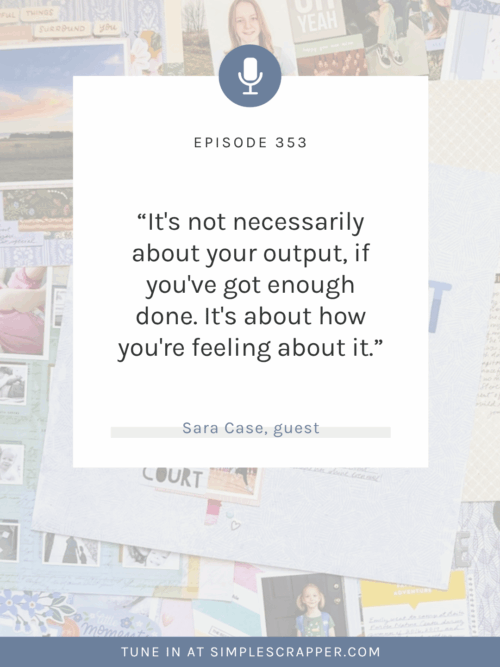
How to Subscribe
The best way to listen to Scrapbook Your Way is with a podcast player on your mobile device or with iTunes on your computer. You can subscribe via Apple Podcasts, Google Podcasts, or by searching for “Scrapbook Your Way” in your favorite podcast app.