In this episode, featuring Simple Scrapper staff and team members, we reflect on the importance of learning from experiences that don’t go as planned. The conversation includes how we navigate false starts and unexpected challenges, along with the lessons we’ll take into another year of scrapbooking. This is the second part of our series leading up to the 2026 Planning Party.
Links Mentioned
- Ali Edwards projects
- Project Life — Becky Higgins
- Adobe Photoshop Elements 2026
- Storyline Chapters at Scrapbook.com (*)
- Quick. Trip. Travel. with Stacy Julian
- KALLAX Shelf unit
- Thickers at Scrapbook.com (*)
- Peachy Cheap
- Shimelle’s Use What You Buy class
*Affiliate links help to support the work we do, at no additional cost to you.
Tracey Fox: [00:00:00] I think that the idea is like really tapping into yourself and knowing what makes sense for you at any given time or season of life. So that you don't start to feel like you're falling short or you're behind because you're not finishing something, versus when those projects are giving you so much satisfaction that you want to finish them.
Jennifer Wilson: Welcome to Scrapbook Your Way, the show that explores the breadth of ways to be a memory keeper today. I'm your host, Jennifer Wilson, owner of Simple Scrapper and author of the New Rules of Scrapbooking. This is episode 313. In this episode, I'm chatting about what we learned when things didn't go as planned with a group of simple scrapper staff and team members.
This is the second of a three-part pre-party series leading up to the 2026 planning party. Registration is open through November 14th, 2025.
Hey friends. Welcome back to Scrapbook Your Way. We are here with another group session as part of the [00:01:00] 2026 planning party.
This session, we are shifting gears and focusing on the things that didn't go as well, and of course, what we learned from those experiences. This is a good, uh, bookend, our partner to, uh, last week's conversation about all the things that did go well and how we can leverage those to learn more about ourselves and do better in the future.
Today I am joined by four guests. If we want to, let's go around and if you could share your name and kind of the types of scrapbooking you like to do, just so our audience can, you know, put a little, um, I don't know, idea on you. So, Amy, go ahead.
Amy Z: I am Amy Zwart or Amy Z in the community. And I like to do mostly 12 by 12. I do my children's school albums that way recently. And six by eight for projects like Week in the Life and December Daily, kinda [00:02:00] those types of things. Um, I would claim to be a project lifer, but I haven't worked on that for a long time, so maybe that's part of what hasn't gone well.
Jennifer Wilson: Maybe, maybe. All right. Our next three guests were on last week as well. Um, but if you want to just share a little bit about yourself or anyone who ha didn't listen to that episode yet.
Tracey Fox: Hi, I'm Tracey Fox. I am a paper scrapbooker. Um, I'm mostly scrapbook layouts, uh, usually 12 by 12, sometimes eight by eight, but I'm a big fan of the square.
Jennifer Wilson: Nice, nice.
Jen Johnson: Hey, I'm Jen. I do digital. I do mostly square also. I do Project Life. I do just regular layouts. I, well, I'm gonna say I do Project Life. I don't, I mean, Amy. You know, can say she hasn't done it in a while, so that doesn't count. But I think it counts because I do it very sporadically also. And yeah, so that's what I do. I scrap in 12 by 12 in Photoshop Elements, [00:03:00] and I print all my books in eight by eight.
Jennifer Wilson: All right. Last but not least, Helen.
Helen DeRam: I am Helen and, and, uh. I like to do layouts 12 by 12, and I like to do mini books, um, like the Heidi Swapp storyline chapters, using those in different ways. And um, also like the interactive type of albums that are about six by eight size. I consider myself a paper scrapper, but I'm probably more hybrid these days. And yeah, that's me.
Jennifer Wilson: Alright. Now there's one kind of caveat here that I, that just crossed my mind that maybe I should have said in last week's episode is that I think when we have these conversations with Simple Scrapper creative team members, staff members, and even just our members, often,
the reason they're here is because they've actually been around for a while and made progress in these domains. I think this happens a lot when we talk about photo management, for example. Everybody's like, yeah, I'm, I'm kind of doing okay. Like, [00:04:00] maybe we get behind, but we, we kind of are more advanced than we were before.
And I know that's gonna come out a little bit today, but also it also shows that even folks that have been thinking about these things for a while, uh, participating in the planning party for years, uh, still have things that don't go as planned. We still make things way more complicated. We bite off more than we can chew.
Um, so yeah. Let's just jump in. Let's start by thinking about frustrating experiences. So what happened to you? Was it of your own doing or an external factor, and how did you respond to that frustration? Amy Z Go ahead.
Amy Z: I worked on a project this year that was Stacy Julian's Quick Trip Travel, and I've done it before. And so I should have known that I will use way more adhesive than ever thought possible. So I ran out of adhesive. And while normally [00:05:00] that's an annoying thing, what happens on this project specifically is there's all kinds of like batch processing that you do.
And I had reserved time over the weekend to do that. Like I was actively planning to work on it. So I thought I had, you know, plenty left and I usually order it in bulk and I was running low. So I saw that ahead of time and I ordered a new bulk order and it did not arrive in time for the weekend. So it's a, it's a stupid little example, but it's also like a great, example of the bigger picture of I could have like canceled the weekend. I could have been really frustrated and not done anything. And instead I went and I bought more adhesive that cost more because it wasn't purchasing it in bulk and I had to do an extra errand and all the things. But I'm so happy that I did and eventually the other adhesive came to.
But um, I think it's just an example of sometimes when things go wrong, you also get to choose how you deal with it, right? And you can suck it up and move [00:06:00] on or have a pity party and get kind of stuck in a hole. So I've done both right in those.
Jennifer Wilson: Sure we all have for sure. Well, I think one thing with the adhesive issue is that if you can't find your preferred or one of your preferred brands locally, then that actually does impact how you scrapbook. Like if you're used to maybe a lot of, uh, wiggle room to be able to literally wiggle things around.
But this one is a instant stick. You might have some surprises there, or it might even be the opposite if you're used to it sticking right away, but, um, it's actually lifting and you are frustrated that things aren't sticking as well as you would like them to. So.
Amy Z: That's a fair point that I did get the kind that I usually use. Um, it just cost a lot more. And was an extra, you know, headache to go get it. But that probably would've been made me even crabbier if I couldn't get it. So fair point.
Jennifer Wilson: All right. Jen, what about you?
Jen Johnson: I have been [00:07:00] for years, whenever my husband and I go on a trip or do something exciting, we'll decompress into, I'll record it with my phone in the Voice Memo app. And that gets me that in the moment, like what we're thinking about, what was our favorite part, like that kind of stuff. And a lot of times once we get home we'll look at photos, rehash the trip or the event or whatever. And that'll gimme like a ton of ideas for scrapbook pages. So we've been doing that for years. And this year for some reason, um, we have, we were not doing that as, as well.
And I'm, I'm not even sure why we, we had a big trip to New York for his 50th birthday and we still haven't talked about that. And that's really a bummer because he did a lot of stuff on his own. Because I was physically unable to do a lot of, a lot of things at that point. And so a lot of the stories are his stories that I wasn't there for.
So, um. We're still kind of working on that. But [00:08:00] we, so we had another big weekend last weekend where we bought a house and then we immediately went to Nashville for a concert that same day. And so on the way driving home from that, we actually did the voice recording on the drive instead of waiting until we got home.
'Cause we knew we'd be super busy. And it wasn't even like a planned thing, it was just kind of a lull in the conversation. And I'm like, Hey, do you wanna do this? And he's like, sure, I'm driving. We're we talk all the time anyway on the road trip. So, um, yeah, I was able to just get that immediately after we had done this.
And I got a lot of good stuff from him of, you know, why we went to the concert, what, you know, what we thought about everything and buying our house and, you know, all this like big stuff. That um, now I have, and I can use that as layouts, um, or layout journaling type of stuff now. So I guess the thing that I learned was I don't have to actually be at [00:09:00] home looking through the photos for us to have a conversation and record it. I don't know why that was, that's been such a big stumbling block for me.
But kinda take away the perfectionism of we have to do it sitting down and have the vibes and have a drink or have the whatever, and look through photos and make it like an event. And like, no, it really doesn't have to go that deep. So.
Jennifer Wilson: I love that. That's a great realization. And also that's a really amazing strategy. I think I wanna try something like that. Um, I'm curious, do you, uh, do anything to organize those files either in your phone or do you transfer to your computer? Like how do you save those?
Jen Johnson: So my early ones, 'cause I, I wanna say we started in maybe 2018. We would just sit at the end of the day and kind of like, what was your favorite thing of the day? What was your, whatever. I know, I remember a couple trips where we had done that and at that point, um, you couldn't really do anything with it.
You had to kind of listen [00:10:00] to it and then type as you're listening or, or whatever. But now the voice recording app or the dicta, it's called voice record, I think is the app. It's the one that comes on your phone if you're, if you have an iPhone. You can actually get the, um, the script. What is it? Oh my gosh.
I should have, um. Transcript. Thank you. Yeah, you can get the transcript from that. And it will, you can like copy that and paste it into a note and just have, or a, a document or whatever. And so that's a fairly new feature or something that I just discovered. I think it's still pretty new. Um, but yeah, it, it definitely, um, you, you need to tweak it 'cause it's not gonna get everything right.
But it's a great start and it's especially kind of if you journal like you talk, which is kind of what I do, um, it's great for that. So I just boop it into, um, just an, a note in my system of [00:11:00] scrapbook journaling.
Jennifer Wilson: Yeah, you know, I, I'm like, there's so many like possibilities here. Like you could send your, all these notes, like as a bundle to, to Chat GPT and then it like, based on your feedback of these trips, recommend new travel locations.
Jen Johnson: Totally.
Jennifer Wilson: There's so many like crazy things you could do both, you know, for your life as well as just just for scrapbooking specifically from that.
Jen Johnson: Yeah.
Jennifer Wilson: I think of everything in data now. I don't know. It's weird.
Tracey Fox: Your frustrating experience is our gain. 'Cause that's, that just gives us all cool ideas.
Jennifer Wilson: Yes. yeah.
Thanks, Jen. Um, mine is, I don't know. I don't know. It's kind of embarrassing, but I think that's the point here. I had at least two instances that I can think of this year where a cat jumped on a table and everything on the table like slid off. And so I'm a piler, but I like to pile things in an organized way.
Little [00:12:00] bundles and like neat stacks of related items for certain projects, like even chronologically sometimes. But when the cat steps on it and then it all slides, then it's not organized anymore. Um, and so that's my own fault because I had piled flat things on top of non-fat things. I get that. And that's what I learned from it, is I just, I can't do that.
I have to really, uh, if I feel tempted to put something on one of these tables, I need to either put it away or I do have the sorter, um, the horizontal shelves inside my Kallax so if there's room there, I can put it there. But it just, it can't be on a table because the cats are gonna mess that up.
Even they all of a sudden like to chew on all that crinkly plastic packaging too. So even those, I've had to really put away a little bit more. So it's a simple thing, but it caused huge frustration. And then I'm like mad at the cat, and then I'm mad at [00:13:00] myself and, and then it's just, there's mess everywhere.
And there's been issues with, in the past, one time it was glitter or sequins or both. Yeah. That's, that's my own fault. I need to learn from it. And we are moving forward from here. So.
Helen DeRam: The cats are making you be more organized.
Jennifer Wilson: Yes. That is very true throughout my house, I think.
Jen Johnson: They're really doing you a favor. They will tell you they're doing you a favor.
Jennifer Wilson: Yes. Yes.
Jen Johnson: It's all for yourself. Improvement. That's why they live is to improve us.
Tracey Fox: I could have put so many cat related frustrations on my list as well.
Jennifer Wilson: That's funny. You wanna go ahead and go into it, Tracey?
Tracey Fox: Sure. Yeah. So the, the frustrating thing I have this year is that as a person who, who this far into scrapbooking, I really pride myself on like knowing what projects I will finish, knowing what projects, you know, fill me up in what I enjoy creatively and scrapbooking time is so [00:14:00] limited, right? Like, we only have so much time for it.
I'm not the fastest scrapbooker kind of by choice because I enjoy the process. And so I, that time is really precious and I got seduced by a project. So, you know, hi, I'm Tracey. I got seduced by a project. It's kind of like you, you have to, you have to admit it. Um, it, it, it happens, right? So like I, um, I have been somebody who does One Little Word every single year, in that I choose a word. I often join the class because I like the community and the prompts. But that type of, um, that type of reflection, that type of project, that type of personal stuff. I've never really married that up with like visually creative paper crafting. I, I always, I'm a big journaler, so I I journal on the side a whole lot.
I have personal journals filled with all sorts of reflective stuff. But for me, scrapbooking is a different pursuit altogether that involves photos and it involves memory keeping. And, and not that those two things can't go together because I see the creative ways people bring those things together beautifully on [00:15:00] paper in an eight by eight album. And then something happened where I got, I loved my word this year. I got inspired by the products, of course, because they're always pretty. Um, and I bought the kit. And even when I bought the kit, I went into it thinking, oh, I'm on, I'm gonna do this differently, right? Like, I'm not, I'm not holding myself to, a complete six by eight album that documents, you know, projects with this one word throughout the year. What I kind of told myself is like whatever amount I document on this year's word in this album with this kit, I will also kind of keep this an ongoing album so that way I can document words In the future.
I would love to reach back and do some sort of documenting on all the words that I've had now for over a decade. All of that is great in theory, but I am not inspired to work on this project. I've made like two pages for it. I don't enjoy the format, I don't enjoy the size, I don't, I don't get like the same satisfaction out of doing that kind of scrapbooking. [00:16:00] And I think another one of the pitfalls that I will admit is like the title page and the first page or so that I did do, uh, went really well online. So like I shared them on Instagram and people were really excited, like, yay, I can't wait to see more. This is pretty, I'm excited. And so there's that little hit of dopamine or whatever from. Uh, scrappy Instagram. And I'm like, oh, cool. You know, like, the algorithm likes this, but I don't like this. This is not, this is not for me. Um, so I, how I responded is that, oh, well I have this album. Um, I treat all albums as ongoing projects instead of start to finish projects. So that's something I'm sure we'll talk about more as we, we talk about, uh, our, our how we approach scrapbooking. But, um, it's there I can add to it. I've already dipped in and used the products from that beautiful kit for a couple of other things. There are definitely pieces in it that I know I'll never touch. They're like prompt pages and things like that. That [00:17:00] I would rather just go to my journal and scrawl um, instead of using those.
Uh, but that, that's okay because there was stuff in it that I liked still, and I still, you know, I get inspired by what I see the community doing, but, there is at this point in my life still, which has been the case for the last many years, and I just, I thought, oh, time for a change. And maybe, maybe there's not time for a change. Um, I, I still just get all of my satisfaction from the, the other types of projects that I'm, I'm already doing on my own.
Jennifer Wilson: That's really huge. And I mean, we've, we've all had that. We we're trying to take a leap. It might turn out great or we might completely like crash and burn, but we learned that, okay, this format I love, it's for you, love it for you, but it doesn't work for me. And that's okay. And maybe it's not that you didn't like the products or even, you know, I know you don't do a lot of pocket pages, but you've done some in the past.
Right. So it's, it's not, it's just maybe this season of life and this [00:18:00] style, and it's just not fitting with where you are at right now. And that's okay.
Tracey Fox: Yeah, it's okay.
Jennifer Wilson: Yeah.
Tracey Fox: And. I do like the idea that like anything that is even a whiff of something in that nature, I can always add to this album. And it can just be like that little place to kind of work out feelings, do personal stuff, or, I don't know. Sometimes you get one of those really cute six by eight prompt pages and if you don't scrap six by eight, you're like, where does this go?
And so maybe I'll do something creative on those once in a while. But, um, for now it's just, it's not calling to me.
Jennifer Wilson: And that's okay. Thanks for sharing. Helen, what about you?
Helen DeRam: So for me, um, for a while now, for I'd say several years, I've been able to scrap most every day after work and then on the weekends as well, you know, I would have some more time. And I just, I really loved it. I loved that groove. And then last year, you know, we've talked about it before, we did [00:19:00] the Aligned project, so I had very focused, like every day I was doing something and I was, I loved it.
I was really into it. And then once that was done, um, early this year, you know, in like January, I kind of like, I felt like I needed a break, but I didn't know what to do with myself. Like I wanted a scrap, but I would go to my scrap room after work and I would just get frustrated with what to do and I would get frustrated with myself.
And there was this whole like, worry that. I'm losing it. Like I'm not gonna be able to scrap again. You know, like I'm losing my mojo. And it was, it felt forced. Like I was trying to force myself to scrapbook or do something or, but, and I was like kind of worrisome, honestly, because I love this hobby so much.
Um, so I just had to like, I just, [00:20:00] even though I felt like weirdly bad that I wasn't scrapbooking, I was like, you know what? I'm gonna take tonight off maybe tomorrow night, maybe a whole week. Um, 'cause I hadn't done that in a really long time. So it was, it just felt weird and I was afraid I was gonna like, lose it somehow, lose my desire to scrap or whatever.
Um, so I had to just kinda let it. I don't know, like, not worry about it so much. You know, I'm an overthinker. So I just kind of let it go and like told myself like, this is okay that this will pass. And, um, I talked about it a little bit in the previous episode. You know, I kind of looked back at what I had done, layouts and projects and really felt good about, you know, what I had done.
And yes, I still want to do this. And then just kind of, you know, did not like baby steps, but sort of, you know, like, okay, I'm, I need to do layouts for Spark. Which was great 'cause that, you know, [00:21:00] kept me in it and kept me focused and okay, I need to do this. And, you know, maybe it was just 15 minutes a night or a half hour instead of an hour that I was doing before.
Um, so I kind of just had to change the way I felt and the time I was using to scrap and I'm still working through it. But I feel much better than I did earlier in the year.
Jennifer Wilson: Yeah, I think I've tried to say over the years because I really believe it, it always comes back. Uh, once a scrapbooker kind of always a scrapbooker. Um, once a Project Lifer for you guys, always a project lifer. Um, it all, it all counts and we're all gonna go through times where we just can't find the same kind of energy we did in the previous season.
So I love how you've, um, found your way through it. Because that's how we get through. We can't often, [00:22:00] it's like the, you have to go through, you can't go around type of thing. Um, and just sit with the frustration and sit with the indecision or uncertainty or insecurity. So thanks for sharing, Helen.
Helen DeRam: Thanks.
Jennifer Wilson: All righty. Okay, so next question. Of course related, we get frustrated with ourselves when we make something more complicated than it needed to be. And it could be within a specific sitting. It could be a larger project. It could be a system you came up with. It could even be, yeah, there's kind of really no end to what our brains can come up with, I think.
So was there a time this year you realized that you did make something way more complicated than it needed to be? And what did you do from there?
Let's go backwards. Helen, do you wanna just jump right in on that one.
Helen DeRam: Sure. When I think am I making something too complicated, I always think of Shannan Manton, and I think it was in, uh, one of our community events. And she was talking about, you know, [00:23:00] Becky Higgins created Project Life to make scrapbooking easier and scrapbookers we're like, hold my beer. So I'm always like, am I doing that?
I'm doing that right now. Like, um, because I will complicate things. But I was thinking about this a lot. And sometimes I like the complication. Because to me the complication is maybe taking more time to do something or making a big interactive thing, that can be complicated. And sometimes that feels good and I like doing that and that's okay. But the difference is when I'm making something complicated and then I feel frustrated by it. And I felt that way, as I just said, you know, in the last few months. So when I would get like that, when I feel like I'm complicating this, I would either just stop, you know, okay, now's not the right time. Or I would push forward, like, let's stick it down. Because I can move things around on a page for, [00:24:00] you know, days. So I would just stick things down and stick things down and put this here. And then my worry was always, what am I gonna do if it doesn't look right? Well, that happened multiple times, and a couple times I just started over, you know, obviously not a big deal.
Um, and a couple times I was able to fix it. So, um, I don't know. It felt good to, and I've been scrapbooking over 20 years and I don't know that I, I was always maybe, I didn't wanna get in that space where I screwed it up or made a mistake. And I felt, feel like I've done that more this year. I'm sure I did before, but, um, maybe I'm thinking about it more and it, you know, the world didn't come crashing down.
I was able to work through it, um, creatively. And I, I think it's, it's even helped me to be, I dunno, maybe more decisive in what I'm doing and, and not spend so much time moving like the [00:25:00] one butterfly, you know, a quarter of an inch in either direction. So, so, yeah.
Jennifer Wilson: Yeah, I've, I have certainly been there. That, uh, creeps up for me. Time and again, I've, like you said, I've tried to be a little more decisive and that sometimes means like there's layouts that I love and those are usually the ones that I didn't think about somehow. Like it just kind of came. And then the ones that I thought about and then I started to get a little frustrated, I'm like, I just wanna be done with it.
And I'm kind of okay that it's not like the best layout I ever made. I know when I gonna, when I go back and look at it in the album, I'm gonna like it just as much as the one next to it. And I'm not gonna most likely remember that, oh, well that was the one that I struggled with or didn't like as much.
Helen DeRam: Right.
Jennifer Wilson: Yeah. All right.
Jen Johnson: I'm so glad that you said that, Helen, about, um, sometimes overthinking, like seeing it in a positive way in in some instances. You know, because I think, I always think of I am super, very much an [00:26:00] overthinker in every aspect. But you know, sometimes that just means you're excited and enthusiastic and you have a lot of ideas.
You know, that doesn't mean that it's always a bad thing, so I'm glad you said that. I think that like, gave me a little thought shift there for a second.
Helen DeRam: Sometimes it feels good to sit in a, you know, like sometimes it feels good you, and you know, when it doesn't feel good and then it's time to put it away or whatever. But sometimes it's good.
Jen Johnson: Yeah. It means you're excited about something. You, you got a lot of thoughts about it. Um, I, I'll go ahead.
Jennifer Wilson: Like curious to explore and try.
Jen Johnson: Yeah.
Jennifer Wilson: Like Yeah, there's, yeah, and as Helen said, like you kind of know which one it is, where it's heading, so.
Jen Johnson: Yeah. Until it gets to that, like, mm-hmm.
Jennifer Wilson: Before you burn it all down.
Jen Johnson: Yeah. Okay. Um, I'll, I'll go ahead. 'cause mine kind of springs from that a little. Talking about Becky Higgins. Um, I, my big thing that I have overcomplicated forever [00:27:00] is, so, I I, my kind of how I scrap is I have my weekly Project Life, which is kind of a summary. I don't use Project Life anything, but it's, I use a specific thing.
It's very specific. It's a summary, it has its purpose. And then I make layouts about whatever I want to. And that's fine. But as I'm going through my photos, there's all those little stories, all those little photos that you don't wanna make a whole page about that should, in quotes, you know, be perfect for Project Life.
That's what I overcomplicate. Because I take all those photos each month as I'm going through my photos, I put 'em in a thing called random photos for July, and I do nothing with them. Because I'm looking, 'cause it ends up being like a hundred or so photos. It could be like 150. I don't need. Some of them go together.
Some I, I could make like my cats in July and make [00:28:00] a compilation page of, of some of the stuff, or like the books that I read in July, you know, that kind of thing. I, I really don't do that either. I see those big chunk of photos and I do nothing. And that should be the most simple thing. 'Cause it's like put them into my version of pockets, you know, make, make a little grid with little pictures and little stories from my journal and just like, simple, simple, simple.
But does that ever happen? Absolutely not. It doesn't happen. So I was complaining about this, about this in my, uh, early morning Zoom and, uh, somebody said, you know, maybe just do, do one card at a time. I'm like, great. That's so wonderful idea. Just, and that's kind of something I can do in this like super busy, you know, season that I'm in of moving and, and all of that stuff. You know, if I can just sit down and make one car a day, um, it doesn't, ma I don't, [00:29:00] this isn't theoretical thing. I have not done this yet. I just got this idea like a week or two ago. I have not implemented it yet. But, you know, because again, I'm, I'm still overcomplicating things, you know, you would think that like, oh, just do one little card, one little story, one little thing every day.
Eventually you'll have enough to put on a layout, right? Simple, simple. Yeah. No, not simple. So. That's a, uh, an in progress frustration thing that I have made too complicated, but it's been for years. It's been literally for years. And I guess that my point of it too is I, the pages that I make like that with all the little random stories are seriously my favorite ones to look back on.
So this is not like I wanna tell every story. Like, I don't care about that. I don't need to scrap every photo, I don't need to do all that. But when I look back at all my pages, there's just little random pages that have, like, this is a book I read. This is a TV show I watched, this [00:30:00] is a conversation I had with my sister.
This is a picture my dad sent me, just all mishmashed into one page. That's like, that's our life. You know, that's like, it's so good, but I don't ever do it. So what do I do, panel?
Jennifer Wilson: Uh, could you, add a degree of uniformity or repetition in terms of you only do three by four, you only do four by six or whatever. You only do little squares so that it's always the same-ish with a new photo and a, and a new story.
Jen Johnson: Right. Yeah. And that's kind of, I, I generally, when I'm thinking about how to do it, I do that, um, it's like three by four. Three by four. It's like four three by fours. Four three, yeah. So it ends up being like 12 little slots. And that's kind of, but again, I make it over complicated. You know, if I actually stuck to that and did that, that would be a great thing to do.
And I would definitely, I I should do that. [00:31:00] Yeah.
Jennifer Wilson: The other thing, is it just a photo collage with accessory journaling? Like 25 photos that you pick of those a hundred. And then on the other page you write some journaling about the month. And then maybe that's where you do like a little bit of, make it a little more layout. But really it's, it's a companion to pure photo collage.
Jen Johnson: That is a thought. I had not thought of doing that. I think in my brain, I just always mixed everything together. But I could totally do that. That, yeah. Yeah. I'm gonna have to think of that.
Jennifer Wilson: That's okay. Yeah. Tracey, go ahead. What were you gonna say?
Tracey Fox: I was wondering if like the, if the curation of those photos is holding you up, like if it's knowing that it's a lot of photos and it's like, how do I tackle this into the one or two pages that I really wanna do? I don't know if there's like a subcategory or a triaging you can do within those photos that don't make the cut where it's like, this one is extra good and I know I'm [00:32:00] gonna, that's gonna make the cut. These are maybe, you know, B team or something like that.
Jen Johnson: Yeah, yeah. And that's, that's kind of, um, kind of where I thought I would be going when I thought of like doing one card a day. Like do the ones that I'm excited about doing first and if I never get to any of the other ones, at least I have those ones that I was most excited for those little stories. So that is definitely, yeah, that kind of triaging would, would totally be helpful for sure. Thank you.
Jennifer Wilson: Another option. 'Cause I'd been thinking about this recently of how can I document these smaller stories that don't deserve, I'm using air quotes here, deserve a whole layout. But I don't wanna do Project Life. Um, and so one way I was thinking about it is in terms of just perpetual small stories on cards.
And so Jen, one, one thing that I'm thinking about is could you do two at a [00:33:00] time, print them out on a four by six, cut 'em in half and go ahead and put 'em in pockets. So that you, you're seeing the progress.
Jen Johnson: Yeah, maybe. Yeah, maybe. Yeah, maybe.
Jennifer Wilson: So I mean, yeah, there's lots of options, but also to like, yeah, to maybe even consider not having it tied to weeks and months, but even just, these are the small stories this year.
Jen Johnson: Just stories. Yeah. Okay. You guys are giving me a lot to think about. Thank you.
Tracey Fox: This was actually a, a problem in my own scrapbooking that I solved for myself at least a couple of years ago. And that's the, as a layout, scrapper, you know, I'm not doing pockets. I do have all those little stories. Sometimes those were a struggle because they, you know, they didn't graduate to needing their own whole layout or whatever. Um, but I've been kind of doing like a seasonal roundup layout. Whether that's a single or a double page spread where all those photos, um, and I have to curate it down a lot. Even though I'm, I put a lot of photos on a [00:34:00] page. I'm printing them at like two by two, for instance.
Um, but still only like 12 to 16 can kind of make the cut on a layout. But the journaling ends up being really simple. I'm not really telling stories per se. I am just kind of doing like a snapshot of the season, um, with all the hodgepodge of photos and then like maybe a bulleted list of the types of things that they cover along with other things we did that never got their own layouts. Um, and that's, that's been really fun for me 'cause there's a lot of product in my stash that fits that. So I've been enjoying that.
Jennifer Wilson: Yeah, I just did one of those and I know Helen did those last year as well, or was it the year before now that you did the layout versions? It might have been the year before.
Helen DeRam: Uh, a couple years-ish maybe. Yeah.
Jennifer Wilson: But yeah, I think that's a, it's a strategy that feels very satisfying for a lot of people.
Jen Johnson: Yeah, I can definitely try that for sure.
Thank you guys.
Jennifer Wilson: Yeah, no, it's, I love troubleshooting like this. So many good ideas, and I'm sure that our listeners are gonna have other ideas or ways [00:35:00] that they have solved that exact problem. All right. Who wants to talk next about their complication?
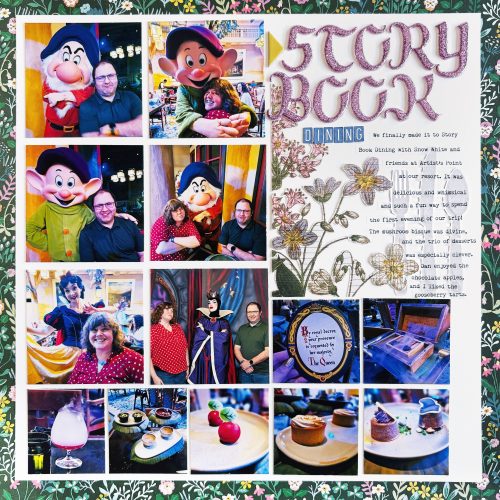
Tracey Fox: I will go. So, um, the, the thing that I overcomplicated recently was a single layout. And the reason that I overcomplicated this has to do with something that has been working for me and that I do enjoy right now, which is making those old things from my, my scrapbook product stash really work. I even talked about that in the last episode. Um, and so I have sitting on my desk forever, probably in, uh, too accessible to the cat. Um, I had this pile of little photos and, uh, a, you know, a big background sheet, um, sitting ready to scrap of this, um, Snow White themed, um, character meal that we did at Disney World on our last trip. Um, and, you know, I'm not, I'm not super themey with my supplies.
I don't have to be, except that I found the perfect American Craft Thickers from my stash that would go with this layout. And they were these real storybook looking. Um, I think they [00:36:00] might've even had a name to the products, might've even been named in a way that it references Snow White. Like they were these stickers that you would use with pictures of dining with Snow White and the Seven Dwarves and the the Evil Queen. So, I was very committed to using these thickers, but I couldn't find any other products, any other lay, like I couldn't lay the things out on the page right to where they looked great. Um, I had never even opened this package of Thickers before. I think I got it in like a, like a miscellaneous, you know, deal of the day kind of Peachy Cheap thing, you know? But I still was committed. Like this is the first and only time I've ever been able to use these, so I'm gonna use them. Um, and, and my approach was just not working. I couldn't seem to lay things out the way I wanted. Usually, like if I have a group of photos and a coordinated product, I can, I can just lay them out in the way that feels right, you know, um, on a page and, and go from there.
But this was not working for me, so I put it off for many weeks. I just kind of had that layout, that pile in the corner of like, well, someday I'll [00:37:00] figure out how to make that work. Um, and so the, the way that I ended up approaching that was that. Um, a challenge from the Simple Scrapper community actually, uh, helped, helped me take a completely different direction with that page than I would've normally. Um, this is in the most recent issue of Spark Magazine, but the design team had a challenge, um, for, uh, you know, the style challenge to combine florals on a page. I was not thinking about this page whatsoever for that. In fact, florals are a challenge for me. I don't usually go for kind of like organic looking type things in general because I, I tend to, I'm drawn to more graphic elements in, in scrapbook products. But as soon as I introduced florals onto this Snow White page, I was like, well, duh, they're in the forest, so florals work fine. You know, there were, there was like vines and everything in the restaurant. Um, suddenly it softened those weird, ornate letters in a way that I never would've thought to do. And, uh, [00:38:00] just, it, it completely breathed life for me into the creation of the layout.
And I ended up liking the, the outcome and it looked different than anything I was imagining from the beginning. So, I guess like the, the moral of the story feels like, you know, you, you, you always need that little injection of inspiration, right? Like, you can always find it, um, look, look for challenges.
Maybe even, um, think about what a challenge or a sketch or, or some sort of prompt, rather than have that make you think of a story that you wanna tell that would fit that challenge, think like, what's on my desk right now? Could I do that with the thing that's on my desk right now? And in this case, it solved a problem that I had and I was so happy for that. Um, doesn't always work out that beautifully, but it was just kind of like, oh, you know, that that was what this page needed apparently to get done. And I used the, I used the letters, so I'm so happy about it.
Jennifer Wilson: Very cool, and we'll definitely include the image of that layout in the show notes for this [00:39:00] episode. So our listeners can check it out.
Amy Z: I saw it and I love it, by the way, good job.
Tracey Fox: Thanks.
Helen DeRam: Yeah. And those letters perfect. A hundred percent.
Tracey Fox: We'll see if I ever get a chance to use 'em again. I was also hung up on the whole title being used in that font, which would've been too much and big. And something about the way the n looked in those letters was like illegible. 'Cause they were so medieval, ornate looking. And, and so I also had to end up losing one of the words and like putting that in a different font and it all came together.
But I, I, I am not used to overcomplicating things that much, um, in my scrapbooking and I was just like, why isn't this working?
Helen DeRam: Welcome to our side.
Jennifer Wilson: Yeah.
Tracey Fox: Well, I certainly used to, but absolutely.
Jennifer Wilson: I was gonna say, we're gonna have to design a stash bash challenge, like around those letters so that you can use them.
Tracey Fox: Honestly, it's, I mean, I think I paid pennies for them a decade ago, and now it's [00:40:00] very or more. And now it's very satisfying that they made it onto a page in some way. So if I never touch 'em again, it's okay.
Jennifer Wilson: Yeah. I think even just, uh, when we talked about this last time with the Hambly transparencies. Like, what's that item that you bought a long time ago, but you haven't really found a good use for? Like, how can we use that on something new? All right, Amy, what about you?
Amy Z: I think it's a great segue. Because, um, I actually wrote down three things of when I made things complicated, but I'm gonna go back and quote Helen from what she said, because I love it. She said, sometimes I like the complication. And when I wrote down these three things, I was like, I would go back and do all three of them again.
And did they add time? Yes. But did they add enjoyment? Also, yes. Like I, I really found my flow with a couple of these projects this year, and it's because of what I changed up. So, um, also kind of piggybacking on Tracey, one of [00:41:00] 'em is using, using classes or, um, challenges to help in a current project. And so I was getting really burned out on doing school layout, kind of themed things for my kids' school albums, but I also moved it to the top of my list because I got behind on it.
My son's a senior this year and I'd like to catch up in some way, shape, or form. And in the process of that, I didn't wanna just ignore my daughter's years that had been skipped. So I actually started with her as a way to get myself motivated and catch up. But using the sketches, um, you know, and the challenges and the classes definitely added to the complication and it made me like really plan things out and really look for specific things.
So, probably added overall time to each of those layouts. But I've been really happy with how they're turning out. And also with the momentum that it's building. And in the classes I've learned new [00:42:00] things. So I've done some of the Use What You Buy, um, classes with Shimelle and I did our Simple Scrapper Square One sessions that Peggy was running as a CoLab.
And then I think there's a couple of, um, Stash Bash or Refresh kind of, you know, challenges or things from Spark. And so it's just been really refreshing to that project. So that's been an awesome add. Um, and then two other things that I did is I have a Week In The Life album and I got the kit from Ali Edwards this year. But I like in my mind it was kind of missing something. And it doesn't really make sense 'cause I feel like the kit is similar to what I've done in the past. But maybe that was, it is, it was similar and I wanted something different. So I went and found floral pattern papers that match each of the days colors. 'Cause it's kind of a color coded so you know, if Monday's red or whatever. And [00:43:00] adding that in has just kind of made it like my own and been really fun to work with.
And so a couple times I know I was absolutely spread out with all the things and getting all the colors right and you know, matched up to write each day. And I was thinking, wow, I'm really complicating this. And then I was like, this is awesome. I love this. And I just, you know, kept going and I found myself totally in the flow and like, that's a project that you can batch.
So I was like, okay, I did Tuesday now I, you know, and I'd be like excited to, you know, get to Friday and Saturday or whatever. So I think it's funny how it kind of plays tricks on your mind that you're just like, I'm doing this a little bit different and it's so fun and I'm just gonna keep doing it.
Jennifer Wilson: Yeah. I think it's so important to recognize the difference between those two, between making it more complicated and leading to your own misery, or making it more complicated and leading to your joy and satisfaction.
Amy Z: Yeah. And not like, maybe not always knowing for sure what's gonna happen, but being willing to try it too. And um, the [00:44:00] third example I had is that QuickTrip Travel album that I mentioned earlier. I, I mixed it up and I, I never play by Stacey's rules anyway 'cause I always have too many photos and so I wanna include more.
And so I always have made it a little bit of a bigger project. But this time I, I made two trips into one album or one project. It turned out to be two albums because I over overdid it. But, um, I combined trips from two different times to the same place. That we're 10 years apart. And again, did it complicate it?
Yes. And I struggled a little bit with will this really fit together. But I was able to tell so many stories of comparison and compare and contrast in that album in still a very easy, quick way that I'm really happy again with doing it. And, you know, kind of trying to map it out a little bit, which you're not supposed to do in that class was adding complication and should I be doing this. But it let me, um, get it [00:45:00] done.
And so that of the three, that one is actually truly done. Week In The Life is really close and school albums are just cranking on, like they're, they're ongoing still at this point, right? But.
Jennifer Wilson: Nice. I love how all of these kinda represent your ability to like, personalize, do it your way. Um, and that's gonna look different for everyone. You know, you might need to add pattern, add floral paper. Tracey probably wouldn't add floral paper 'cause that's not her favorite style. Um, Helen might add like a flippy thing to it. So.
Amy Z: Exactly. Exactly.
Jennifer Wilson: Um, I wanna touch back on the, the first example with choosing different challenges. Because I think there's one example here where, um, you wanna do the double dipping, the triple dipping, kind of satisfying different things and allowing challenges and your own products and stories to kind of plan it out for you.
But if at some point, like you're realizing there's like [00:46:00] an odd man out, like something doesn't fit, it's okay to let go and say, okay, I'm just, I'm not gonna do the class assignment. Or I am actually gonna swap these products out with a different one because this isn't, this isn't going in the right direction.
Sometimes we can like, kind of hold on tightly and clench to the, the plan. That we're realizing that that rigidity is what's making it more complicated than it needs to be. Because sometimes it's great to, to try to do all these things and get all the ideas in one little bundle, and make that page. And it's, you know, all the, you know, it's all the ingredients for your recipe. But sometimes, you know, you don't wanna add the, the red chili flakes are gonna ruin the whole thing. So.
Amy Z: Yeah, I think that's true in the school albums. The trick is also that a lot of topics are recurring. So how to do, how do I show the artwork from the year in a different way. Or how do I, and then also sometimes realizing who cares? It's her artwork and it's different this [00:47:00] year because it's different artwork and she looks different.
Right. You know? So not trying to reinvent it each time too. So I, I think you're right, that knowing, knowing when I want to mix it up and change it, versus when it's like, no, this is just a page that just needs to get done and get added. And so I'm still working through that. I think because I got so excited about the classes and the challenges that then everything had to be that and dial back to like, Nope, just get some pages done and do it, do it on your own. And with, with the tools and like the learning from the last classes or the last, you know, things you've done, which has definitely applied.
Jennifer Wilson: Yeah. Awesome. All right, thanks everyone. So finally, what can you observe and then learn from an unfinished project? So it could be one from this year, it could be one from the past, and what might you change in the future? Or what have you changed as you've paid attention to why a project didn't get done, and, uh, how you were able to take it to [00:48:00] conclusion.
Tracey Fox: I can go. I have learned that. It is, it needs to be a very rare to almost never thing for me that I do a project that requires finishing. Um, and so I, I do very few projects at all in scrapbooking that have a start, middle and end. Um, there, and, and so in doing that kind of the highest level of finished that needs to happen for me is the layout. Not the, not the album itself. Um, not, not some sort of larger project that will just feel unfinished forever if I don't fill in all the slots. Um, and so I, I will create layouts, file them in, they stand on their own, but they're part of a bigger picture. And if that's all I get done, then that's okay. So like, I don't do an annual scrapbook album where like maybe there's 50 pages for 2004 and 10 for 2005. It's just ongoing [00:49:00] of volumes of albums. And I don't care where they start or finish, they start or finish based on how much space is in previous volume and the next volume. And, there's no, like, I may feel for myself like, oh, I wish I would've documented X, Y, or Z, and maybe I'll get to that someday. Um, but there's nothing in there that looks like a gap or like a hole.
Like it's still page after page of, of stuff. Um, same thing for a vacation. If I don't, if I don't get all the photos from a vacation scrapped or all of the, the highlights that I wanna share, I still may have five or six layouts from that vacation. And I'll be like, well, that felt, that represents that vacation.
Okay. So I'm calling that done. If I ever wanna go back and do a piece, then I'll, I'll go back and do a piece. I think the only, holiday albums are another thing like that. I've, I, I know for a fact and I will not be seduced by December Daily, or at least the format of December Daily. I buy the products. Um, but it is not, it is [00:50:00] incompatible with my own way of scrapbooking to actually have to put something to ev every day of 25 or 31 days.
I, I, I can't. So instead, I just make a layout about everything that feels holidayish or significant from the season. Um, sometimes that starts well before Christmas, sometimes that goes into January. And I know people are making that 25 day system adapts where they're telling a different story on a different, like, people make that work in such cool ways.
And what I'm, what I do is not that different ultimately, except that, I don't have, I don't have to fit a one through 25 system whatsoever. It's just, I'm gonna scrapbook things about the holidays. They go into this album and it's, it's done when it's done or it's done when I feel done. And very often I will plan out pages in advance that I think I might do in an album. I never make a foundation page for it or anything like that. And by the end of the season, I'm not as inspired by that story anymore. So it doesn't make the cut. I never, I may never scrap the photo or it may [00:51:00] make it onto another project. And all of that just feels so flexible and like, it works so well for me.
Um, and I think it's just because unfinished product projects in the past I have looked at and felt so unsatisfied by their existence. Um, and, and I, I think I've, I've, just like, Nope, I'm gonna, I'm gonna make it so that I don't have those, period.
It's kind of like, the cool thing about scrapbooking to me is that depending on how you approach it, if you really are just kind of finishing layouts each time you are scrapbooking, it's never unfinished. Like it's still, it's still photos that are cool to look at. If you get any journaling on the page, that's still valuable.
It's not quite the same as like a sweater where you've only created a sleeve. What you do have down is more useful than nothing. So I think there's something to that as well. That we have this idea in our minds of what constitutes a finished project and it has to be fully embellished. Or [00:52:00] maybe the journaling has to be really complicated and capture every emotion, and that's really not true. What we do and what we get down is valuable. Regardless of how quote unquote finished it is.
Jennifer Wilson: Nice. Yeah, so well said. I have a connecting idea to, uh, my thoughts on my unfinished projects. And I think the trend for me is that if I was able to set up the project, uh, kind of batch wise, I look at it as in layers. Like, so there's the structure of the project, probably some sort of papers, then the photos, and then journaling and embellishing.
If I work that way, I am far more likely to finish the project than if I do, like with December Daily, day 1, 2, 3, sequentially. I eventually time will get away from me and I will stop. Whereas, and, and maybe this is a secret for me in the future, if I'm only looking at the project as a whole, like what [00:53:00] I do with Week In The Life, I lay everything out and I figure out, okay, which things am I gonna use each day?
And I'm putting things in pockets or even for, um, and this was the structure of the Before Your Story album. So this is my class where you document, uh, your story, birth to adulthood or someone else's in one album. And the reason that I think that works so well is because you're doing so much of the structure in advance. Planning, all the stories in advance. And then after that it's basically, you know, one card at a time, like we were talking about with Jen for her potential Project Life pivot.
So, um, so yeah, working in like batches and layers basically from bottom up for me is what helps a project get done, when it's really like sequential start to finish. Um, as a project, eventually I will abandon it. So that was, that is my observation.[00:54:00]
Amy Z: I, I like the examples of December Daily that kind of fit both of these. Um, and it was actually my example too, that taking it as a project in December just feels really unrealistic to me. And I've tried a lot of things. But the reality is I need to be able to just document the stories and maybe, you know, manage the photos to some extent. Which I honestly don't even, I always get done in December.
Right. You know, there's just a lot of other things and your time is just spent differently. Now, a lot of people figure it out, but for me, I have not. Um, but looking at Tracey saying, you know, what you do get documented and done is enough and is great and is more than you know more than before. And also Jennifer's like batch process approach.
Um, my reality is I think I just need to schedule a time to do it. And last year I purposely didn't, or I kind of pushed [00:55:00] it out and I haven't started one ounce of 2024 right now. And I'm okay with it. Because I had other things I wanted to do instead. And I finished other projects this year and it is how it worked out.
But now I'm looking at 2025 going, Ooh, do I want that to happen again? Probably not. So now it might get a slot in January, right? Or you know, one, if not both of 'em. So I'm in, I'm intrigued by the batch process because that's. I like that. And there are certain projects that work that way for me, but I can also think of other projects where I don't batch and why is that different or how do I do it?
And I think for me, the reality is I will have unfinished projects because I like to move around to both of those kinds. And sometimes I feel very awesome about just getting a layout or being able to do my own thing and kind of breaking free from the batch processing. And on the opposite side, I feel very accomplished that, you know, oh, I did this Quick Trip Travel and you [00:56:00] know, it was very batched and it was very, you know, thought out.
But now I have these albums I get to look through. So they both provide something different to me, both creatively and tangibly, you know, as done projects. So. I just have to keep balancing between the two and what I find fun. So, you know, it's a, it's a plug for the focus finder of, you know, what's important to you and what, what's filling you up right now.
And you know what, in my mind I always add the little question of what do I actually have ready to work on? You know, what, what doesn't have too much of a gap to fill kind of a thing. You know, if I, if I haven't even sorted photos for a project, I'm sure not probably gonna start that one right now, but, you know, set myself up for success by doing that on the side while I work on a different project. So.
Jennifer Wilson: I wanna underscore your point about time because you know, all of our conversations today, I hope we all like glean something from them, but sometimes nothing needs to change. We're not [00:57:00] doing anything wrong. We don't even have to do any new observations. We just have to set aside the time to do the things that we wanna do. And sometimes that's not even half the battle, that's three quarters to 90% of it. In order to see progress. 'Cause we can't even make these observations and make course corrections and learn about ourselves unless we are putting in the time.
Amy Z: Very true.
Jennifer Wilson: All right. Who's next?
Helen DeRam: So I noticed that, um, you know, a couple times I'm just getting pulled into the excitement of whatever the project is and the release of it, like Week In The Life, December Daily.
Jennifer Wilson: I take it we can just blame Ali for all of our, um, distractions and.
Helen DeRam: Yeah.
Amy Z: We love you, Ali but we need to talk. Yeah.
Helen DeRam: Yeah, we do love Ali and we love her projects and they're amazing and I, I've, you know, done them for a long time. But it's, it is that momentum and it's really easy to get pulled into it. And so, [00:58:00] um, like this year I did buy Week In The Life product, like not the main kit, whatever. I bought the journal and some other things.
And I had great intentions of doing it, but I just never did. Um, I might, we'll see what happens. Maybe I'll pick a week, but, I can usually recognize when I'm just getting pulled along. Like with the recent December Daily release, um, I kind of forgot about it and then I was looking at all the things and I was like, Ooh, that's pretty, that's nice.
This is nice. But I know in my heart I just, I can't, and I don't necessarily want to do that project this year. So is it just all the brand new, shiny things and when I feel like that, um, I can turn away from it and, and or maybe just buy one little thing that, you know, I could incorporate into my stash and not feel like I have to do the whole project.
So I think I've gotten to the point where I can [00:59:00] recognize, do I really want to do this or am I just being pulled along by the momentum and the excitement of the project. I have plenty of unfinished projects that I want to finish and I feel good about that. But there's certain ones I know I bought product for that I'm okay with not finishing. Maybe I'll use that product for something else and maybe I won't. So I guess just recognizing when it's something I really wanna do or just all the shiny new things.
Jennifer Wilson: Well, that does also highlight the importance of community momentum and that, you know, we've created that inside a Simple Scrapper. Tracey created that with Scrappy Christmas in July. Whenever you can like bring people together around a shared goal, then we're more likely to all like, attach onto that momentum and get more done than we would've otherwise on our own.
Helen DeRam: Yeah.
Jennifer Wilson: When you were talking Helen, about just that. That being pulled along. I definitely get that during [01:00:00] planner season, which now seems to be several times a year. And I just have to put all these blinders on. Like, no, I don't need to join a whole new system and buy all these things, and I've been there, done that. I need to stick with what works, um, because it's really easy to get sucked into the possibilities, you know?
Helen DeRam: Yeah. Yeah.
Amy Z: Can I add something too about Helen talking about product? Um, I do a shout out to Bri in the community Breon. Um, she did something this year that made my head go, huh, I never thought of that. So she bought some of those kits like Week In The Life, or maybe this even helps Tracey with, uh, One Little Word product that you have.
And she was putting it into like her Aligned projects and into different things. And I, I recognized some of the pieces and I was like, Hey. Wait, that doesn't go with that. What is, how, how is she doing that? Right. And, and I, I got myself so flustered going. I've never ever thought of like using that in a [01:01:00] different way or, you know, and it, it was, especially because I knew it wasn't like she just had leftover product 'cause that I have done, right.
And it also wasn't like, uh, I bought it for this and I decided not to. She just legitimately bought it to do other things with it. And I was like, that's amazing. And why didn't my head like, expand with ideas, you know, from that ever. And I just think that's a fun way to give yourself a little bit of a taste of the products or a little bit of, you know, being able to do this color coded Monday, Tuesday, Wednesday thing or, you know, whatever piece drew you in.
Maybe you can just do a tiny bit of it and, you know, set aside that not all the things come in not the giant kit or you know, you pay shipping and all of that. Right. You know, there's complications sometimes too. But I just was fascinated by using it in different ways and think I need to watch for options like that to fulfill that little need sometimes too.
Jennifer Wilson: Yeah, that reminds me, I [01:02:00] have this like box of just, um. One Little Word product. Why is that not, I'm not doing One Little Word. Why is it not in my stash now separated by like, you know, chipboard and dye cuts and things. It probably would get more well used then at that point. And as you said, a lot of it is very applicable to just the way we scrapbook these days. Not all of it says One Little Word on it at all, so.
Amy Z: Right.
Tracey Fox: Why is it that I give myself permission to do that with a kit that I've bought after the fact on clearance? More, more than I do when I buy it in advance for the project?
Jennifer Wilson: That's a good observation. I don't know, I, like, I always encourage the philosophy of do you need to buy it if you wouldn't pay full price for it? But, you know, it's always good to save money, but, how much is it really worth to you? Because we do treat those things differently. Yeah.
Amy Z: In this way, Tracey's almost saying that, getting it later, she's willing to just put it in her stash. But when you know you paid full price, it's hard to, you know, [01:03:00] break it up or whatever. So I, I see that angle too. I understand it.
Tracey Fox: Willing to do it any time rather than let it frustrate you. I mean, there's like a get over the sunk cost fallacy, right?
Jennifer Wilson: Yes, that's very true as well. All right, Jen, did you talk about unfinished projects?
Jen Johnson: No, I, um, it's probably the one I have the least to contribute to. I'm very much like Tracey in that I don't do projects and I don't finish things. Um, but I think that I do take a lot of inspiration from watching other people do it. So I have found that when I try, when I sit down and I think I'm gonna do December Daily, I'm gonna do one page for dah, dah, dah.
I'm gonna do it like everybody does it. I don't do it, and I get frustrated. But if I just say, I'm gonna make a bunch of layouts about Christmas stuff and December stuff. And it's, it like takes the pressure off or, or something. But then I, I have, you know, the December Daily classes and stuff and I see the [01:04:00] beautiful things that people are making for their December Daily.
Like, well, I can absolutely use that for whatever I'm working on. You know, my page is in December. So I, I enjoy the momentum I get from looking at other people's projects without having to make it a project on my own. And, you know, like Amy was saying and Tracey was saying about, you know, do using the supplies for different things.
Like I can definitely, you know, do that. I like using a, a thing off theme, you know, or for, for, for not it's intended purpose. You know, I think that kind of stuff is a fun challenge to do. So, you know, just thinking along those lines. I, I mentioned the previous podcast that I've only finished one, one thing, one project. Which was, which was a bunch of pages about a hike.
And I think [01:05:00] that. I was trying to think why was I successful with that? You know, why is that the one thing in, you know, 15 years of scrapbooking that I actually finished? And I think because it was so low pressure. It was like, it was just a dumb hike and I was hap I was proud of myself, you know, for having done it.
And, but it wasn't like, this is Christmas or this is a Week In The Life, or this is like a, you know, a thing with a title in big letters or something. It was just like, this is a dumb hike. And, and I say dumb hike, but, you know, it was a, something I was proud of doing. I was excited to scrap those pictures.
I, I, and I used kind of the things that you guys were talking about, like, I kind of batched it a little bit. And then I stepped away from it for a few months and then I was like, oh, I'm excited to do this again. So I came back to it. I don't really have any words of wisdom other than like, if you're not into projects.
Look at other people, but don't call it a project. Like [01:06:00] don't call it a comeback. Don't call it a project. But yeah, so I, I think that that calling something a project, uh, puts more pressure on me personally, and maybe other people feel that way too.
Jennifer Wilson: Yeah, I'm sure there's many that do, and it's important to kind of understand what do you think of when you think of project? Does that fill you with excitement or fill you with dread? And that might give you some ideas about how to shift what you're doing or even just your language around what you're doing so that you can feel more successful and forward moving.
Tracey Fox: I think there's something to that for me, definitely Jen, with the idea of a project and I think some of my, um, some of my approach to wanting things to just be flexible and not have to be projects that are finished. Has to do with, like a couple of years ago, I went back and I did finish a couple of things and that were, had been hanging over my head and I, I kind of had like a hashtag never again feeling about it.
Like, i'm just gonna, I'm gonna adjust my entire approach so [01:07:00] that I don't have that feeling again. And I think it's also like, you know, kind of that, going back to that idea of enjoying the over complication, you know, like do scrap as scrap bookers. Are we, are we burdened by a thing or is that actually part of the excitement? I've heard enough of, of enough scrapbookers seem really legitimately burdened by unfinished projects. That I've not wanted to fall into that for myself. Um, but there's, there's certainly an element where people, they, the, they like the projects enough that it's worth it. Like there's a satisfaction, there's something that you, that you get out of it until you don't.
Jennifer Wilson: You know, as I reflect on this conversation, I'm reminded that some of our best learning comes from the things that don't go as planned. Whether it's running out of adhesive, getting seduced by a project that doesn't fit our style, or realizing we've overcomplicated something that should be simple, these moments teach us to adapt and personalize [01:08:00] our approaches in ways that truly work for us. And maybe that's the real gift here, giving ourselves permission to do things our own way, even when that means changing course, letting go of what isn't working, or embracing the beautiful mess of figuring it all out as we go.
Tracey Fox: Right. So I think that the idea is like really tapping into yourself and knowing what makes sense for you at any given time or season of life. So that you don't start to feel like you're falling short or you're behind because you're not finishing something, versus when those projects are giving you so much satisfaction that you want to finish them.
You know, there's, there's kind of both going on.
Jennifer Wilson: Certainly, certainly very well said. Thanks, Tracey. All right. Any final thoughts on what we've learned from things not going to plan. I think we can all assume that within a year there's always gonna be surprises. There's always gonna be new stories to scrapbook, new projects that you didn't think about or non projects, new [01:09:00] products to buy.
And we all have to like adjust from there. Um, your printer's gonna break down. That seems to be a universal truth is that if you're printing something, even if you're a digital scrapbooker, like Jen, your printer at some point is not gonna work. That's, and we have to, um, have, you know, the strategies to cope from there.
Either a backup solution, your nice handyman or, or maybe it just needs new ink. So this has been a fun conversation. Thank you all for spending time with me.
Jen Johnson: Yeah, that you. fun.
Jennifer Wilson: These are always so good to hear so many different perspectives, and I hope our audience feels the same way. Of course, you can always remember what is it that I say?
Jen Johnson: Scrapbook Your Way. You can Scrapbook Your Way.
Jennifer Wilson: And as always, please remember that you have permission to Scrapbook Your Way.
Sign up to receive email updates
Enter your name and email address below and I'll send you periodic updates about the podcast.
How to Subscribe
The best way to listen to Scrapbook Your Way is with a podcast player on your mobile device or with iTunes on your computer. You can subscribe via Apple Podcasts, Google Podcasts, or by searching for “Scrapbook Your Way” in your favorite podcast app.
0 Comments