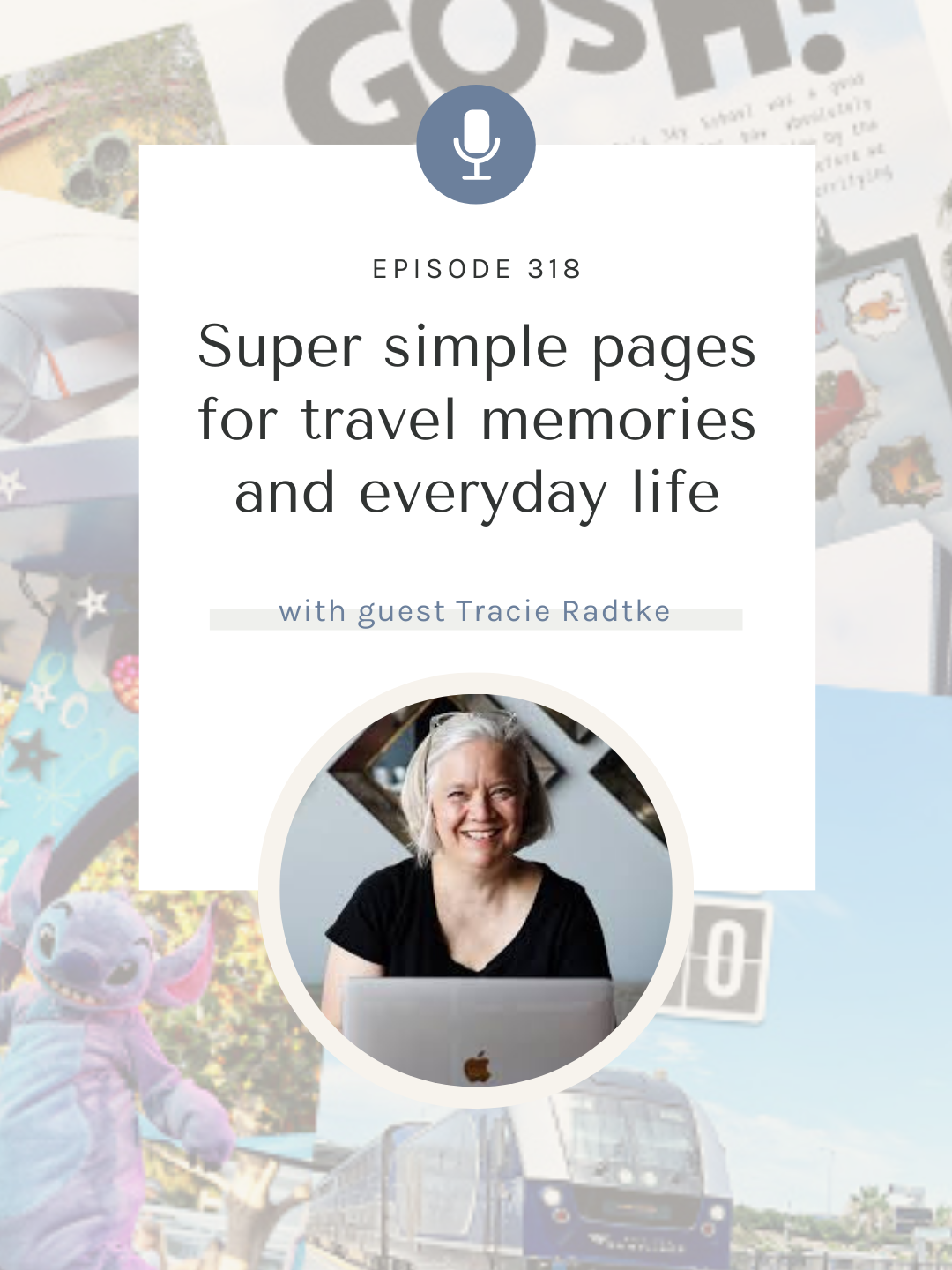
When you’re feeling the itch to make a change, try thinking small and subtle like Tracie Radtke. Tracie is a digital memory keeper who focuses on clean and simple pages that she prefers to have printed in books. She keeps her process interesting for each project by switching up style choices like shadows and grids. In this episode you’ll hear how Tracie’s process has evolved over time and why she’s settled on her current scrapbooking strategies.
Links Mentioned
- Tracie on Instagram: @whattracieismaking
- Tracie’s Patreon
- Project Mouse
- Canon R Mirrorless camera (*)
- Shutterfly
- Project Life
- Ali Edwards December Daily
- Blurb
- Photoshop
- Affinity
- InDesign
- Canva
*Affiliate links help to support the work we do, at no additional cost to you.
Tracie Radtke: [00:00:00] I've always been fairly clean and simple. And I didn't put a lot on my pages ever. But in the last few years I've really gone to very simple. Letting the photos, kind of be the star, and doing more journaling with that as well.
Jennifer Wilson: Welcome to Scrapbook Your Way, the show that explores the breadth of ways to be a memory keeper today. I'm your host, Jennifer Wilson, owner of Simple Scrapper and author of The New Rules of Scrapbooking. This is episode 318. In this episode, I'm chatting with Tracie Radtke about the role of simplicity in her digital scrapbooking process.
Our conversation focuses on the small shifts she makes so that her hobby never gets boring.
Hey Tracie, welcome to Scrapbook Your Way.
Tracie Radtke: Hi, I'm excited to be here today.
Jennifer Wilson: Yes. I'm looking forward to our conversation and hearing more about how you like to scrapbook. Can you start by [00:01:00] sharing a little bit about yourself?
Tracie Radtke: Yes, my name is Tracie Radtke and I live in Chicago. Um, I started scrapbooking when my kids were little. I actually started in a photography forum first, and that led me to scrapbooking. And um, now they're both grown. But I still have tons of old photos to scrap, plus a lot of travel now. And it's just me and my husband and our two dogs right now.
Jennifer Wilson: Nice. Very cool. Yeah, we were discussing before we, we jumped on that you live in a loft in Chicago and that was kind of always my like late teenage, early twenties dream. It sounds like it was yours as well. So, you know, maybe someday that'll happen for me too.
Tracie Radtke: It was, and it finally happened. We had our eye on this building and as soon as the right unit opened up, we jumped and downsized to a loft.
Jennifer Wilson: Very fun. Very fun. So, Tracie, do you have a favorite recent layout or project?
Tracie Radtke: I am excited to [00:02:00] start new projects because I'm always starting new projects. I traveled quite a bit in October, so I am starting my travel scrapbooks for Boston and New England. And I'm going back to an actual, looks more like an actual pocket page with the little like stitching around each square, so it looks more like a regular pocket page.
So I'm doing that for my Boston and New England book. So I think that's gonna be kind of fun. And I'm actually using and scanning in some of the papers and brochures and things that I brought back from the trip to add to it this time.
Jennifer Wilson: Very cool. Yeah, we're gonna really dive into a lot because you are a digital scrapbooker and so I can't wait to hear about how you make decisions and, and how you've kind of landed at this place for your hobby. But in the meantime, is there something new you're excited to do, use or try?
Tracie Radtke: Um, in scrapbooking I, so I'm [00:03:00] doing that, which is kind of go with the New England book. That's going back to something I've done before, which I'm excited to go back to. But my Disneyland album for Um, October, our October trip, we just went. I am trying to go completely graphic, completely flat, no dimension, just very magazine like, and I'm excited to try to see if I can pull that off.
So far I've made it through three pages like that, but sometimes ideas don't stick through the entire book, but.
Jennifer Wilson: Yeah.
Tracie Radtke: Hoping this one will.
Jennifer Wilson: Very fun. Anything, anything new in your personal life or um, that you wanna share about in terms of something new you're excited about?
Tracie Radtke: Um, what I'm excited about right now is finding the sense of community here in Chicago. Like there's a lot of stuff going on in Chicago right now, and just community has come together a lot. I've been going to, I crochet, so I've been going to a lot of stitch circles and just being [00:04:00] out with people and started a sewing class on Tuesday that I'm excited about. Just trying new things and getting out in the community and supporting small businesses.
Jennifer Wilson: I love it. I love it. Yeah. have not been able to get up there very often. I live, you know, depending on the traffic, you know, two and a half to three and a half hours away. So, but I can't wait to, uh, to find some time. Maybe not in the winter, but when it warms up again.
Tracie Radtke: Winter isn't as bad as it seems sometimes. I mean, we are close to the lake.
Jennifer Wilson: Yeah, no, I know. But yeah, especially, we don't end up getting that much snow on this side of the lake, so. So as we've discussed already, you're a digital scrapbooker and you really kind of consider yourself more on the minimalist side. Um, how would you describe your approach to someone who may not be familiar at all with that style of memory keeping?
Tracie Radtke: That's kind of hard. I've always been fairly clean and simple. And I didn't put a lot on my [00:05:00] pages ever. But in the last few years I've really gone to very simple. Letting the pictures, the photos, kind of be the star, and doing more journaling with that as well.
Part of it's speed too. I have a lot of back projects and I want to get through them. So keeping it simple helps me get books together more quickly. And then the other thing is, and this is gonna sound kinda strange, but kind of brought me to minimalism, is I do a lot, we go to Disney every year. My daughter and I.
And I have a lot of Disney books and my favorite products are Project Mouse and they aren't creating any new products. They haven't it for years. So I needed to find new ways to kind of use the same products over and over again.
Jennifer Wilson: Okay.
Tracie Radtke: Which is the beauty of digital is you can use things over and over again. And that kind of brought me [00:06:00] to using less of it. So that each page, each trip looked different. 'Cause I was pulling a different piece for my kit.
Jennifer Wilson: Uh, okay. Great point. Yeah. Have you always done digital or were you originally a paper scrapbooker.
Tracie Radtke: I have always been digital. Like I said, I started back, my kids were probably like, three and four and they're 24 and 25 now.
Jennifer Wilson: Okay.
Tracie Radtke: And I started in, I've always been interested in photography, so I started in the photography forum of Two Peas. When that used to exist.
Jennifer Wilson: Yeah.
Tracie Radtke: And from there it was like, oh, I'm going to turn this photo I took into a card to mail out at Christmas. And that's kind of dipped my toe into digital scrapbooking. 'Cause I was pulling in digital scrapbooking products. And then I just started scrapping digitally from there. I attempted to do a few projects with paper, but um, I'm messy [00:07:00] and I like that my mess is completely contained on my computer.
Jennifer Wilson: Yes, yes. So, uh, when we were talking before, you mentioned how this project that you're starting for your Boston trip is going to use like basically faux page protectors, like with the stitching. And I noticed you use a lot of grids, but sometimes you're using shadow, sometimes you don't. How do you decide kind of what overall like style still within this like very minimalist approach, how do you decide what's gonna work for that particular project?
Tracie Radtke: It to me sometimes it depends on how much other product I wanna use.
Jennifer Wilson: Okay.
Tracie Radtke: If I am like. We went to Utah and to Zion and to Bryce, and just had beautiful photographs of the scenery there. And I'm not gonna use a lot of product on that. There's not a lot out there for it. And I'm just gonna keep that simple.
Those are usually flat. [00:08:00] If I want to use more pocket cards and um, have that more traditional pocket page look, then I'll add my shadows and stuff. But part of it's just to keep it interesting because when it is so minimalist, there's just small changes to keep things interesting and new to me.
Jennifer Wilson: Yes. Yes. So yeah, that can be helped. I love this point of trying to make yeah, a, a small shift. So it's fresh and new and interesting again. Without saying, I'm gonna do something completely different and I have no idea how it's gonna work out. And it might fail miserably. Um, but instead we can keep it interesting with much smaller shifts.
Tracie Radtke: Right. That's what I like about it. It's like it's, it's not a big thing, but that's something that I have to decide and it's like, okay, well this one I'm doing a lot like right now, contrasting the Disneyland book with the New England book. Is the Boston New England book is [00:09:00] going to have shadows. Is going to, um, have more product and the Disney that I'm working on the same is very flat with no shadows, so it kind of keeps things interesting.
Jennifer Wilson: Yes, for sure. Now, it's definitely clear you love kind of grid compositions of all kinds. Why do you think that works well for you versus maybe more of like, you know, a tr like a, a layered style of page or, you know, some of the ones that are a little bit more, um. I don't know the, the ethereal ones that, that have a lot of, uh, masking and things like that.
Why is, why, why do grids work well for your brain?
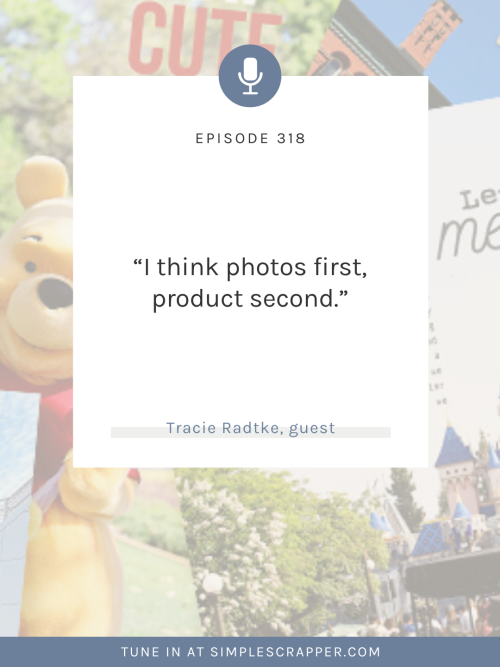
Tracie Radtke: I think for me it's because I started with photography. Like that's, that's honestly, I mean, I love capturing my stories and having that all documented. But I love playing with my camera. I always have, I love, you know, [00:10:00] taking little detail shots and really thinking about my composition and things like that. So I, I tend to think photos first, product second.
Jennifer Wilson: Now, what are you using to take photos? Most of the time these days?
Tracie Radtke: Most of the time, um, I'm using my, well, that's a hard question now that I think about it. Day to day it's my phone.
Jennifer Wilson: Uhhuh.
Tracie Radtke: But traveling and any events we go to, it's my, I have a mirrorless, I have a Cannon R Mirrorless camera. And I use it like if we go to Disney, we go anywhere, you know, on my trips. That's what I use most of the time.
Jennifer Wilson: That's what I was gonna ask you, whether or not you take it to Disney and how do you like handle it when the rides don't, you have to like, I would be very nervous to put my bag on the other side even though, you know, the staff were sitting there watching it.
Tracie Radtke: Well, okay, first of all, with Disney, [00:11:00] you always take your stuff with you.
Jennifer Wilson: Okay.
Tracie Radtke: So you never, you never leave your stuff. But that's another issue of how comfortable you are with getting it banged around some.
Jennifer Wilson: Okay.
Tracie Radtke: Um, my previous camera was a workhorse and it bounced off a lot of things and still kept on going. This one, um, I usually carry a bag that's big enough that I can throw it into the bag. And then put the bag in the pocket.
Jennifer Wilson: Yeah.
Tracie Radtke: Or like, we had a group of Digi scrappers that all got together and went to Disney World in January. And there was like a couple people that would sit out some of the rides, so I would just hand my camera off to them while I went in road rides with the rest of the group.
Jennifer Wilson: Fun. Yeah. Yeah. I would think that, and I haven't ever researched this, but a mirrorless would be more like able to handle the jostling than the DSLRs did.[00:12:00]
Tracie Radtke: Right, and it's lighter.
Jennifer Wilson: Yes.
Tracie Radtke: Although I got a fairly heavy lens.
Jennifer Wilson: Mm-hmm.
Tracie Radtke: But it overall is lighter than my other camera by far. I just, I love the quality of photos, so I have a hard time. I, um, got last year for Christmas or two years ago for Christmas. I asked for a point and shoot again just for fun
Jennifer Wilson: Yeah.
Tracie Radtke: And I took it on a Disney World trip with my daughter and I only used it for the trip.
And it was good, but I still missed having my, my big camera photos.
Jennifer Wilson: I understand like once, once you're into it, you're into it and you can appreciate the difference. For sure.
Tracie Radtke: Yes.
Jennifer Wilson: So you mentioned, you know, you like things contained onto your computer. Are you primarily using your computer to scrapbook or do you also scrapbook maybe on an iPad or something else?
Tracie Radtke: Totally on my computer. [00:13:00] I, um, I think I do that more just because I like to set a designated time to go do that. I go into my office, work on my computer, and then walk away and be present with what else is going on. So I don't tend to work on it anywhere besides at my desk on my computer.
Jennifer Wilson: Nice. I love that. 'Cause I, you know, sometimes you hear the opposite that folks do choose to use something that's more mobile so that they can also be present. But there's that point of is that really being present even though maybe you're physically are.
Tracie Radtke: Right, and that's just kind, I kind of like just going and being in my space doing that and then walking away. But I do have a tendency to walk past it and think I'm gonna sit down for just a second and then disappear for half an hour.
Jennifer Wilson: Um, so does everything that you create get printed into a book or do any pages get printed individually?
Tracie Radtke: For me, everything is printed into a book.
Jennifer Wilson: And so does that mean [00:14:00] everything's a project?
Tracie Radtke: Yes. Everything's a project, but I do have books that are called I, for lack of a better title for it. They're called, remember this books. So any miscellaneous pages that I, uh, make that don't really belong to a project, go into a folder for the, remember this books. And then as soon as I have around a hundred pages. And Shutterfly has a sale for three extra pages, I print everything in that remember this book.
Jennifer Wilson: Nice. Now, are your books all the same size or do you print different sizes and how do you decide what size it's gonna get?
Tracie Radtke: They are all different sizes. Um, which to somebody else that might, you know, seem chaotic. But again, I need a way to keep it interesting. Because if it's not interesting to me, I won't do it. So I started out [00:15:00] where like traditional 12 by 12. And I had like my Project Life and everything was 12 by 12. And then my December Daily were eight by eight. And then my travel albums were 10 by 10.
But now I've switched to, um, a more traditional book look. So I have my eight by 10 books. Almost everything I do is eight by 10. I just really like that size. It's good to handle, it's easy to look through. And then I do little travel journals in either five by eight or six by nine. And they look more like a little novel. I do those rather quickly right after a trip and I get all my notes written down. And that way I've got something printed right away. That has all of my information from the trip so I can kind of look through it. But it also serves as a guide as I can continue to work on the actual book.
Jennifer Wilson: [00:16:00] Oh, that's interesting. So you, okay, can you gimme an example of like that process in terms of a past trip that you've done, say both for.
Tracie Radtke: So I am really behind on Disney World trips. As you can tell, we go to Disney a lot. My daughter and I's thing that we do together. And Disneyland I'm caught up on. Disney World I'm overwhelmed and I don't know where to start. But when I come back from a trip, I will go through photo by photo. Thing we did down the road, you know, down the line of everything we did. And pick like one photo and then journal about it. One photo journal about it.
I will copy and paste the descriptions of the food we ate and put in there so that everything's captured before it goes away. It's no longer offered on the website anymore because they've changed menus or anything like that, just.
Jennifer Wilson: Sure.
Tracie Radtke: Get that all [00:17:00] down. And then I print it as a trade book through Blurb. And then I have my little book that I can look through while the years it's gonna take me to actually get the full book done.
But as I do the full book, all I have to do now is pull up my page, copy and paste my journaling, because my journaling was fresh at the time. So I remembered all the little things and all the little stories and the funny thing that happened. Before I forget all that. I have it in this book. And I've also used those little books.
Like I take a trip, like the New England trip was with my parents. And we take a trip every year. And I make a book with the photos and a few labels and stuff that I print a copy for them and for me. But I also go in and I make myself one of those little trip books that talks about my feelings about things.
And talks about how I viewed things [00:18:00] or all the little funny stories from the trip that are my, from my point of view. That I would feel weird, including in the book that I printed for both of us. But I have my own little personal book of stories.
Jennifer Wilson: Sure. So in, in the final book is the key difference that you're going to include a lot more photos.
Tracie Radtke: Right. Because in the, in the trade book, in the small book I do, there's just one photo per event.
Jennifer Wilson: So it's more like a reference.
Tracie Radtke: It's just a reference. It's just to remember that, okay, we rode this ride and then here's the funny story that happened. So that when it's time to go do the page, I can put that photo plus the photo of us on the ride and the details I took in line. And then also include that story before. That I recorded before I forgot the details of it.
Jennifer Wilson: Okay. Okay. And do you think that some of the, I [00:19:00] guess I'm, I don't know, uh, making assumptions here. Do you think the joy you get from doing the bigger book is connected to your love of photography and, and that whole process?
Tracie Radtke: Yes. Because that's when I get to use all my photos. So yeah, I still enjoy doing that bigger book because that's all my photos. That's all the little details in line or you know, around the parks or when we were traveling in New England. Just signs as we walked down the streets in Boston and just took all those little detail photos and that gets me excited for the big book because I get to use all those.
Jennifer Wilson: Yes, yes. So, so when it comes to Disney, how do you figure out what stories you're telling? Because someone who's going, you know, once for a, you know, the big trip of a lifetime time thing is gonna scrapbook that very differently than someone who goes every year.
Tracie Radtke: Yeah, and I've got that because like my daughter, how this all [00:20:00] started is we went for her dance nationals one year when she was in seventh grade. And then in eighth grade, her spring break didn't align with her brothers spring break, who was in high school. So we took a trip to Disneyland ' cause we had kind of got a taste of it the year before at Nationals. And we're like, this is going to be our once in a lifetime trip to Disneyland.
Jennifer Wilson: Yeah.
Tracie Radtke: We're going to do everything. We're gonna document all the things, we're gonna do everything. And that book is very different from every book I've done after. Because that book was like written as if we were never going to go again. So it's got everything. But now that we go as often as we do, because it's kind of just become our tradition to go once a year.
We just, we have different stories each time. There's, we do different things. We don't do everything anymore. But we do the things that are special to us. There was one time that all we did was focus on meeting characters. And so that book is [00:21:00] very character oriented. It's about the stories of our interactions with the characters.
So it's just, even though we go to the same place every year, we do it differently every year. So there are new stories to tell, and if it's just we rode the same ride, we always ride again, it's just photos.
Jennifer Wilson: Mm-hmm.
Tracie Radtke: I don't worry about telling a story about it. I just include the photos because you take slightly different photos every time you go too.
Jennifer Wilson: Do you take any kind of notes in the moment, or is it really that the Trade Book Project allows you to capture everything that you can immediately.
Tracie Radtke: I try, I've, I've tried really hard. I, I've read how different people do it. Um, this last trip to Disneyland, I did buy a Disneyland notebook, which was going to be my way to take notes. I try, I tried at least jot down memory joggers. I don't necessarily write down the whole entire story as if I'm [00:22:00] go how I'm gonna journal it in my book. But I at least write bullet points of like this funny thing happened, don't forget this. And or what we ate and things like that. I will jot down little reminders of to, especially if it's something that I might not have gotten a photo of.
Jennifer Wilson: Yes. Do you take photos to like that you're planning never to use, but they're just for the, the documentation memory portion of it.
Tracie Radtke: Yes, I do that a lot. There's ones that are just to remember what we did, and sometimes they make it into the album. Um, sometimes I need a filler, especially if I'm doing one that's more pocket oriented and there's a certain number of pockets that have to be filled. Um. Yeah, I will. They might make it in, but there's a lot of stuff that is taken menus, times like a thing that'll tell you when the event times are.
I take a lot of those just so I remember those kind of details. And then also [00:23:00] just every time we do something, I take, I snap like a picture. Sometimes it's with my phone, just so I can kind of remember the timeline of the day.
Jennifer Wilson: Yeah, that's awesome. And, and I get the, the, I always endeavor to take a lot of notes myself, and I've never been that good at it. So, I take photos of the little things. I, you know, we take, we've done audio clips and video clips of, you know, recounting a story.
Tracie Radtke: Oh, that's good.
Jennifer Wilson: Anything somehow is easier than writing something. But you know, Apple Notes also is, is helpful too, so.
Tracie Radtke: There's one trip that I decided that I was gonna have a Google Doc, and every night I was going to type it up, and that way it'd be great because it just copy and paste into my book. And I went to go work on the book and I opened it up and it was blank. So apparently I didn't actually follow through with it.
Jennifer Wilson: Yeah. So one thing you did follow through on is you recently completed your Christmas photo books for 23 and [00:24:00] 24, and had those printed. Tell us more about those and what worked well for you with those projects.
Tracie Radtke: Those, but okay, first of all, I know there's like December Daily and document year, December. I made it easy on myself years ago and just titled my project, the Stories of Christmas, and whatever year it is. That way I never felt like I failed. Because I didn't get daily or I didn't, you know, or something fell outside of December.
So. That works well for me. My books usually start, you know, our first Christmasy thing starts in November. Usually with putting up the tree, or there's like our neighborhood tree lighting this year, I think is the 23rd of November. So some of that stuff's gonna happen outside of that timeframe anyway, so those books are very pocket oriented. The 2023, I believe [00:25:00] is the one with the actual pocket dividers and things like that made it look more like an actual pocket page. And then last year was still pockets, but I allowed myself, sometimes it was a full nine by 12 set of pockets. And sometimes it was the equivalent of a six by eight pocket page condensed kind of smaller on my page. Just depending on how many photos I had and what the stories were I was going to tell.
Jennifer Wilson: Very cool. And will you be using, will you be doing another book for this year?
Tracie Radtke: Yes. And I've already started to think about it. And I haven't made a lot of decisions yet. Um, it is eight by 10 again. And it's gonna be pockets. I don't know whether I'm gonna limit myself. Because I only have, I make my own templates. So I can, I make whatever I need. [00:26:00] But I can't, I don't know how to make the grids.
So I was using a, I bought a set of grids that I was fitting my templates into. And that kind of limits how I do my photos, so I haven't decided yet whether I go with the grid again or just pockets of whatever I actually need.
Jennifer Wilson: Yeah, no, those are lots of decisions. What software are you using? It's something we, we kind of skipped over earlier.
Tracie Radtke: I use Photoshop.
Jennifer Wilson: Okay. So I've just been experimenting with the brand new Affinity, which it's now no longer gonna be Affinity Photo in different, in all the different ones. It's just Affinity with these different modules. And their layout module, which is, I guess, equivalent to InDesign, has this ability to have, like, I can customize a grid to, you know, uh, I did an eighth of an inch grid. And allows you to like, create those boundaries, uh, perfectly by snapping to the grid. And, [00:27:00] uh, so far it's, it's very seamless. And I, and I'm someone who's used InDesign for 20 years now. But in terms of scrapbooking, I can see myself using this a lot. So.
Tracie Radtke: That's cool. Haven't used that at all but that sounds neat.
Jennifer Wilson: Yeah, and it's free. Because Canva bought them, they are now basically trying to become an Adobe competitor by offering, the equivalence of Photoshop, Illustrator and InDesign for free. So, yeah, definitely something to work into. And I'm not by any means an expert on this, but um, yeah, if you do struggle with like creating your own grids, uh, it's, the setup for that was much easier than I'd ever found it to be in Photoshop. So.
Tracie Radtke: Okay. Now I have a set of actions that I bought years ago. That create all of my, that I can create my pockets with. That's just kind of my comfort zone is Photoshop. But I also, [00:28:00] because of the level of photo editing, I do. I'd be curious to see what theirs would be like.
Jennifer Wilson: And how do you organize your photos?
Tracie Radtke: My photos.
Jennifer Wilson: If you do, and it's okay, but there's no, there's no judgment either way.
Tracie Radtke: No, I do, and I've been doing it this way for years, but it's, it's just, I have a folder for the year and within the year I have a folder for each month. Like, you know, 0125 mirrorless, and that's my main camera. And then I have like an 0125 January iPhone, which has all my iPhone photos in it. And then, um, trips go within the month that we took 'em.
Jennifer Wilson: Okay. Okay. Yeah. Very cool. I, I have been so intrigued by your process here. I noticed you also have a Patreon. So what has, what has included with that?
Tracie Radtke: On my Patreon we have, first of all we have a community. We have chats and [00:29:00] Um, kind of a little gallery or places where you can share your pages and things. But I share my templates that I use. I share my process. I have a whole series on printing with Blurb. Because that's who I print through most of the time. Like how to know what your margins are gonna be. What it looks like on your page versus in their software versus how it prints.
There's a whole series on that.
Jennifer Wilson: Yeah.
Tracie Radtke: Photoshop, little tips and tricks. Trying to think what else. Just my pages, what my products are. I do, when I get a new book. I usually share a flip through on Instagram. But on my Patreon I'll do a full walkthrough and talk about what products I used, any techniques I used, and that kind of thing.
Jennifer Wilson: Very cool. Yeah. I love the, the community aspect and you can, bring together folks that [00:30:00] like to create in the, in the way that you do and, and share more with them.
Tracie Radtke: And that that's the group that we got together at Disney World last year.
Jennifer Wilson: Nice. Nice. That's so fun. So what do you, uh, just before we start to wrap up here, you had to make a choice, Disneyland versus Disney World?
Tracie Radtke: Disneyland, it's the original.
Jennifer Wilson: Yeah.
Tracie Radtke: It's also smaller, which makes it more manageable. Like we can go and spend a couple of days and feel like we did everything and go home versus World is a commitment. There's a lot to see and do there. So I kind of like that. And then I just, I just like that it's the original and I like the weather in California.
Jennifer Wilson: Yeah, yeah. No, I'm the same. And I will like, I'll, when I go to Florida and I've been to California far more times. Um, but be like, this isn't the wrong place. Like I'm, you know, I'm turning here and this is not supposed to be this way.
Tracie Radtke: Exactly, or you know, you walk past, It's A Small World because it doesn't have the big [00:31:00] facade that it does in.
Jennifer Wilson: Yes.
Tracie Radtke: You're just kind of like, oh, wait a minute. There it was.
Jennifer Wilson: Yeah. Yeah. So Tracie, this has been so fun. Can you share where our listeners can find you online? Anything you have coming up in the next few months?
Tracie Radtke: You can find me on Instagram at whattracieismaking, and it's Tracie with an ie. And then on my Patreon, this is bad, I don't know what my Patreon is.
Jennifer Wilson: We can include the link in the show notes, it's fine.
Tracie Radtke: On my Patreon, I am going to continue to share. I just started a kind of a series of sharing the templates of my past document your December, December Daily.
This, uh, stories of Christmas books. I started releasing those to my members. I am going to start soon with, um, my December Daily pages and releasing those on Instagram because I'm excited about that. [00:32:00] That's my favorite scrapping time of the year. I think it's probably my favorite. Because I can forget all the other projects I have going and just focus on all the fun Christmas stuff.
It's a good excuse to kind of forget about the pile of projects that are kind of piling up. I do need to be making some Christmas gifts of some trip albums, one for my son and one for my parents of trips, so I've got those to be working on too.
Jennifer Wilson: Fun. Fun. I've enjoyed following you and look forward to continuing to do so, and hopefully I'll be able to get up to your neck of the woods to do something fun sometime.
Tracie Radtke: Yeah, if you do, lemme know. Definitely.
Jennifer Wilson: Oh, I will for sure. Well, Tracie, thank you so much for spending time with me.
Tracie Radtke: Well, thanks for having me. It was great.
Jennifer Wilson: And for all of our listeners, please remember that you have permission to Scrapbook Your Way.
Sign up to receive email updates
Enter your name and email address below and I'll send you periodic updates about the podcast.
How to Subscribe
The best way to listen to Scrapbook Your Way is with a podcast player on your mobile device or with iTunes on your computer. You can subscribe via Apple Podcasts, Google Podcasts, or by searching for “Scrapbook Your Way” in your favorite podcast app.
0 Comments