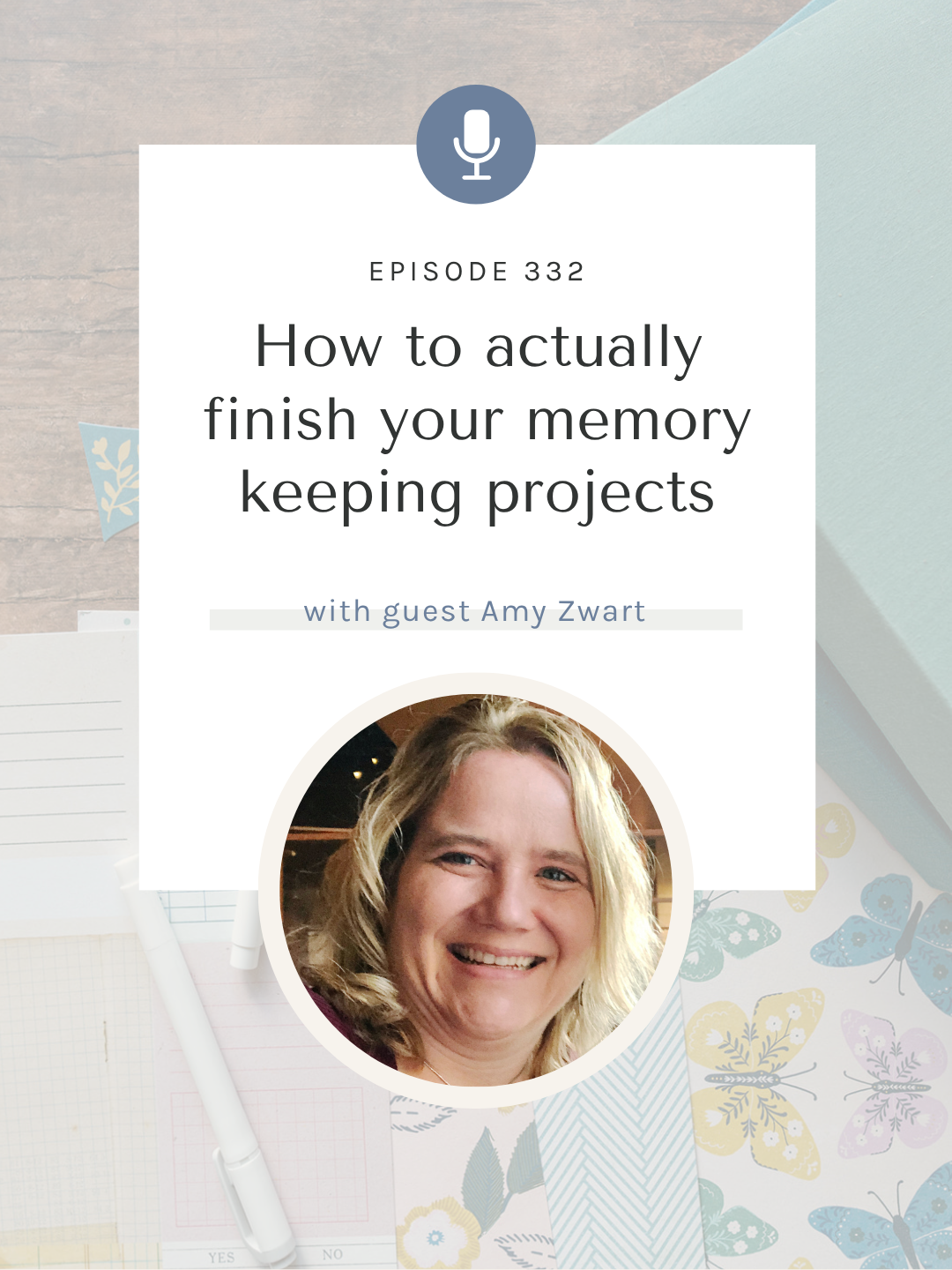
Amy Zwart is Simple Scrapper’s community manager and the person I call the keeper of the testimonials. She’s the one who catches the moments when members finally finish the thing they’ve been circling for months. She brings a unique insider view to a conversation about what finishing actually looks like and what makes it possible.
- Amy shares a round-up of recent member wins across a range of projects, from photo books and cruise albums to a handmade Alice in Wonderland album with popups, and what each one reveals about what it takes to cross the finish line.
- We cover how Finishing Day works and why the Plan, Prep, and Pep session the week before matters just as much as the day itself, including how knowing what to expect removes the element of surprise and lets you start with a real plan.
- Amy and I dig into the role of permission to pivot in getting unstuck, and Amy shares the story of her long-delayed ornament album, which finally came together after she gave herself permission to completely change course.
- We also explore how small consistent habits, like ordering photos on a regular basis or showing up for 30 minutes of a crop, add up over time and make big projects feel far more manageable.
Links Mentioned
- LOAD
- Ali Edwards One Little Word
- Project Life
- Ali Edwards December Daily
- Jill Allison Bryan
- Ali Edwards Week in the Life
- Hoka (*)
*Affiliate links help to support the work we do, at no additional cost to you.
Amy Zwart: [00:00:00] going back to granting that permission, I think it's true because, as women we can get caught up in, well, I already spent this much time on it, or I already spent this much money on said supplies or things. And so what would that mean if I, charted a new course and, did it a different way. Sometimes just that permission to get over ourselves and think is part of it too.
Jennifer Wilson: Welcome to Scrapbook Your Way, the show that explores the breadth of ways to be a memory keeper today. I'm your host, Jennifer Wilson, owner of Simple Scrapper and author of the New Rules of Scrapbooking. This is episode 332. In this episode, I'm chatting with Amy Zwart, Simple Scrapper's community manager, about what it actually takes to finish a scrapbooking project.
Amy has a front row seat to every member win that happens inside the community, and we talk about the habits, tools, and permissions that help scrapbookers close the loop on their [00:01:00] projects.
Hey Amy. Welcome back to Scrapbook Your Way.
Amy Zwart: Hi Jennifer. Great to talk to you today.
Jennifer Wilson: For those who haven't heard you before on the podcast, can you share a little bit about yourself?
Amy Zwart: Yes, I'm a Midwest girl. I'm in Minnesota, just south of the Twin Cities. Um, I live with my husband and two kids and our dog. Um, my oldest is my son who's now 18 and graduating soon. He has one quarter of high school left I realized. And my daughter is uh, right, right. And my daughter is a seventh grader and she'll be a teenager this summer. So we got, we have both of those events on the horizon here.
Jennifer Wilson: Yes. Big milestone year.
Amy Zwart: Right?
Jennifer Wilson: I'm curious, are you doing anything specific for your son in terms of memory keeping and this special graduation time?
Amy Zwart: Yes. So, um, well, one thing kind of on the side is I am trying to pull photos for some posters and, you know, things for [00:02:00] the graduation party. So people have been hearing me talk about that for a year. 'Cause I've tried not to procrastinate it, but there's still some things that'll be coming down to the wire, I'm sure.
But yeah, so that's been fun looking through past photos and, you know, pulling things and school photos and all of that. Um, and then I have been working on his regular school album that's a 12 by 12. Um, my daughter's is a little bit more neglected in the last couple months as I try to catch that up as far as I can.
I know it won't be done because he does have events coming up, you know, like there's big things that happen in May even. So finishing it by June is not likely. Right. Oh. Um, and then I did also start an album that I'm trying to decide, I think it's maybe more for me than him.
Jennifer Wilson: Mm-hmm.
Amy Zwart: It's a, it's a six by eight album that I call letters to my senior. And I've just given myself permission to write a letter and [00:03:00] include it in that six by eight album with, you know, it's kind of some fun papers and real easy kit of embellishments.
Um, and then sometimes some photos too. So, for example, I wrote a letter about, you know, we went to Disney World and how we've been there a few times in the past, and I pulled some photos from when he was really little and how it was giving me how the mom feels that now I'm bringing him at, you know, this stage in age.
So it's been fun. I, like I said, I'm not sure how much he's gonna love it or want to read it. But, um, I, I called this project kind of a bookend project because when I was pregnant with each of my kids, I also wrote what I called like a dear tiny baby. When I was pregnant. And had a, you know, a book of letters. And just kind of things that were going on at the time.
And a lot of it just things that I was thinking and feeling. So I'm not a big journaler, so this is maybe my, my most feelings kind of projects that I've [00:04:00] done, so.
Jennifer Wilson: I'm sure it's a, a helpful companion for this time and, uh, you know, he'll appreciate it someday, I'm sure.
Amy Zwart: Right, right. That's what I like to think too.
Jennifer Wilson: Now, is this your favorite recent layout or project, or do you have something else that you wanna share?
Amy Zwart: Um, those are definitely what I've been working on. Um, that feel serious I would say. Or feel, you know, when you talk about some of the legacy ideas behind scrapbooking. Um, I did kind of pause and take a break from that and worked on an ornament album. And that has been actually more rewarding than I expected.
I thought it was an easy plug in the pockets, kind of, you know, put some things in order kind of thing. And it was that. It, in some ways it's an inventory project, right? And so not a lot of, you know, extra doodads or things. Um, but I really enjoyed the memories that it brought up, of, you know, these are the trips [00:05:00] we've taken. Or we have a tradition with my family about making homemade ornaments each year. And seeing those and how many we really have, you know, was surprising and kind of fun to have it all in one place.
So that album is very close to done. And I did one for us. And then I have like the kids specific album or specific ornaments in an album of their own as well. Um, so there's a few kind of sections. I'm still trying to wrap up and get the journaling cards done on. But I, I paused that again to go back to the senior, senior project.
So.
Jennifer Wilson: Those are very cool. I, yeah. I love hearing stories over the years. Like it always comes up again and again on the podcast of folks who've started that type of album and how rewarding it is and, and memorable. I, I'm curious if like, the specificity of it has helped you tap into those, those feelings that sometimes are hard to come by when it comes to your journaling.
Amy Zwart: Yes and no. I would say like there's some things that [00:06:00] are, they still feel very factual, you know, to record. You know, we got this on this trip, but I also added a few things that were like holiday decor kind of items. Um, this is where I like to expand my projects, right? Like, 'cause ornaments wasn't enough.
So, no, I laugh, but I am glad that I expanded it a little bit. So I have things like, you know, we have a, a Cookies for Santa plate that we've used, you know, since they were really little. And just, you know, I have a photo of that and just a quick note of, you know, it's been something that's been part of our Christmas since the beginning.
Um, so I, I, I do think there are some feelings that are coming out. It's not just factual, um, or, you know, I have an ornament in memory of my dad, or, you know, things like that, that some of 'em are definitely more sentimental.
Jennifer Wilson: So fun. Yeah, no, now I wanna do that, but not allowed to start any projects at least until all [00:07:00] the rest are finished. So, before we get to that topic of finishing, is there something new you're excited to do, use or try either in scrapbooking or your everyday life?
Amy Zwart: My items today are not scrapbooking related, and you may laugh, but I have some new shoes that I'm really happy if I'm a got.
Jennifer Wilson: Oh, tell us about 'em. New shoes are hard.
Amy Zwart: Well, my first question is, would you call them tennis shoes, sneakers, or trainers?
Jennifer Wilson: Oh, uh, probably tennis shoes more often. Sometimes sneakers never trainers.
Amy Zwart: Okay. Okay. So I don't know if that's a Midwest thing or not, but yes, I grew up wearing tennis shoes, and that's what we call them. Um, I know that's not always the case, but yeah, I had some that clearly, like I wore out and I didn't realize I wore them out. And it was kind of a commotion, um, which made me then go through all of my [00:08:00] shoes.
And so, yeah, I got some Hokas based on what everyone said online, and you know, what everyone's wearing. And I, I also got some Nikes. So yes, get out, hopefully the weather will help me wear them more, get out walking and any kind of things were up too.
Jennifer Wilson: I love my Hokas, they're amazing. So.
Amy Zwart: Well, yeah, as soon as you talk to people, that's, you know, that's where it's at. So I'm like, all right, I trust you.
Jennifer Wilson: Yes. Yes. And then you, you're gonna mention something else.
Amy Zwart: And then next month I get a new washer and dryer. So again, super exciting.
Jennifer Wilson: Um, front loading. Top loading, know, what's your preference?
Amy Zwart: Uh, we're a front loading family 'cause we have like a shelf that goes above it. Um, and I have to say, it's really just, this is a replacement product, right? But you don't know what you got till it's gone and we're having some issues. So we're trying to stay on track here.
Jennifer Wilson: I saw this gadget on YouTube recently where it's [00:09:00] kind of like, like if you un undid a hanger, but it was made of like rubber slash silicone and it was flexible. It's just basically this thing that helps you keep the door open but not totally swung open. So it can be open just enough to, to keep it dry on the inside. But not all the way and kind of in the way of things. Um, I'm, I'm sure I don't even know what it's called, but it seemed really handy.
Amy Zwart: Right.
Jennifer Wilson: I, I, I have a top loading for that particular reason, but we don't have a shelf above it, so.
Amy Zwart: Yes. Yes. Um, yeah, we've had different homemade gadgets like that in the past too. So we'll see what happens with the new one or what it needs. I've heard some of 'em have something kind of built in and I don't know that I checked that specifically on ours. So.
Jennifer Wilson: Yeah, I would think that would be something they would start doing. So.
Amy Zwart: My first question when we were checking was I had to make sure the doors opened the right way. 'Cause I remember in the past having, you know, the dryer door had to be [00:10:00] flip flopped or something, so I was.
Jennifer Wilson: Oh.
Amy Zwart: Trying to figure that out.
Jennifer Wilson: Gotta make sure. I bet there's some that you can change and some maybe that you can't flip. So.
Amy Zwart: Right, I had to be sure.
Jennifer Wilson: Yeah, we had to get a new dryer recently that was not the most fun, but we're It's fine now.
Amy Zwart: Right.
Jennifer Wilson: It caused, yeah, we. Uh, how do I say this? Like it was between the dryer and the vent situation basically created a compounded issue where the vent ended up killing the dryer. And yeah, it's all very sad, but it should be good now. Now we know if things don't, don't dry very quickly, go clean the vet right away. Before it gets backed up. Um, yeah. Anyway, yes, those fun things that we just love to do, right?
Amy Zwart: So, so fun.
Jennifer Wilson: Yes. So I wanted to chat a little bit about finishing today. Um, in part because we have finishing day coming up this weekend. And there there'll be more of those later this [00:11:00] year if you're not listening to this episode when it comes out. But I wanted to talk to you both as our community manager and, and what I like to call our keeper of the testimonials.
The person who keeps track of all the nice things that members say. Um, because I, you are the most in there and the most connected to what's happening day to day. And you happen to catch all these wonderful things, whether it's on a Zoom or somewhere in a chat. And sometimes I'm just totally floored by, the words that are shared.
Amy Zwart: Yes, we've had a lot of people working on things and you know, making progress, but a lot of finishing has been happening. And it's amazing to see. It really is very fun, especially if people have reported, you know, kind of along the way that, you know, okay, they're making progress, they're making progress, and then when they hit that final, this is done.
You know, it's such a celebration. The whole community comes around for it.
Jennifer Wilson: Well, and really that, that reporting along [00:12:00] the way, that's, I think that's one of the tricks towards getting something done. Is if I say that I'm doing this and here it is. Somebody might check up on me. It's like, Hey, where, where are you at on that thing? Um, and so, and this, the more you do report, I think that increases your chances of finishing in the end.
Amy Zwart: Right, because, and for myself too, I'm almost using that as that's my checklist. Like, I look back at where was I at last week when I, you know, when I gave an update or things too. So sometimes it's a reality check with yourself of like, oh, I did get a lot done. I actually saw someone posted that this week.
I, I didn't think I had done much, but you know, when I looked back, now here are the things that really did happen. So it is great. So I do have some examples of some member wins that I've seen lately.
Jennifer Wilson: Yes, yes, there's been some like big and small. The one that like really stands out to me as a member who'd been like carrying around a box of [00:13:00] photos for 30 years and not doing anything with it. And then she finally was able to empty it and sort it and get them where they needed to go. And I'm like, yes.
Like, let's, let's do this.
Amy Zwart: Right, right. Yeah. 'Cause you know, the, the box of things becomes intimidating, right? Because you don't know, well, what, what is that really gonna be? Or if you don't have the plan, so it's a box of photos, but where are they going to go? Or what kind of sorting needs to happen. Or, you know, figuring out that plan is the first part of being able to get something like that done and accomplished.
Jennifer Wilson: Well sometimes like the longer you leave something, it's a box or it's something silly, like measuring something, like something that just isn't particularly fun maybe has some steps, you have to figure out how to do it. We put those things off and they become more and more intimidating and in the end they're never that bad.
Amy Zwart: Exactly. Exactly. Yeah. Very true. Or how you word it on your to-do list even is what I noticed. You know, [00:14:00] like sometimes it really should be just open the box. Like see what's in there, know what you're dealing with. Not take care of the box. Just first open the box.
Jennifer Wilson: Yeah, I mean, that's a skill in itself of like being able to give yourself checklist items that are things you can do. Um, and that's taken practice for me over the years. But once you really get going, I, I definitely feel like it's easier to feel like I did something today. I maybe didn't do the whole thing, but I at least took some steps forward.
Amy Zwart: Right, right.
Jennifer Wilson: So what are some of those wins that you had noted?
Amy Zwart: Yes. Yes. So Natalie, uh, had a very successful month for LOAD. And she got a larger sized photo book done for a trip, um, in the past. So that's a, that's a very large project. That's, that's a huge win in, I don't wanna say in a small amount of time. 'Cause I think she had started it before that month, but also a month is still, you know, it's a [00:15:00] reasonable amount of time.
Jennifer Wilson: Well and the consistency of working on it every day too, right?
Amy Zwart: Right, right. That's the. That's the, I don't know, the spectacular part of that for me, as someone that doesn't do things on a daily basis like that, is like, wow, that's, that's amazing for me to see. So I loved hearing about that. And you know, she, again, because it was a daily project, was posting daily with updates and, you know, where she was at.
And, and the community rallied around that to help her, you know, continue on and to help with, you know, some proofreading and, you know, encouragement. So it's a great example.
But I also have, Bre worked on some vision boards for One Little Word. And this one sticks out because I think, you know, there was some conversation she had to have around it about how to make it work and how to make it fit in her actual project.
And, you know, if you're buying magazines and cutting things out, sometimes you wanna cut out all the things. And so she had kind of some size [00:16:00] concerns, I would say are, you know, trying to figure out with problem solving that other people helped, you know, why don't, why not make more than one? Why not take pictures and add 'em into your project so that you can make 'em whatever size you want?
And then the photo can be printed at what fits in the project.
Jennifer Wilson: Oh yeah. I love that. Sometimes like we're thinking that this is, is a certain process or this looks a certain way. But then maybe there's like five other ways you could be accomplishing the same thing. That might be more fun, more easy.
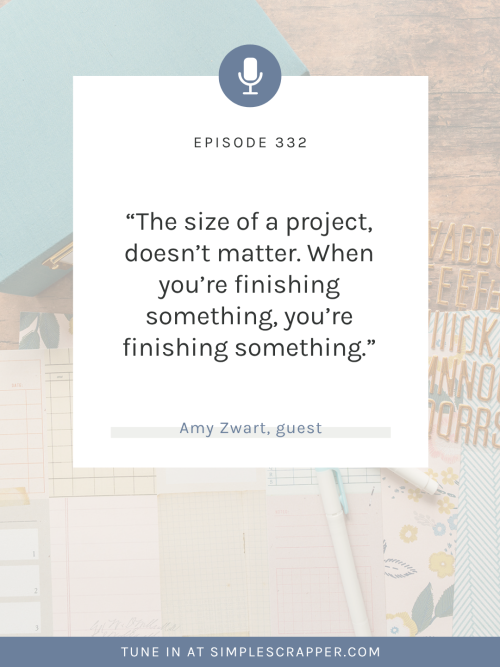
Amy Zwart: Right. and I, I just wanna point out that the size of a project, like, it doesn't matter. Like, when you're finishing something, you're finishing something. And, you know,
Jennifer Wilson: Yes.
Amy Zwart: Sometimes, you know, my Project Life album, you know, or month is different than someone else's anyway. So, you know, they're never apples to apples, but,
a couple other fun ones were Lorian you know, again, working on, uh, a Project Life month at a time, [00:17:00] so for February. And that's a big win because she had been away from it for a little while too. So coming back in and taking it head on, it was a good thing.
Jennifer Wilson: Well and she works primarily in traveler's notebooks.
Amy Zwart: I think so, but maybe not for Project Life.
Jennifer Wilson: Maybe she wasn't when she was reporting on this. Yeah.
Amy Zwart: I think for Project Life she has, you know, more of like a nine by 12. I'm not sure. If I know that for sure. Um, but travelers notebooks for sure, for other projects. So you're right. So that's interesting too to, you know, have the, the mix between the two sizes and getting back into something can be tricky because of that.
Jennifer Wilson: Uh, certainly. And there was one more I, sorry, I interrupted you.
Amy Zwart: No, that's all right. Um, Judy, uh, finished a layout about her dad. And I saw in the comments, you know, she thanked some people for encouraging her and helping her get it done. So in some ways that might've been from attending, you know, a crop and just being there together. [00:18:00] And in some ways that might've been, you know, asking for specific help about how to make it happen or how to make it work.
Um, that story was specifically from a Story kit idea. So, you know, sometimes those ideas can be in your head for a while when you've had the kit. And sometimes they're new and you haven't figured out how to put 'em together yet.
Jennifer Wilson: Yeah, sometimes you need like troubleshooting with maybe not having the, the, the right images that you would love to have. Um, or part of the story is difficult and how do you want to include that. Um, in terms of sharing that with others, uh, getting what you need from it. I mean, there's many different approaches and so it's often helpful to, to kind of get, bounce that off others.
Amy Zwart: Right, right. Yeah. And hers was a sentimental layout, so I'm sure, you know, getting those feelings down is part of that process as well. Courtney and Christine both had [00:19:00] album wins. So Courtney finished a cruise album and Christine did what she called an Alice in Wonderland album for her daughter, which sounds fun.
Um, I haven't seen any pictures yet. She said she would maybe try to have her daughter take some. But, um, that one sounds like a fun project and again, had some popups and different things that, you know, when you're doing extra, extra, extra, um, things. Sometimes it can slow you down and have you figure out how it works, like the mechanics and the logistics of it.
Jennifer Wilson: Well and because we have, you know, paper, digital, hybrid people who've done either in the past as well. There's always like something to learn, um, from others. Maybe you're trying a new technique or, yeah. There's just, there's just there's just like shared wisdom from having a of diversity of experience that we have.
Amy Zwart: Right. And I think, you know, sometimes, you know, there's a card maker in the group and they're like, well, this is how the popup works on this [00:20:00] card or on this thing, you know?
Right. So the, like you said, the diversity of experiences across is really helpful.
Jennifer Wilson: Now, I think sometimes the, it's not just about the big wins, it's about the day-to-day showing up, the consistency of creating and finishing of closing loops. That really stands out to me as well. What do you think that we do that most helps members be finishers?
Amy Zwart: We offer accountability. But we also offer planning. So I think a big thing for me is having member meetings where we're talking about our plan for the next journey, you know, the next two months. But then we're checking back in too. So a month can go by really slowly or really quickly. It depends where you're at with, you know, what else is going on.
And having that check in again I think has been really helpful to people.
Jennifer Wilson: And like [00:21:00] how, how do you see accountability coming through? I mean, not every type of personality needs accountability. Some just enjoy the comradery. But I do think there is I think there is maybe a personality type that does need others around, whether it's to say what they're gonna do, they need the bodily, the body doubling aspect of, of being on camera with someone. Um, they, yeah, they, they need something to keep them showing up. Maybe it's the date on the calendar to, to attend a crop.
Amy Zwart: Yeah, I think that's true too. That the crops provide, you know, that, that consistent date and time. But then there's also member meetings that might be that date in the future. Like, this is when I'm going to schedule this next project or this next step of this project. Um, and then along with that, I would also say just having the community there to help get you unstuck.
And so [00:22:00] sometimes that is very specific to how do I fix this thing that I can't move forward? And sometimes it's just more of a, I've been away from scrapbooking for a while, how do I reengage. Or, I left this layout, you know, in a box for, you know, six months and I'm coming back to it and now I don't like this part, or I wanna change this part, or this new piece to the story needs to be added, you know?
And so they ask other members how, how would you do this? Or what are your ideas to help me move forward? And I think that support is, I don't wanna call it underrated here because I think everyone does appreciate it. But I don't think we realize how that support really does get us to finishing. And taking that next step and completing something.
Jennifer Wilson: Yes, it certainly does. One thing that's standing out to me, I'm trying to figure out how, how to, how to say this and, um, ask the question. So what [00:23:00] are some of those maybe things that you think end up needing to be troubleshooted when it comes to, to finishing? Like what are, what are those stuck points?
Amy Zwart: I think my first reaction is the, I'm stuck because I haven't been working on it for a while. So, you know, kind of revisiting the what was I trying to do here and what's changed since my last idea. So, um, you know, taking my ornament album as an example, it was gonna be three by four cards of ornaments and three by four cards of journaling about said ornament.
And I was like, well, I don't want just all ornaments all through the book. I wanna, they're kind of in categories in my mind. And so I wanna put some section dividers in and what does that look like. You know, so I put in a four by six card, but now I [00:24:00] have a a pocket page. So now I have three other four by six pockets to put that page in.
So now what do I do with those pockets? Um, I ended up adding photos that went with that section. So for example, our vacation, vacation ornaments now have, you know, a little section title that says vacation or travel. And then I have just a couple of pictures of us on said vacations, you know, so three pictures from, you know, what's more than 25 years.
So it's a way to not capture every vacation in a, in a photo of the family kind of way. 'Cause the goal is the ornaments. But it also shows like this is how long ago some of this has been from. Where, this is where we found some of these little mementos that, you know, hold the memories. Um, so I [00:25:00] think talking something like that through can be helpful to say, you know, what would, what would you put here?
Or is this a place just to have like decorative, open space in my album. Because there's not a lot of that. Every page is full. Right. And so that's the example I can think of in my own recent album. And thinking of other people asking that, you know, in a, in a different way, like, what would you put here? Or how would you document, you know, that I have three years of this, but I really only want it to be on one layout.
You know, how would you combine that? Or what, what do you wanna see across the years versus what's unique from each year? And you know, I see this like, Tiffany does a very awesome creative December Daily. And she'll, she'll say, well, I have, you know, this, this day is showing the crafts that my kids made. But I kind of wanna get all the kids on there, you [00:26:00] know, like they, each daughter is doing a different craft and doing different things.
So how would you fit that on? So it's a six by eight album, and that's where she ends up with fun ideas of little tags that come out or something flips over, you know, to show the backside is the project. You know, picture with the daughter or things like that. So it's fun to see, you know, what, what their ideas start as.
And then, you know, as they get input or talk things through, you know, how it, how it ends up in the end, how it turns out.
Jennifer Wilson: And even with your example that adding those photos of your family adds some really like meaningful context to the album. Of which otherwise could be, yes, the journaling is meaningful, but the images themselves maybe are not as like, as exciting. At one point. It's kind of like a catalog. It's really cool.
Trust. I'm not, I'm not trying to like underscore it but uh, or undersell it. But when you add personal photos [00:27:00] along with it, I think that just makes it even more of a richer story.
Amy Zwart: Right, exactly. That, you know, and I, I take no offense. Because I was calling it my inventory album for a while, right. Because I was like, it's all about, you know, organizing the dates and trying to see, you know, when did we get this one. Um, so I do think that that's a great example of like kind of lifting it up a notch. And you know, when other people reach out to ask questions like that. You know, and sometimes, sometimes the right answer is the easiest, smallest option. Or like, don't worry about that, that doesn't have to go in this album. And so members have a lot of, you know, variety of answers and opinions too. And so you, you can take all of those and then go, okay, what's right for me? Or what feels best right now?
Jennifer Wilson: Yeah, so with our Before Your Story Class, I'm always recommending from the very beginning you need a piece of paper. You can put it on the back of your original worksheet and, but you have to [00:28:00] have a place to write down all the ideas that you're going to have while working on this project. You cannot put them all in the album.
It won't fit. Or you'll never finish. But I, you're gonna have all these ideas and so I keep reminding 'em 'cause it comes up again and again. Well, you know, I wanna add these five additional layouts. If you wanna add those later, great. But in order to finish the project, you need to put that aside for now and just keep a note. Um, because yeah, just like kind of having, those rails is something that, that I like to provide. Just because I know that I need them. Otherwise I won't, I won't get things done. So I'm always trying to like structure things like that from the very beginning.
Amy Zwart: Yeah, and asking someone else, you know, what would your rails be? Is a great example of this. Like, you know what, this is my goal for this project or this layout, you know? How would you keep it in check?
Jennifer Wilson: Yeah. Yeah. And I think you, you mentioned also like the, the having stepped away from it, like [00:29:00] reconnecting with your why. So like, you might say your goal and it, it's a, you know, a, a creative description. But really why, like, why do you care about this? Then like, what is also, what is enough? Like what is enough photos, you know, how much does this need to, to capture in order to be both meaningful and, you know, creatively enjoyable to put it together? And I think when you think about it a little more critically, you might not end up with the same project that you originally envisioned.
Amy Zwart: Right. Right. And that's, that's also the joy of the membership. You know, the community is helping you pivot when that's the appropriate move. Right. And.
Jennifer Wilson: Yeah,
Amy Zwart: Yeah, taking that advice and knowing when, when it applies and when you're like, no, that I'm gonna push back on that. This really is what I want this time. So.
Jennifer Wilson: In the Finishing project classroom, I, I talk about these as like [00:30:00] course corrections. Um, but I really think we just need to use that, that friend GIF of Ross with like the pivot, screaming, pivot. And like, that should just be the, the theme of the Finishing project.
Amy Zwart: That's great.
Jennifer Wilson: Well, well, I, I'll touch more on that in a little bit. But I did have one other question about kind of how things all fit together with the way that we, we support scrapbookers with finishing. And, and you already mentioned the journey planning process, but I know this particularly helps me with this problem of, okay, I want to finish all of these things. And my list, you know, might not even be like, here's the top of mind list and then, oh, here's the other list that I have down.
Let's refer to those as well. So my list keeps getting longer. But I know I can't finish those. I have to make choices. So how do you think the planning process really like, helps, uh, members be more realistic about what they can actually [00:31:00] do?
Amy Zwart: Here you're talking to someone who usually sets a pretty unrealistic plan as my journey plan. So I feel a little bit, um, I won't say called out. But I'll say I'm, I'm maybe not the best one personally to discuss this. But overall I do think it's the idea around how much time do you really have, what else is going on?
And you know, you're helping call that out as we work through that workbook. And you're saying, you know, and, and even if that's specifically about Finishing day, you know, how many hours do you really have? What, what's your dedication level? You know, what's your energy and effort, you're willing to do this Saturday or whatever.
Um, and I think those are good questions to answer, right? Like, we can push back on our own selves with that and say, you know, if, if we [00:32:00] have dinner plans at seven, that doesn't really mean I get to scrapbook right up until seven. I have to stop and clean up a little bit and get ready for dinner and, you know, all the things, or we have to drive there, or whatever.
So, like, just really making us think about that. Is, I think where, you know, you really provide some success in, you know, the planning ahead. Um, the other thing that you talk about a lot is, you know, make your list and cut it in half. And, you know, be happy with getting half of that done. Um, or let's see, I'm probably not gonna have the right words, how you word it.
Again, in the workbook, having, you know, your, your first goal, but then what's your, what's your above and beyond goal? So I know you have a better word for it than I don't have it on the tip of my tongue right now.
Jennifer Wilson: So, uh, my, my friend Jill Allison Bryan, who's also been on the podcast, she uses these [00:33:00] terms certain, possible and audacious. And she encourages her clients to, to think about their objectives from, from that perspective. So that you're always thinking about what's possible, but then you're also trying to stay grounded at the same time.
Amy Zwart: Right, right. So that's, that's exactly it. Having an audacious goal, you know, I then I feel better that I can still write it down, even though I might not be getting to it. Right.
Jennifer Wilson: It's helpful to know where you're headed. Like even if that.
Amy Zwart: Yes.
Jennifer Wilson: Audacious is gonna take, like, it doesn't mean it's not possible. It just means it might take time, it might take planning. Um, but if that's where you want to head, you need to then construct your plan around that. Um, otherwise it, it never even becomes possible if you don't have a direction.
Amy Zwart: Right, right. And you know, things happen in the day and you know, sometimes something gets canceled and it opens up. So then instead of panicking and saying, well, what am I gonna do with that time? Or [00:34:00] kinda withering it away, then now you have that written down as, oh, look at what might happen today now, because you know, these other things have changed. So I do really like that approach.
Jennifer Wilson: I think there's also the opposite case of, today I was, Emily has a club after school, and so I was gonna pick her up at five instead of, you know, 3, 3 15. And now we're expecting a hailstorm. So I'm probably gonna pick her up at three 15. So I'm not driving around in a hailstorm at five o'clock. Um, but that means that the things I had planned from 3:15 to five, uh, which might've been fun things, are, are not gonna get done. And that's okay. But there, there's like that, that well could happen just as easily. So.
Amy Zwart: Right, right. Yeah. There's, yeah, the weather. Weather is definitely still a factor in so many things too. Oh, what a bummer.
Jennifer Wilson: Well, and yeah, who knows? They might change the forecast a million times between now and then. I'm gonna check like an hour before and figure it [00:35:00] out. But, you know, um, that's part of why having that 50% goal might mean that you could still get something done, even if you end up interrupted in ways you didn't anticipate.
Amy Zwart: Right, exactly.
Jennifer Wilson: So, so talking specifically about Finishing Day, like, how would you describe that from your perspective? You know, having been first a member and, and also also as our community manager.
Amy Zwart: Um, I still put it as one of my very most favorite events.
Jennifer Wilson: Nice.
Amy Zwart: There's something really special. Yes. There's just something really special about coming together, knowing you have a plan. Um, seeing everyone, you know, on the Zoom, that's usually how I do it. You don't have to be connected. Um, and just seeing the replies come in, you know, the updates of what people have been working on.
So I think it's fun to always kind of know what, what's happening out there, but also, you know, what's getting done. So. I think [00:36:00] this the social side, like it's actually honestly kind of a quiet crop generally. Um, if people have been on a long time, sometimes there'll be little breaks of, you know, discussion or again, if someone has, you know, a question to ask or a way to get unstuck that they wanna talk about, um, that's always welcome.
But it is generally a quieter crop. And anyone that's been my crops, that's usually not the case for me. So I do always have to adjust a little bit in my thinking of that. But overall, it makes it productive. And I'm able to do some of that heads down work on a Finishing Day. So again, I appreciate kind of having that on the schedule and knowing, you know, that that could be it a good day to finish the journaling on those layouts that are almost done,
just need the journaling. Or to think through the planning of, you know, the new project or the next step in this project. So. I've really enjoyed it as [00:37:00] like, I mean, I guess even a borrow from our latest book, club book, it's like immersive time that you're able to, to spend and know other people are getting things done as well.
Jennifer Wilson: Well, it's just that additional layer of accountability beyond just a regular crop. Or it, it's not just coming to your table to scrapbook as like a regular thing. It's, I have an objective here, whether your finishing goal is very small, like clean off your desk, to empty your space. I mean, it could be any there anything in between. But whatever it is, you have a clear thing that you wanna get done. You try to be realistic about it. Maybe, uh, have the, as again, have those audacious goals as well. Um, then you have a kind of that time buffer around it too, of this is when we're, you know, inviting you to do it. And we have so many members that end up saying, okay, I can't do it on this day, but I'm gonna do it on Friday.
I'm gonna do it on Sunday or the Monday after. They [00:38:00] choose an alternate day. Uh, because having that label means something.
Amy Zwart: Right. Yeah. And some people extend it and they make it finishing weekend, and I think that's awesome too. You know, then your, your list can be a little bit longer and you know, you have more time dedicated towards it. And I, I should also point out that the Plan, Prep, and Pep Day that comes before Finishing Day is equally, I don't know what to say, exciting or appreciated by me. Because there really is something about knowing how you're gonna start that day and having some of your supplies out or,
you know, having looked in that box that you were gonna handle. Or, you know, whatever your task for the day is, you've, you've gotten a jumpstart on it. And you've started to think about it. So, you know, in the past it's kind of worked that, that day is on a Wednesday or a Thursday before the Saturday of Finishing Day. And it gives you a few more [00:39:00] days to just think about what's coming up.
Jennifer Wilson: And I, I like to talk about it as not being surprised. Because I know I've said I'm gonna do something on this day, and this happens a lot like with house projects. Okay, this is the day we're gonna do this, and then you open the door or the box and you're like, oh. And it's not exactly what you expected. It could be better, it could be worse. But by having that Plan, Prep, and Pep You know what to expect. You've gotten past the element of surprise and can then be even more, uh, realistic and strategic about actually making progress. Um, because you can gather items, you can adjust your plans, you can, you know, uh, really figure it out with facts in front of you.
Amy Zwart: Right, right. And that, again, going back to the pivot term, that gives you a chance to pivot projects. If you actually don't have the photos in hand or you know, don't have the printer ink or you [00:40:00] know, if something is missing. Well now you don't have to waste your whole, you know, Finishing Day because you were unprepared.
Now you have time to pivot and get a new project or go, you know, do that errand to get the printer ink or you know, whatever the case may be.
Jennifer Wilson: Yeah, I mean, with a Wednesday Plan, Prep, and Pep, that's enough time for Amazon to deliver your ink if you need it to. So.
Amy Zwart: If there's no hailstorms or blizzards.
Jennifer Wilson: No, very true, very true. One other thing that stands out how the habits and routines that we lean on, like the rest of the month. The rest of the creative journey, how those support finishing. And I think, you know, staying connected to your photo management, staying connected to your stash, like I think all the things we do add up to make Finishing Day something that is even more fruitful than it could be if it was in isolation.
Amy Zwart: True. Yes. Um, [00:41:00] I know like I order my photos so I know if I if I haven't done photo management as far as, you know, the ordering of the photos for a while. Then I get a little twingy like, uhoh, where am I at? You know, I have to look back. But if I've stayed on task with that, then that's not a question. That's not part of the equation when I'm going into Finishing Day or, you know, the next part of that project.
And so I think that's key. But also, if I have been to crops that week, I already am on my way of, you know, doing the next step and I know where I left it. So it ties in with all the fun things, right, of like attending crops and leaving yourself breadcrumbs. And, you know, knowing where you're at. That's so much easier when it's, you know, a daily or weekly process than when once a month you're coming in or you know, even longer.
It's always harder to reconnect when it's been when you've been away for a little bit.
Jennifer Wilson: [00:42:00] And those, just the, the little bits of connections. Sometimes you might not think the 5, 10, 15 minutes is valuable. But it, it usually has more of an impact than you think it might. Whether it's like delete, you know, the daily delete before bed or, you know, you can only come to 30 minutes of a one hour crop in the morning, but you do it anyway before you have to head off to a meeting or, or whatever your responsibilities are. Making those like small commitments to yourself add up to something much bigger.
Amy Zwart: Yes, for sure. So showing up, you know, in those ways, or even just looking at your list of what's next and kind of keeping it top of mind so that you know. You know, here's what I can do in that 30 minutes. Yeah. So you don't sit there for the first 20 minutes figuring out what you should be doing.
Jennifer Wilson: Well, that's one of the reasons why I often create kits. 'Cause if I have everything for a layout on my desk and it's just one layout, and I [00:43:00] have photos and a sketch, and I have products, I know where I'm headed. Like it's almost an inevitability that that page will get done. Because it is, I feel like it's almost 90% there when you've done that much planning for it. And so that, that, that's what helps me keep it top of mind. Now, if I had five of those on my desk, I wouldn't, I couldn't do it because I didn't have to make a choice. But just having the one is really, really helpful.
Amy Zwart: Yeah, that's a great example.
Jennifer Wilson: Now I mentioned the Finishing Project earlier, and this is a class that's more than a decade old now. Um, it was originally taught many times as a four week class to finish a specific project. Usually something a little bit on the bigger side. And then also think about what can make you a better finisher. And every year I think, oh gosh, I should update this. And, and this will sound arrogant and it sounds arrogant to even think it to me. But I review it and I'm like, I'm not sure what I would change, because I think it's really good. I think it's very, it's a [00:44:00] very helpful, thoughtful, straightforward process of figuring out
like, where do you get stuck? Why do you think that is? In trying to troubleshoot it to figure out, is it, you know, because this format. Uh, doesn't, or this size doesn't work for you? Is it because you weren't ready with your photos? Um, and yeah, we're doing that ad hoc all the time for Finishing Day and in the community. But this is definitely like a, know, a very focused, concentrated effort around becoming a finisher. Is there anything from the Finishing Project that stands out to you that you think it's, it's good with helping with or, or other things that members have said about it?
Amy Zwart: I think you nailed it with the focus. So I think there's lots of reasons why projects can end up unfinished. And I love, I love the content in the Finishing Project. For figuring out, you know, was there, was there a mistake made along the way of thinking, you know, it could go this way or that I had more time [00:45:00] or different things.
So it lets you explore different options. But the, the other half to the Finishing Project, I think is just as important and it's, it's giving you the focus to say, this is what I'm gonna work on and I'm gonna be consistent and I'm gonna report back. And I'm gonna be heads down on this. Because sometimes the answer is just always, I just need to do it.
Like there are no stumbling blocks other than the dedicated time to do it. So seeing others do that has been great. Um, Shannon recently has been going through it and she does add in little updates, so I should back up and clarify the Finishing Project, we sometimes run as like a community. And you know, like a CoLab where everyone's doing it together. But the materials are there for anyone to do any time.
So Shannon has been going through and doing it, and I believe she's working on like annual [00:46:00] albums that she does in photo books. And so she's running into some of the problems. Yes. Like, you know, where are these photos or this, this year is missing, you know, certain event photos that I need to track down.
Um, unfortunately she also ran into a, the photo book size constraint. And had to kind of back out some layouts and do some things right? So there, there are still issues and, you know, problem solving to happen. But the real win for her has been the dedication to that project and really saying, Hey, I can do this.
And it's, it's just, it's like having someone along your side, you know, or something like that, this encouraging little voice to say, keep going and, you know, so that the dedication and the time I think is just as important as the content of figuring out if you, you know, need to course correct or, you know, if [00:47:00] you've looked into other options for how to do this project.
Jennifer Wilson: Yes, yes. One. One aspect related to that course correction that stood out to me as well was. The permission to pivot. That, that it's okay if maybe your original plan, isn't gonna work out. Um, maybe even your whole project isn't gonna look like that way you started it. In the end, the meaning will still be there regardless of how you finish it.
Um, and like sometimes having that permission to make the change is what someone needs. Because otherwise they just feel stuck because like, I can't, I can't do it this way. Like, it's too time consuming. Uh, it's, there's way too many pages. It's not gonna fit in the photo book software. Um, or it would have to be multiple books, which is, I mean, photo books these days are very cost prohibitive, so let alone multiple books is, is even more challenging.
So, um, I think that's just another layer of, of what makes it helpful.
Amy Zwart: [00:48:00] You are right, the permission that, you know, as adult women, we shouldn't need to hear someone else say. But boy, does it feel good when someone else could say, oh, you can change that. You don't have to do it the same way you first envisioned. You know, it's, it's definitely valuable.
Jennifer Wilson: Well, there's that, like, you know, uh, I don't know, sexist old adage of, you know, it's a woman's prerogative to change her mind. And I'm like, do you know how stubborn women are at not changing their mind and sticking to it and saying, no, this is how I'm going to do it.
Amy Zwart: Very true.
Jennifer Wilson: I'm saying that for myself that that is something that, uh, can be difficult.
Amy Zwart: Yes. Yes. Well, and, and again, using my ornament, uh, album as an example, I started that project a long, long time ago. And I don't think I recognized fully that that was a sticking point to me. That I didn't like how it was going, or I, [00:49:00] you know, didn't give myself permission to pivot until other members did one.
You know, and I, I started to pull the things I liked best, you know, from each of their versions that would work for me. Like, so this still matches my end goal, or, you know, and I even struggled. So I found the original album that I had started with, it was a different size. It had not a lot done in it, but it had some,
some photos printed. So then it felt wasteful. What if I don't use those. And I can't tell you how good it felt just to throw some of those photos away and be like, who cares? It doesn't matter. It's not done. It's not doing any good sitting in this box either. So let's clean that out. And then I actually thought I was gonna get rid of all of the pages that I had started too, and I ended up revamping 'em and using 'em as some of those divider section divider cards or things.
So yeah, so I felt [00:50:00] great about it. You know, in the end I also was able to repurpose that album for something else. And so, you know, in the end, that's probably one of my most recent and probably biggest, you know, major pivots on a project. But I don't think I realized that I was stuck on it as much. I think I thought it just wasn't a priority. And that, that maybe was the case too, that it kind of got tucked away. Um, another great thing is photography of like taking ornament photos. Like I had a lot of photos in the early years 'cause I wanted to do this project. But when I looked back I'm like, oh, they're so blurry, or they're not crisp.
And now like the iPhone portrait setting, you know, while it dangles on my tree is like, this is amazing. Right. So, so that I'm happy about too. Yeah. So on one hand it's kind of funny to see like a really old ornament look like a really crisp new photo. [00:51:00] Right. You know.
Jennifer Wilson: Yes.
Amy Zwart: And then I did save a lot of the old photos just because then it kind of was a timestamp too for me to, to know, well we had that at least in 2004 or whatever.
So.
Jennifer Wilson: That's fun.
Amy Zwart: But going back to, you know, granting that permission, I, I think it's true because, you know, as women we can get caught up in, well, I already spent this much time on it, or I already spent this much money on, you know, said supplies or things. And so what would that mean if I, you know, charted a new course and, you know, did it a different way.
And sometimes just that permission to get over ourselves and think is part of it too. Like
Jennifer Wilson: We're great at adding guilt on top of guilt. So.
Amy Zwart: Right.
Jennifer Wilson: Little guilt ice cream sundae there for us. Um, we know how to pile it on and yeah, it's, it's, it can be challenging to tease that apart and [00:52:00] tell yourself that it's okay. And, you know, you'll, we're all learning from it. Um, and every time that we do make that change, it's gonna impact the next project that we start. So that we can be more realistic, be more understanding of our own limitations of, you know, what creative processes are exciting and fun for us.
Which ones maybe good for others, but not for us that we can admire without having FOMO about. that can be a challenge for sure.
Amy Zwart: Right.
Jennifer Wilson: Is there anything else that you wanted to highlight from our community that you've noticed over the years? Um, I, I feel like we've talked a lot about this, that it's been so helpful to just, to be able to share, to ask for questions, to say, okay, how do I, how would you do this? Even sometimes, you know, I'll be teaching on a Zoom and I'm doing something live and I'm like, okay, I can't figure out which, which pattern paper direction to go here.
And then I'll get six different reasons from six different members about why I should choose one [00:53:00] or the other. And that helps me figure out what's important to me and, and to make those decisions. Um, I love, yeah, I love just hearing the different perspectives and sometimes it makes me think about things in a, in a whole new way.
Amy Zwart: Right. And an example that I was thinking of as this, you know, this idea of talking it through was, you know, you recently did your December Daily decision of, I don't wanna do a whole project. I just wanna try it as still a large and complicated layout, but trying to put it all together in one kind of story in place. Instead of how I've done it in the past.
And your example with that also, like the permission was also there, not just to pivot now, but to pivot again if you didn't like it. And I think that was really key. Like, you know, here's my plan going forward, if this doesn't work or I don't like it. So I don't know if you have anything to add with how that's been now kind of [00:54:00] on closer to the backside of that experience.
Jennifer Wilson: Well, I can say that I'm almost done. We are here at the end of March. And if it all goes to plan, I should have everything like photographed in a blog post written, uh, and queued up for the week after this podcast goes live. Right now. That's what's on the calendar because I wanna share like, the whole process of how this came together and, and what I think about it.
And I will say it was both easier and harder than doing an album. Um, and, and just for those, I, I've mentioned this a couple times, but what I did is I have a, it's a two page spread and there's 25 little pockets, envelopes, bundles, flip ups, all kind of all different types, kind of all designed differently. And they all have photos or journaling or both. I guess they all have journaling and some of them also have photos. It's all printed [00:55:00] very tiny. And future me is going to really be mad that I printed it so small. But I did learn a lot from it and I, I do feel like I'm, I am feeling done, at least for now with doing a big album. I don't feel like our, our December season as full in, in the holiday way as it used to be.
We're kind of just because Emily's getting older and she's more interested in doing things with her own friends during the holiday season when she has a break. When she's not playing volleyball and not in school, she wants to go to hang out with friends and, I don't know, play video games and do whatever they do. So it's just different and that's okay.
Amy Zwart: Right.
Jennifer Wilson: The stories and the photos that I have are also different. And so I do think that some sort of layout, is something that I wanna try again. So that's where I'll leave it for now. Hopefully. Next
Amy Zwart: Yeah.
Jennifer Wilson: Next week there will be a blog post and I will, [00:56:00] we'll share more about all of my, my observations.
Amy Zwart: That's awesome. We have, we have that to look forward to. And, and again, I, I just appreciate, you know, that you shared the experience along the way and the decision making and like I said, kind of the, the backend what ifs. You know, and options for the future too. So, and I, I think it's also a, a key part in this community is recognizing when kinda life has changed.
Like you said, Emily's doing different things, but it doesn't mean you don't have, you know, it doesn't mean there's zero stories that you wanna capture, but how, how's the best way to capture that or where. You know, and what does that look like now? So I think those are great, you know, thought provoking questions to ask ourselves too.
Like, what, what does this mean? I have a similar example, um, for a Week In The Life. People were first talking about, you know, is Ali gonna do Week In [00:57:00] The Life this year? And what, you know, so I wanna say back more in January when people were trying to figure out, you know, when would it be and what's going on?
So I started commenting that I think I really still wanna do it, but it's gonna be a busy time of year. And, and it has been with regular school things, but the senior year graduation stuff on top of it felt like a lot, right? And kind of had me going, oh, is this the right choice? So Peggy actually was the one that first said to me, what if you moved it?
What if you captured a different time of year, you know, from the community, but also different than what I had been doing in the past? And I was like, oh, there's options. Wait a minute. And, um, I sat with that for quite a while and I, I think it was tied in with me building my original, you know, journey plan [00:58:00] and kinda looking at across the year or two, kinda an annual plan.
So I definitely sat with that for a while and I kept coming back to, um, but things will be different later in the year. And then I will no longer be capturing what I want to capture. So those changes would be captured next year, right? If I did it again. But what about, you know, what's happening right now. And so the, the kind of compromise that I came to is that I still do want to document it and kinda keep it at the same time.
So I've, I think I've always done mine in April or May. And, you know, it's tied in with like, there's also like naturey outdoors, you know, we get our light back, we get some flowers and green trees and you know, things. So it's been kind of a fun season to document too, in that way. So I think my [00:59:00] plan right now is to document it, but then maybe not do the album until the fall. Because then I will be through all the graduation stuff and, and I'll probably still be working on the school album, don't mind me. But, you know, it can be a, a project on the side later in the year. Instead of trying to say, okay, now I gotta get through all the photos and I have to do, you know, I just wanna document it,
first. And give myself permission to just have that be enough at first. But I, I will say that it wasn't an option I had given myself. And then, you know, Peggy's question really had me like, well, I don't know. And, you know, I had to think that through for quite a while. And, and I appreciate that, you know, like giving me pushback on my, this is how I always do it, kind of mantra.
So.
Jennifer Wilson: Well, and I think doing it in the fall will give you different perspective to share than you would normally in the album. Because it's not so in the moment. You're gonna be [01:00:00] looking back from a different place and maybe even starting to make some of those comparisons of what life is like now in, you know, September, 2026 versus May, 2026. And it might look a little different.
Amy Zwart: Yeah.
Jennifer Wilson: Um, so I think that'll be really, really interesting.
Amy Zwart: Yeah, that's a good point that, you know, I, I try to capture the journaling in the moment, but that's happened in some other albums when I've, you know, when there's been an extension on actually getting it done. That then you do have that opportunity to add more detail from later kind of a thing. So yeah, I like that reminder too.
Jennifer Wilson: Well, I think I've had projects where I had journaling from the time, and I added journaling later. And I just, I literally labeled them that way. Like, you know, by, by the date. Or even just by the year. Like, you know, recorded in 2018 versus recorded in 2026. Just so that it's clear to the reader's perspective, but it's valuable to include both. Because then I'll read [01:01:00] the things that I wrote a long time ago and I'm like, well, that's not really how I would say it now, but that is how I said it then.
So what is the real one? They're both real. I mean, it's, yeah, that's an interesting conundrum, but I think there's lots of solutions.
Amy Zwart: Right, right.
One other example from the community that I've seen recently about talking about the start of a project and you know, what it looks like. And that, that is like around school albums. Like what would you include for your kid's school album? And what's interesting is sometimes it's because my child starts kindergarten next week and sometimes it's because I have a graduate, you know, so I'm going retro and both are fine.
You know, I make no judgment on which approach. But I think the answers kind of come out differently then based on, you know, what the scenario is and you know, what is your end goal and is it, one album summary [01:02:00] of things. Or, you know, in my case, each of my kids will have multiple albums, and I'm okay with that.
You know, I've done it along the way. So I think it's, you know, it's just another topic of like, this is a big project, but does it have to be a big project? Do I want it to be a big project? What, what are the rails? Again, going back to your question earlier or your comment about, you know, establishing rails. Is people are asking the right questions so that they can establish their own rails.
You know, it's, it's Scrapbook Your Way and it's finest of, you know, you don't have to do it how everyone else has done it, but what do you want it to look like? And then, you know, if you want that included, then now, yes, you do have to save that, you know, worksheet one once a year. Or, you know, capture their, their printed name or, you know, different things.
So having that foresight to, you know, look at what you wanna save or what you wanna capture, I think helps people when [01:03:00] setting that up too.
Jennifer Wilson: And, and also even finding the, the surrogates for that. You know, I had grand plans of doing like the worksheet or a currently list every year. And I think I have some notes somewhere for like a couple years. But now I'm gonna have to go back through my photos and really all I want to include is like, what was she into every year?
Like, what was she, you know, watching, reading? What was she playing with? Um, and I think I'll be able to get that from context clues from the photos. And also just like chatting and having memories and sharing photos and, and kind of coming up with maybe some missing pieces. Um. because not everyone is perfectly organized and going to remember to do that. Like some folks have maybe a tickler file that has a reminder to do that every May or whatever. Um, I'm not that person. have to have reminders to like take my medicine every day. So thinking about May is not really on my agenda, but I do take photos and [01:04:00] I, I love going back and kind of looking for those clues in them that can help me put together the journaling as well.
Amy Zwart: Right. And that's again, another great example of doing it in the moment versus doing it later. You know what, like I, I have, I think it's uh, you know, on his first grade pages or kindergarten, it's like this tiny little photo that says he played soccer and then as a senior he finished playing soccer, right? Like, I didn't know that back then. So it's this tiny little photo. It's like, I don't know where this is gonna go. Right?
Jennifer Wilson: Yeah.
Amy Zwart: So, you know, that that'd be the equivalent of, you know, Emily with her first volleyball out there, and it's like, I don't know what's gonna happen. And now you're like, okay, volleyball 24 7. Right.
Jennifer Wilson: When you start, even like having these conversations has helped me start creating little folders of I might want to use altogether later. Whether it's for something like a graduation or even [01:05:00] like, okay, here's a picture of every one of her volleyball teams from when she was like 10 years old. And then like, oh yeah, like we were in a tournament in Milwaukee and I recognized this kid and mom from a different team I mind you and one that's even like two hours away from us. Oh, no. She was on her team when she was 11, so. We were in Milwaukee. So it just, those little things. But because I had those photos, I can pull it up and be like, oh yeah, that kid looks like that kid. Even, you know, a little bit different 'cause they're five years older. And, uh, I went up and talked to the mom, which having the data empowered this introvert to do. And yeah, it ended up like it's a whole thing now and I have my little folder of here's all the team photos so that I can have that as, as a reference and for this, you know, eventual layout that I'll make.
Amy Zwart: That's awesome. Yeah, that is a great, great example.
Jennifer Wilson: Yes, Well, I hope this has been helpful [01:06:00] to all of our listeners, whether it's ideas for your own projects, permission to, to make that change or, or also the invitation to, to come join us in, you know, the coolest place to hang out for Scrapbookers on the internet. So.
Amy Zwart: Simple Scrapper where it's at,
Jennifer Wilson: No doubt. Yes. Yes. Amy, can you share where our listeners can find you online? Are you on social media?
Amy Zwart: I'm not, so you have to find me in the community. And you can look for me in the crop room as well. We have a couple different times I'm usually there, but I do try to attend our events as much as possible as well.
Jennifer Wilson: You have to have exclusive access to get, to get ahold of Amy. So, uh, if that's another incentive to come join us, definitely a, a wonderful asset to our community. I always, I always appreciate everything that you do.
Amy Zwart: Thank you. I love being here, so it makes it easy.
Jennifer Wilson: And thanks for, uh, spending time with me on the podcast. I appreciate this is not quite super last minute, but you know, [01:07:00] relatively last minute recording and I appreciate you, uh, hanging out and chatting.
Amy Zwart: No problem. And I wish you the best with your predicted hailstorm today.
Jennifer Wilson: Yes, yes. Hopefully it will all go well. We are blue sky and sunshine right now, but we'll see what.
Amy Zwart: Oh, good.
Jennifer Wilson: Happens in the next few hours. But I don't like the idea of baseball size hail, other than the fact of maybe we'll get some new siding out of it. But it doesn't sound like a fun project, so.
Amy Zwart: No, I do not wish that on you.
Jennifer Wilson: Yes, yes. All right. I hope you have a wonderful weekend and I'll talk to you again soon.
Amy Zwart: Sounds great. Thank you, Jennifer.
Jennifer Wilson: And to all of our listeners, please remember that you have permission to Scrapbook Your Way.
Sign up to receive email updates
Enter your name and email address below and I'll send you periodic updates about the podcast.
How to Subscribe
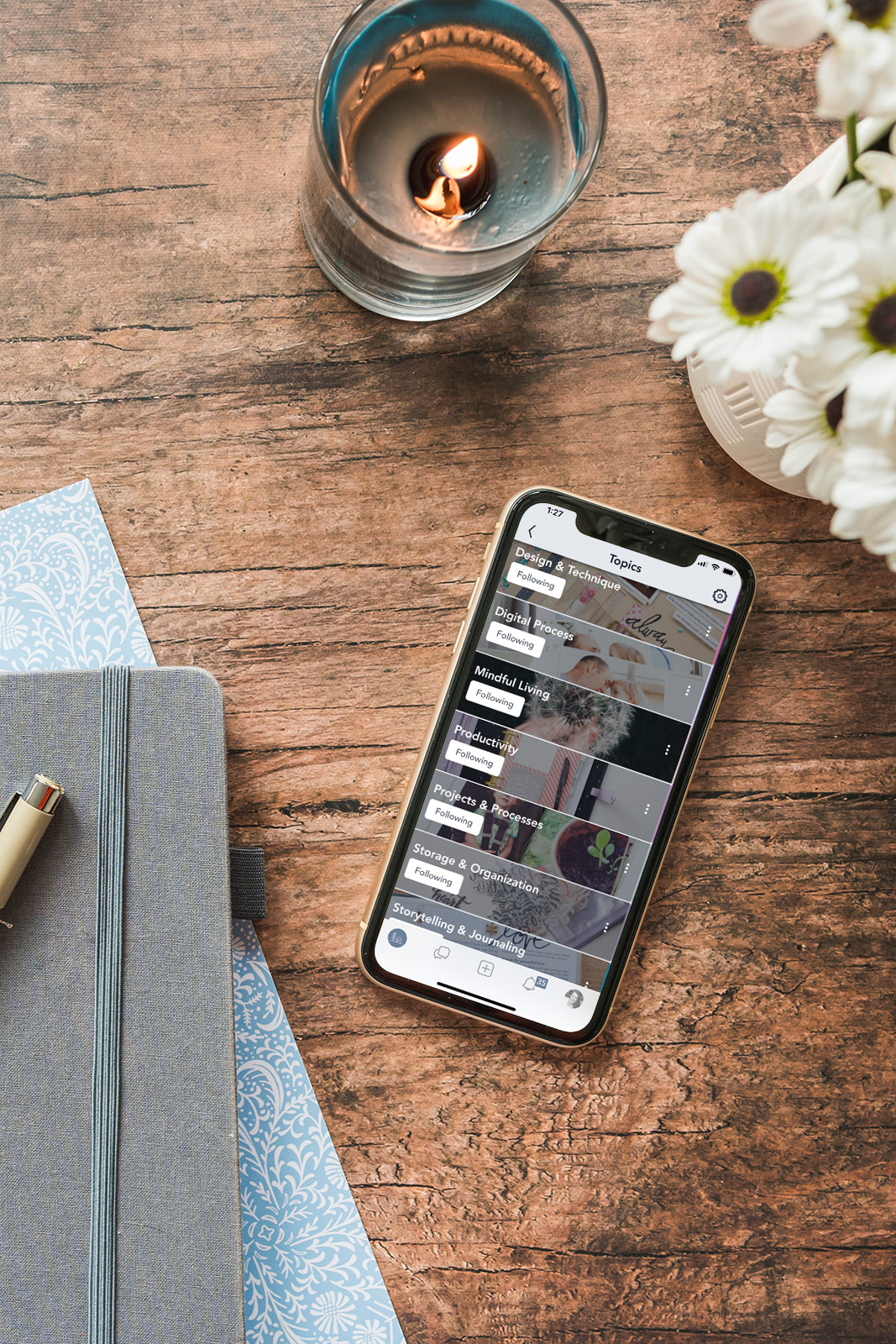
The best way to listen to Scrapbook Your Way is with a podcast player on your mobile device or with iTunes on your computer. You can subscribe via Apple Podcasts, Google Podcasts, or by searching for “Scrapbook Your Way” in your favorite podcast app.
0 Comments