How do we take that “I should scrapbook this!” moment and save it for later? That’s what this episode is all about. I asked a group of Simple Scrapper staff and team members to join me for a conversation all about journaling. Our discussion includes stories about personal journals, how we decide what to share in our scrapbooks, and systems for keeping track of the facts, feelings, and memories we don’t want to forget.
Links Mentioned
- Keynote
- Shutterfly
- Ali Edwards Quarterly Kit
- Apple Journal App
- Day One App
- Momento App
- I Am App
- Project Life
- Susannah Conway Journal Your Life
- Stacy Julian Library of Memories
- Creative Memories
- Affinity Photo
- Trello
- Clickup
- Ali Edwards Storyteller Class
- Shimelle Journal Your Christmas
- Blurb
- Evernote
- The Playbooks from Kendra Adachi
- Canon QX 20 (*)
- Canon Ivy (*)
*Affiliate links help to support the work we do, at no additional cost to you.
Breon Randon: [00:00:00] I have the day summary template that I, I just pull up a new thing and I hit a new day summary template. And, it is pretty easy. It is anything notable happened today, three things that I'm grateful for, or that I'm thinking about. What did I read, watch, hear today, and any news. That's it.
Jennifer Wilson: Welcome to Scrapbook Your Way, the show that explores the breadth of ways to be a memory keeper today. I'm your host, Jennifer Wilson, owner of Simple Scrapper, and author of the New Rules of Scrapbooking. This is episode 319. In this episode, I'm chatting with Simple Scrapper staff and team members about journaling. We dive deep into the how and why of capturing facts, feelings, and memories in all forms.
Hey friends, it's another group podcast recording. I'm excited to be here with all of you today.
Breon Randon: Happy Scrapping.
Jen Johnson: Woo.
Jennifer Wilson: All right, let's go through very quick fire. Tell us who you are, uh, [00:01:00] and where you live, Bre.
Breon Randon: My name is Bre Uh, you'll see me the Simple Scrapper community floating around. I am in northern Virginia, just outside of DC. So, uh, you know, always in the heart of our nation's capital.
Jennifer Wilson: Nice. All right, next up, Helen.
Helen DeRam: I am Helen and I am, I am in Northern Illinois.
Jennifer Wilson: Sounds good. All right. Peggy.
Peggy Collins: I'm Peggy. I live in the Denver Metro area.
Jennifer Wilson: Great, Melissa.
Melissa Magnuson-Cannady: Uh, my name is Melissa and I live, um, about an hour north of New York City in the Hudson Valley.
Jennifer Wilson: Nice. Nice. All right, Jen.
Jen Johnson: I'm Jen, I live in northern Kentucky, currently. Near Cincinnati.
Jennifer Wilson: Cool. Cool. And then finally, Monica.
Monica Moriak: Hi, I am Monica and I, uh, live in Northwestern Newark or Northwestern Delaware. Um, we do sort of have parts to the state. Uh, maybe 45 minutes outside of downtown Philly.
Jennifer Wilson: Very cool. All right. Yes. So now [00:02:00] you can connect those, uh, voices with their names as we go forward today. I wanted to do this conversation after we had another one that kind of spiraled off talking about how we manage journaling. And journaling is such this loaded concept when it comes to scrapbooking. We're always feeling pressure of like, did I add enough journaling? What if I added no journaling? But I wanna kind of peel behind, behind the scenes, go a little bit deeper on how we approach all the things that lead up to having journaling on our scrapbook pages. And so, um, I wanna just like start by sharing kind of like an icebreaker, a recent favorite excitement.
And then we're really gonna get, we're gonna get deep here, so if you wanna go around and share something new or exciting to you, let's go backwards this time. Monica.
Monica Moriak: Uh, new and exciting. Journaling in general is generally new for me. I always warn people, be careful what happens when you join this group. [00:03:00] Um, but uh, I have some exciting ideas of sort of journal, junk journal type things that I'm interested in trying next year. And I think I have like three months of almost daily, like maybe two misses, journaling. In my, the journal app on the phone. Of some level. It could be all over the place, but yeah. It's all your guys' fault.
Jennifer Wilson: We'll take the blame.
Peggy Collins: We'll take it.
Jennifer Wilson: Anything new exciting in your scrapbooking world, Jen?
Jen Johnson: I am still buzzing from the Planning Party. It just, it was so good. I just have so many thoughts. It was great.
Jennifer Wilson: Awesome. I'm, I'm still buzzing from your presentation yesterday about your, uh, using Apple Keynote. And I actually did, let me see. I have like 15 slides now in preparation for what I'm gonna share tomorrow night for Stash Bash related to how I'm gonna tackle my December documenting. So.
It was definitely [00:04:00] an inspiration in the right direction.
Jen Johnson: Oh, that's great.
Jennifer Wilson: All right. Melissa, what about you?
Melissa Magnuson-Cannady: So besides Planning Party, 'cause that was also true for me too. Uh, I have been working in Shutterfly on an album for the trip to Sweden that I went on with my husband and my parents and we met up with family there. And yeah, I actually have most of the pictures placed. Like the title pages or titles of pages, but journaling is exactly what I'm working on right now.
So it's a mix of like new things and trying to reflect and like remember 'cause that happened in June. Um, and then also immediately upon my return, I did do a bunch of writing to try to capture some of the stuff. So I need to dig that out and see what it says because I don't remember.
Jennifer Wilson: That maybe needs to light a fire under me because my project isn't done and I went in 2020, so. But I'm gonna blame the pandemic as like putting a [00:05:00] halt on my, what I would've scrapbook immediately. So, sounds great. Melissa, what about you, Peggy?
Peggy Collins: Yeah, I've been, uh, pulling together some of my supplies for my everyday life 2026 project. And I made a humongous dent in the Ali Edwards Quarterly Kit papers that I had. So there was a daily kit in there and so I was able to use a bunch of stuff out of that. Um, so that's a big win for me to kind of knock some of that out and have it ready to go for next year.
Jennifer Wilson: Great. Yeah, especially some of those, some of those quarterly kit papers can be more difficult to use because they're so high contrast, bold graphic papers.
Peggy Collins: Yeah. Yeah. So I found a combination of things that had like days of the week and things like that on it, and then some more plain papers that I could turn into journaling cards. And so I'm really excited to have that stuff out of my stash and into my books.
Jennifer Wilson: Fun. Yeah. Yeah. Helen, what about you?
Helen DeRam: Well, like everyone else, I was definitely very [00:06:00] excited by the Planning Party and it kind of directed me to dig into my Creative Hub. So I started really looking at what I had and hadn't looked at in ages. And I'm excited to see Jen's presentation as well because what I have, you know, really wasn't working.
So I'm excited to kind of get into making that Creative Hub work for me.
Jennifer Wilson: Ooh, I love that for sure.
Great to hear. Alright, and the last but not least, Bre.
Breon Randon: So yes, like everybody else, Planning Party, Planning Party, Planning Party, it was all Planning Party all the time last week and it was absolutely fantastic. Um, but during that, aside from the actual planning portion, I was really excited that the concept of Peggy is always kind of going on about with breadcrumbs.
It finally like clicked for me. Um. I've been listening to it for like, what, a couple years now. And it just like, I, I would overthink it and I was getting too worked up about like, oh, I can't decide like what the next couple things are. And so, um, it just occurred to me [00:07:00] somewhere somebody was mentioning in the Planning Party that they had a list of like each type of thing.
Like had its up next, you know what I mean? Like, so it wasn't just like your next top three things, which is always, I was immediately just like, I can't figure out the next top three. That's just like too hard for my brain. Um, but like, so I actually just wrote down like my next photo item, my next, um, my next page item, my next Square One item, my next Aligned item.
And so it's not a ton, it's like six or seven things. But I was really kind of closing, like focusing on that top three and it just really freaked out my brain. But since I've done that, I've been able to kind of go through, even just over the course of the week, I have this huge list of things that have now been checked off.
'Cause I'm okay with having the next top, like the top five. It's like the top five, not the top three. But it, it's the number one of each item. So anyway, it just kind of clicked and that has was really, it felt good. It was, it was nice. So.
Jennifer Wilson: I love that. Yeah, I use that [00:08:00] all the time. Not in scrapbooking at all, but in my, just, you know, my work life and everyday life. I think about all the different kind of project domains and what is that one next step. Like, because I can't possibly do everything. So let me just try to like, at least move everything forward a little bit. Before I can, you know, then get my brain back in gear to maybe go in deeper.
So I love that.
Monica Moriak: That's, that's how I do my Creative Hub is what projects do I have that I wanna move forward that are kind of top of mind. And where's what's the next thing? And then I like, okay, this week, okay, I can, I can work on these two this week looking at my energy or what have you.
And so that's how I've, um, that's kind of how I've had to do it. Like top three, I can't, I was like this then and that like I, I couldn't do that. And then I find that, which project are we gonna work on? And so it kind of is like, what feels right, what's My energy, like. And I, um, I'm not in a space where I have any regular schedule. Like [00:09:00] today I had an afternoon free and then I didn't. Right, like meetings, people wanted to talk to me, things needed to get done. Right.
Breon Randon: Well, and that's kind of the prob that was sort of the issue, right? Is that I would not pick the top three because I couldn't narrow it down. And then all of a sudden I, I do spend an inordinate time at my desk because I do work from home. And I would find myself the equivalent, the emotional equivalent of like, doom scrolling for scrapbooking, right?
Like, I'd be like, oh, and then like, you know, I'm looking around and yeah. And then I spent three hours and I've been here and I actually, maybe I've edited a couple photos and maybe I've done a bit of journaling. But like, I haven't actually moved anything forward because I spent most of that time not focused on like, trying to find where I was. And so, um, I don't know why just opening that, that aperture up just a little bit, like made it a lot less black and white for me.
Jennifer Wilson: Nice. I just noted down that we're gonna make some adjustments to our next year's journey plans to really incorporate this idea to make it easier [00:10:00] to pick those, those next actions. So I think this has been really helpful. All right. You guys can go now. Like I'm, I'm good. So we already talked about journaling.
Breon Randon: Mic drop we're out. No.
Jennifer Wilson: No, I'm just kidding.
Monica Moriak: I think one of the things I thought about from the journey planning that I really had to change my mindset is the idea that, um, setting a project that will be at a specific timeframe. That we may work on, and then I'm going to get this project, the, I should be able to do this in these two months, and then this one will take four months or month and a half. When I look at my stuff. And I'm more like, okay, this is my number one project, so this is gonna get my master time. But here are a couple other things that I would love to work on, especially if I'm looking to a challenge.
Can I say, I'm gonna do a challenge, but I'm gonna do it part of this project? Or, or something like that. So maybe I've got these four kind of in the works and this one is easy, this one is hard, right. But right now, this is my priority. So [00:11:00] if I, if I don't have the energy to work on this, there's something else I can at least move forward. Um, and so thinking that way, multiple projects that are moving similarly as opposed to linear projects.
Jennifer Wilson: Hmm. Yeah. Yeah. That helps us feel a little bit more in control and that we have choice too at the same time. So, all right. Let's transition back to journaling our topic today. So Monica, you actually mentioned earlier that you've been kind of keeping up with the journal. It seems like maybe for the first time or a first time in a long time.
Monica Moriak: Yes, yes. So I've never been much of a journaler. I've always said I'm not much of a journaler. Uh, the Journal app in the phone is something that has kind of helped me because it is kind of, it's easy, it's simple. I can, there's not really much of expectation. Uh, I started, I did some morning pages for a while, and that definitely helped during a very tumultuous time.
It was hard for me. Uh, feeling like I'm [00:12:00] doing it right or wrong. It, it, it is overthinking, I'm sure. But, um, I also shred those, I know most people keep those journals. I shred those because it is just like my thoughts and nobody should read that. Journaling has always been hard for me, um, because I worry about who might read this and what they might think later.
And so that leads to of course, overthinking. And then of course, I'm not doing it right. Um, but I don't know, I just, I started just doing a couple of things. And some of the journal things were Aligned, right? I, like one day I would say, okay, I'm doing the Aligned prompt. And I would put the that in and I would add some photos and I would do the journaling.
And then when I go back to do the page in my travel notebook, I copy the journaling and print it or what have you. Uh, and I don't know, the more I talk with people who are journalers and it just kind of rubs off and, maybe building the habit. It's been interesting. It's all over the place, so some things are pretty deep.
It's usually at night before I go to bed, so that was one of [00:13:00] my tiny experiments.
I journal for a few minutes. I read in a physical book. I tried fiction, I gave it up. I'm back on nonfiction. And, um, I, uh, and I sleep much better if I, even if it's 15 to 20 minutes, I sleep much better. And I, I know that. And so it's kind of a priority for me now.
Jennifer Wilson: Oh, I love that. I love when we can associate actually positive change with seemingly small behaviors. Like, oh, it's not a big deal, but it can be a really big deal.
Monica Moriak: I don't know why, but I just know that there is a connection.
Jennifer Wilson: Nice. nice. All right. Who else? So do you keep a personal journal and if so, how long have you been journaling? I know some of you have been doing this probably for decades.
Breon Randon: So I actually, I did, when you posted questions, I actually was like, oh man, how long has it been? And so I looked back in my Day One app and um, I have been using Day One for quite a long time, since its [00:14:00] inception. But before that I used Memento and Memento and Day One imported everything from Memento.
So. I just looked back in June, um, third, uh, 2002. It was my first entry. Um, I would say for the first year I wasn't daily. I was pretty intermittent. Um, but after that, it's been more often than not every day. And so I have a lot of years of journaling in my app that I can kind of go back to. Um, and.
Jennifer Wilson: You said 2002.
Breon Randon: Uhhuh 2002, so.
Jennifer Wilson: 23 years.
Breon Randon: Yeah. Yeah. And I will tell you, but here's the thing, like I keep it super easy. I am not, like, this is not necessarily all like, I mean, you know, from the heart and like maybe what Monica's doing is a little bit more like, you know, cleansing. And, and mine is every night when I go to bed. Um, because I will forget by the next morning I have tested this theory and if I try to go back the next morning, I'm like, [00:15:00] it's like, it's like, you know, one of those flat brain waves.
Um. And I, so I will, I have a template because Day One you can set up your own templates. So, um, my, I have the day summary template that I, I just pull up a new thing and I hit a new day summary template. And, um, it is, it is pretty easy. It is, um, anything notable happened today, three things that I'm grateful for, or that I'm thinking about.
What did I read, watch, hear today and any news. That's it. It is not like how I deeply feel about everything in the world, although, like, I can get off tangent if I really have big feelings about something, I can rage. But, um, but overall it's just, and I will tell you there's no punctuation going on in here.
And there is no, like, there are, it is nothing but sentence fragments and, and, you know, misspellings of galore. Like, I could never export this book, even though I know Day One does offer that. Because it would just be like gibberish. [00:16:00] Um, a ton of the early stuff has a lot of links to like, old Facebook posts and Flicker, you know, and I'm, I haven't been on social media for a decent amount of time.
I don't have anything left. Um, and so, yeah, I mean, some of that stuff is dead information. But it is really good for me to be able to go back. Um, and I can also search at any given point too. Like, so if I, you know, am thinking about a trip to X, Y, Z, I can just say, you know, Hey, New York City, Brooklyn, what did I do in Brooklyn ever?
And, um, and that's really helpful. And then I also have, and I think we're gonna talk about this later, but I also have some trip templates. I have that work for when I'm on, on trips and when I come home from trips. So, um, and it just makes it, I automate, it's an automated thing. I don't think about it. It's, and it's just been such a long habit that. You know, but it really feeds my scrapbooking. The whole point is, for me, that is my master file.
Jennifer Wilson: Hmm.
Breon Randon: It is poorly formatted. But it is a [00:17:00] good start when I need to think of something.
Jennifer Wilson: So being able to search it made me think about how I am constantly searching in, uh, my Facebook messages, because there's people that I talk to all the time every day about what's going on, and so that becomes this like, record. That, you know, I am journaling, I'm just journaling to another person in conversation about, you know, so it was, it was Steve's birthday, or, you know, we went grocery shopping or whatever.
So all that stuff kind of gets put there too, so.
Breon Randon: And if you think about it on an even bigger scale, but with the same idea of what you're talking about now, and with Apple, you, you just pull down on your screen and you hit search and it searches across your entire phone. So that's your text messages, your notes, apps, your reminders. Day One, like it goes into a lot of these apps, not all of them, but wherever there's an API. And like you could just search Steve and everything that is Steve related on your phone can come up.
Jennifer Wilson: Wow. Okay. That's creepy, but I love it.
Breon Randon: But I [00:18:00] mean like, yeah, like if you're looking, for like when did somebody send text me their credit card number 'cause I need to put this into something. You know, or whatever, you know, like you can search that person and it comes, everything comes up. So, you know, for better or worse, it is a, an automated type of journaling. Like found journaling.
Jennifer Wilson: Yeah, yeah. No, and I've like, I've wanted to kind of do it the other way where I would like to be able to have it, basically follow me and make a journal from it. Like
Breon Randon: Yeah.
Jennifer Wilson: Track all of my behavior, all the things that I say all the times I ask, you know, Google what the weather is like, take all those things and just bullet point them out for me as a journal.
Breon Randon: Yeah, I was gonna say, that is something I do like with the Day One. 'Cause it does have your weather patterns, it does have all your exercise patterns, it has all of your, it has your step count, it has, you know, where you went in the day. And that those are all features you can turn on and off. But like, that is all, like, all automated in there.
I don't have all of that turned on. And I think it's actually gotten even more in, you know, in [00:19:00] depth since the last time I bothered looking at the features. I just was, I'm, I'm, I'm set in my ways and old at this point, I got what I need.
Monica Moriak: I would say the Journal app, one of the things I liked about it is it would say, Hey, you had this long conversation with somebody.
That's an A suggestion or you were at this location, or, wow, you took this long walk or you had this. So it'll have a variety of ideas. It'll pull up, Hey, you went to such and such and here's some photos you took. And so it's suggestions along those line. Maybe not as detailed as you were thinking about it. And so you can pull that up and say, oh yeah, you know what? I had that long talk with my friend. Yeah. I'm gonna add some detail about that. Right. Um, and then I have the I Am app, which is like a motivational app that I use to help with my, um, anxiety. And if there's something that catches my eye, I can share it to Journal. And then, so there's a lot of things you can share across that. [00:20:00] So I find that that has been, that's, I think that's one of the things that has intrigued me about it. And maybe made it easier to continue using.
Jennifer Wilson: Very cool. What other experiences do folks have?
Helen DeRam: So I actually use the Memento app. I'm still using that. Um, and I've been using it since late 2016. And pretty much since I started using it, I say like most of the days, every day I have filled, if I took pictures, you know, put the pictures in there. And then my journaling. And my journaling is probably similar to Bre's where it's not deep thoughts necessarily.
It's mostly, you know, what we did and little things. Um, you know, if I, I'll look for like text messages as well. I'll screenshot those and add those as pictures and, or talk about, you know, oh, I talked to my sister, whatever. So there is a little bit of that, but um, it's also just kind of like what [00:21:00] happened the day in the day, or you know, what was, the bird I saw or whatever. Um, but it is great and you know, yes, I can search it and I love having it there. Before that, my journaling was sporadic and it was in notebooks, and I still have all those notebooks and they're all random notebooks somewhere. Um, and I was thinking I didn't get a chance before our podcast, but I was wanting to go back and just see because I was handwriting those, if they were more feelings based.
Jennifer Wilson: Hmm.
Helen DeRam: Than, than the facts based. 'Cause I think like a lot of people, you know, or for me, and I'm assuming for a lot of people, feelings are easier to hand write than they are to type. I don't know, um, if that's everybody I'm assuming, but maybe not. Um
Jennifer Wilson: No, I can see that.
Peggy Collins: Yeah.
Breon Randon: And see, I find my feeling stuff, I know we're gonna talk about this later so I don't wanna go into it, but feelings is when more I'm sitting down to do a long form journaling, like it's more of a mental shift than a physical shift. I have to be [00:22:00] like, I am looking to do this kind of writing. And that is where that comes in.
So it doesn't, I'm not ready to do that every day. But, but there is a time and a place for it. It's just not at my daily wrap up.
Helen DeRam: Yeah.
Jennifer Wilson: All right. Anybody else?
Melissa Magnuson-Cannady: So my journaling is super, super sporadic.
I am like, you all are so impressive with, um, the consistency. I, I mean, I dunno, maybe at some point I'll try to habit stack something and see if it can stick. But, um, super sporadic. But I, I have, as we were talking, like I was listening to all talk. It occurred to me that probably my most consistent thing has been for the past couple of years, maybe three or four years, I've been doing the, like a family yearbook in the Project Life app. And I feel like just listening to you all speak, I'm like, oh, well that's pretty much like a weekly journal.
So anyways, I think most of my journaling is actually [00:23:00] related to scrapbooking, you know, either like before, during, or after. Or, you know, it, it's, um, yeah. So it's just kinda different. And then the other thing that I started doing this year was when I travel and I stay in a hotel. They have like their little like notepad. I'll like write, hand, write something and then like, I'll usually put the room key next to it or like something else that kind of tells like what it is or where it is. And then I'll take a picture of that. I mean, I also take the paper, but it's kind of a, I don't know, it's just something I started this year and that's been, I've been relatively consistent with that this year. But we'll see how long it lasts. But, so I do journaling, but it's very, very sporadic in all sorts of different approaches and some digital, some handwritten, but I'm enjoying it. And I love the idea of journaling. I almost signed up for a class with Susannah Conway Journal Your Life, but I didn't, um, maybe at some point. But it's [00:24:00] so, it's something I do, but I don't, I don't know if I'd consider myself a journaler, if that makes sense.
Jennifer Wilson: Melissa, I'm curious, how often are you getting into the Project Life app to add information about your week?
Melissa Magnuson-Cannady: Um, definitely once a week, but, well, unless I'm traveling, et cetera, et cetera. But typically I'm pretty consistent at once a week. So usually everything, like I'll kind of write it for the prior week.
Jennifer Wilson: Mm-hmm.
Melissa Magnuson-Cannady: But a lot of that text, and I, I think I've brought this up before, like a lot of that is very, like, more fact like, oh, this is where we went, or, and I'm trying to infuse more feelings into it. Um, and I've actually been trying to figure out maybe a different approach for next year where I can be more reflective in it, but haven't figured that out yet. But,
um,
Jennifer Wilson: Maybe by the end of this conversation you will.
Melissa Magnuson-Cannady: I know exactly, that's what I'm hoping. I'll definitely have more ideas and thoughts. I mean, I'm [00:25:00] already, I'm already gathering them up, absorbing them.
I just, in looking at the Project Life, well, they're, I haven't printed them, but anyways, in looking at them, I'm like, oh, it's all, it's very much like, who, when, why, where, what, you know, and it's not as much reflection.
Breon Randon: Well, that makes sense though. 'Cause it's a smaller, I mean, on a three by four card, there's only so.
Melissa Magnuson-Cannady: Yeah. So it's, yeah.
Breon Randon: You know, you're limited a little bit by format.
Melissa Magnuson-Cannady: Exactly.
Breon Randon: Maybe one of the editorial templates that's in there. I use those sometimes and I, those are some of my favorite pages. 'Cause it's just a giant text box.
Melissa Magnuson-Cannady: Well, and in fact, Aligned ended up being like a weekly journal.
Jennifer Wilson: Yeah.
Melissa Magnuson-Cannady: So. Like, I guess last year, whenever we, yeah, that was last year. Um, I de you know, so that was kind of like a weekly journal. Uh, yeah. So anyways.
Peggy Collins: I'd also say, Melissa, that the I certainly, my everyday life kind of [00:26:00] documentation that's very facts based. I think it's a little bit the, the premise of the project, the premise of that project generally for most people is not a super in depth feelings kind of thing. It's more a, these are the things we did and these are the people we saw and those, so I don't, i'm not terribly surprised that you don't have a lot of mine, don't have a lot of feelings in those either.
So I think that that's not totally unexpected.
Melissa Magnuson-Cannady: True, true.
Peggy Collins: I'll tag on here that I'm, I'm an even less, more sporadic, uh, think then Melissa is. It's, it tends to be, if you find me doing personal journaling, there is some sort of fairly serious mental health, semi crisis going on. So usually that's when I will actually turn to a journal to dump that stuff outta my head. It often gets painted over the, like it's so bad that it gets painted over or it.
Jennifer Wilson: Sure.
Peggy Collins: Shredded or, so the generally that kind of personal journaling is part of my [00:27:00] day-to-day. But when Melissa was saying, oh wait, I do do a little bit, I realized the last two years I've been maintaining what I've called my everyday life document. Which is just a literally a, a Google doc. That I keep kind of a month to month running, these are the things we did. Like these are the cultural facilities that we visited, these are the books we read, these are, and those feed my everyday life project. So that from that perspective and those get updated once a week. But that's pretty much the extent of my journaling. That's not when I'm traveling. Traveling is a different beast. I think we're gonna talk about that a little bit, but um, I journal when I'm traveling. But very much facts. This is where we went today. This is what we saw. This is sometimes I really enjoyed this, this really, um, tapped my interest or whatever. Something like that. But it's, there's not much feeling stuff in that either.
Jennifer Wilson: Peggy, you just jogged an idea that if we could, or I could, uh, [00:28:00] spreadsheet my fact-based journaling, you know, especially being able to see it over time, you know, like a box for each month of the year or multiple years. Um, just to note things in bullet points. I think.
Peggy Collins: Yeah. That's exactly what it is. Yeah, it's, it's, and I, some of it runs like it's, I add to it through the whole year. Um, like the cultural facilities, like I'll add, I, I just copy that whole block and put it into the next month and then add to it as the month goes on. Some of it, like the reading, I make a new entry for each month. Um, so that has been really helpful for doing that, um, kind of project. The, the Everyday Life project. So that's been helpful.
And I, and if I get behind, it's brutal. So if I.
Breon Randon: I can imagine.
Peggy Collins: If I can just stay caught up, if I can just do it every Sunday and I actually have a Sunday planning hour that I'm pretty good about hitting that document and making sure that it gets updated. But I fell behind earlier this year and it was a very, [00:29:00] very painful day. I had to catch up on all of it, but it works pretty well otherwise.
Breon Randon: Yeah. No, but I 100% agree. That's why I do it every night. 'Cause I, I'm like, uh, I'm never catching up if I don't do a little bit every day. It's never happening. Um, just real quick, you were mentioning, uh, Jennifer, how you wanted to like, kind of put it in the spreadsheet.
Somebody during Planning Party and I'm so bad with names and I apologize, but somebody had actually shared a woman who makes a planner, like a binder planner in the Planning Party. And it was like this whole thing, you know, about essentially around Library of Memories, some version of that kind of combined with Creative Memories.
And it was like a little, and as she apparently sells this pre-done binder. But what I took away from that video that the, um, that the community members shared. Was that they had, she has sheets for these timelines, which are essentially a printed out version of a Google spreadsheet. Like it's, it's like a gra, you know, the grid.
And she was talking about doing these timelines for your family members or [00:30:00] for your trip or for like, because it has no heading up there. You could put your own version however you wanna use it. But I was just like, it really kind of struck a nerve. I was like that and I actually put it on my Planning Party like list for next year is like to do one for my kid because of all these, like I do a ton of journaling.
But to see it in this scope of like, oh, wait a minute. First grade we did Girl Scouts, we did camping, we did like, and these kind of like lists in these boxes. Because that stuff is, even when you're journalling every day. It is really hard to kind of get that, you know, thousand foot overview of some of these, like, you know, nitty gritty in context, kind of journaling clues.
Right? And so essentially this was a paper version of what you guys were talking about with a Google doc. And I was like, that's brilliant. I would love to have something like that, to put some of these feeling stories and, you know, album construction endeavors into this context and get a little bit more later. Thought it was a good idea.
Jennifer Wilson: Well and there is The timeline worksheet in [00:31:00] the Before Your Story classroom, which could be used to and adapted. And I doing it for your kid, even though that's not what the project is about at all, I think is really would be really helpful. Last night I was asking another mom like, what year were they in kindergarten? 'Cause I have no idea.
Peggy Collins: Yeah. Just to even have it to reference. Yeah.
Breon Randon: Yeah. Well, and that's what the lady did. Like, she put like, you know, you know, Emily, you know, went into kindergarten. This grade here was her teachers and these were all the columns. And I was just like.
Jennifer Wilson: Yeah.
Breon Randon: Mind blown. How many times have I reached for a reference of something like that where I'm like, I have no dang idea where, what school was that?
I don't remember what school that was or whatever. And I'm gonna spend a whole scrapbooking evening going and finding that. That's the thing. It is like, it really kind of takes that time and, and you know it, it's gonna be spent doing something I don't really necessarily wanna do. And I was like, that timeline situation would really help for some of these more [00:32:00] excavating items.
Jennifer Wilson: Oh, certainly. Helen, what were you gonna say?
Helen DeRam: Oh, just if I fall behind in my Memento app by like three days, then I start dreading having to put my.
Jennifer Wilson: Hmm.
Helen DeRam: Notes in.
Peggy Collins: Well that's what got me in trouble was because I kept putting it off because I knew it was gonna be bad and I kept putting it internet, so I just made it worse. Like, I, I, I, uh.
Helen DeRam: Yeah. So I have to, like, if I, and it makes me like almost nervous, like, like, I'm like, oh no, I'm three days behind. You know, I know I have to spend a longer chunk of time to fill that in, and it's not, it's not gonna be as meaningful. Even though I'm not getting into super deep thoughts. I am putting thoughts in there and the thoughts I had three days ago, I do not remember. So.
Breon Randon: No, same, same.
Peggy Collins: Yeah.
Breon Randon: That's why I declare journaling bankruptcy like at a certain point it's like, uh, it's dead. It's gone. Now. We've lost that to the ether.
Jennifer Wilson: So would it be beneficial for someone to try to do [00:33:00] a daily habit, just like before they go to bed and then monthly go back and make a bullet point list from it? Is that overkill or would that be the only way like. I would forget a lot of the things if I didn't record them daily, or I do forget a lot of things.
Breon Randon: I, that's how I do my story list. Like at the end of the month. That's, I go through my photos and I go through my Day One and I go, these are the top, you know, 20 things that I wanna hit from this month.
Helen DeRam: So are you reading each Day One journaling or.
Breon Randon: I mean, yeah, it's, it's a, it's a flick. It's a flick. Yeah.
Peggy Collins: I was gonna add one other thing about my little cheater one once a week journaling. Is that two years ago I counted certain things. So I wanted to do a by the numbers layout at the end of the year. And I knew that. And so at the beginning of the year, I defined what they were. And like one of 'em was how many times I ate pizza that year. So it was so fun at the end of the year. And there [00:34:00] again, if I didn't count that weekly, it's game over, right? I, there's no way, I'm gonna remember three weeks ago that I had pizza. Like that, so they had to, that was, and I didn't, I don't have those this year. And I think that's part of the reason I fell behind because I thought I could keep up with the other stuff without doing it weekly.
And so I need to do something similar. I need to have those same kinds of items in my list next year that force me to know that I cannot skip. Because I won't be able to keep. And there's something about that counting that feels very, like you have to do it right. I'm not very often the woman in the group that says you have to do it right.
But if I'm gonna count the number of times I have pizza, I'm gonna wanna know that I had, that, I counted them all. Um, but that number is right, per se. So anyway, it's a fun thing if that helps move you toward doing something.
Um, 'cause I'm, I cannot fathom the day that I'm gonna be a daily journaler. I just can't even imagine what's gonna drive me to that.
Monica Moriak: I said [00:35:00] that too until six months ago.
Peggy Collins: Anything could happen. But here I am, retired and I'm like, Nope, that doesn't sound good to me at all.
Monica Moriak: Yeah.
Peggy Collins: So, so there you have it.
Monica Moriak: Interesting, interesting. I do do text to speech sometimes into my journal. Um, which isn't too bad. I try to do text to speech for a variety of things. Um, so practice it.
Breon Randon: Um, do it on my watch
Monica Moriak: Yeah, no, my watch ignores me. So there we are.
Jennifer Wilson: We've, we've touched on this a little bit already, but is there a difference between what you would write in a personal journal, which it sounds like a lot of us, like if you're writing really personal stuff, that's not necessarily going in your fact gathering area. That's going on a piece of paper that might never be seen again. Um, versus the journaling you put on a scrapbook page. Like, what are the similarities and differences? And you know, I've, I've spoken many times in the past when I tried to do Project Life in [00:36:00] 2021, that was my only successful year. And it turned out to just be a, you know, a feelings dump diary. Um, which is great, that's what comes out of me.
But that wasn't even the original intent of it. The intent was to capture the year and it ended up being something else. So how are those things sim separate and together for you?
Monica Moriak: Yeah, mine are definitely separate. Anything I do in journaling, first of all, I. At least until recently was posting my pages. Right? So it had to be for public consumption. Um, but I wanted anybody to read it to get a positive impression. Of, um, so it would be something positive about, even if there were struggles in there about somebody going through some struggles with my kids, it would end on how this, how they overcame the challenge or, or something like that, right? It would be a positive. And I, I, anything that I write out like that, that I assume someone else can see or maybe is designed for [00:37:00] someone else to see. I'm like, would I be okay if, if someone posted this on Facebook, how would I feel about it? Um, and so that's, and to my credit, recently, I've had someone post private emails and texts on Facebook. To try to make me look bad. And.
Jennifer Wilson: That happens to our school board too.
Monica Moriak: Yeah. Yeah. And so I am glad that my MO is kindness and not responding negatively to things. So it, it kind of goes hand in hand for me. And I, it, I'm assuming if anything I write, my children are likely to read. And I, I don't want my children to read something at some later time after I'm gone, and it to then change their perspective in a negative. Right.
Jennifer Wilson: Sure.
Monica Moriak: That, that, that would kill me. I just, [00:38:00] you know, that, that hurts my heart to think about.
Breon Randon: I will say that I am almost exactly the opposite of you.
All of my feelings stuff is in my scrapbook. And almost none of it is in my journaling. And so everybody who reads my scrapbook is all of my feelings. And I kind of am just like, cool with that. I don't know. Um, I'll think about it and I'm like, who's gonna read my scrapbooks? Right? It's gonna be my partner or my daughter, maybe some extended family.
I sort of view my scrapbook as like, this is how I really feel about things. Like, I do this because this is how I feel about things. You know, like I don't need, I don't need just a bunch of photos. Like for my family to look at. Like they could just have a photo roll. If that's the case, they could just scroll their phones and that's fine.
But if you're gonna look at my scrapbooks, you're gonna see what my deepest feelings are about everything. And I sort of feel like you get that [00:39:00] from my pages. My pages are all of my heart, like all the time. And I try to approach it like, with I'm not gonna like, obviously, you know, I document my daughter's struggles and stuff and like some things that we've had and, and you know, struggles in our family.
And I try not to be unkind. That's kind of my rule, right? Is like I try not to be unkind. Which I also probably wouldn't do in my journaling anyway. Like I just, 'cause I feel like, almost if I give voice to some of those things, like it makes them truer, if that makes any sense. Like it's like I would hyperfocus on that and that's what I'm gonna be taking out of the experiences if I'm writing down all these horrific things like, you know.
But, um, but like, if you read my scrapbooks, that's how I, that's me. And that's really how I feel about it. And also my scrapbooks are my love language to my family. And they are my deepest passions and emotions about our real family life. And so that is also the good stuff and the really bad stuff. [00:40:00] I mean, some of the stuff is really bad, you know, like we've all had our things, right.
And, um, I remember like, specifically I was thinking about this journaling, and I, it's a silly thing now, but like, I remember it's like maybe 15 years ago, my partner and I had an argument on Valentine's Day. And let me tell you that scrapbook page about Valentine's Day, it was not like, it was, not it. Like it was, it was, and it was, I I, I try to be.
And I do think about that later, right? Like that later perspective. But I did write exactly how I felt that I was hurt and that like this was a big deal to me. And like I'll tell you, Jay picked it up like 10 years later and he's like, you know, I don't remember it like this. And I was like, okay, that's fine.
And we had a really good discussion about that day, even a decade later. And um, maybe I wasn't equipped 15 years ago to talk about those things with him. 'Cause I was, immature you know what I mean. Like we all change and grow. But anyway, I look at my scrapbooks as this way for me to work through those things and [00:41:00] to also have a record of really how our family was from my perspective at that time. And that includes the crumby stuff.
Jennifer Wilson: Bre do you think there's something from the kind of creative process that helps you take those facts that are in your Day One and Breng them out into to journaling?
Like it's, it seems like it's all together you.
Breon Randon: They are my breadcrumbs, right? Like, like Peggy's always talking about breadcrumbs. And that they are my breadcrumbs to my feelings. I can tell you when I look at those facts in those, in that template that I have, what was I doing that day? Well, if we were at school, and then I wrote down that, you know, we were at parent teacher conferences, and then I read, Abby went to bed early. And then I read like, you know, I mean there's a, there's a trail that goes through all that.
And then I'm like, oh, well that probably wasn't a good day. Why wasn't that a good day? And I can go through and then I look at the photo for that day and then it kind of all comes together in this big emotional soup of like, this is what the real story is behind that [00:42:00] photo. Right? Like, I don't need that in my Day One, like, it, it doesn't help me there.
What happens then is, and I know we're gonna talk about that later, is like, where do you put your journaling when you're trying to do these types of stories? I have a different process for that.
Jennifer Wilson: Okay. Okay. Yeah. All right. So we have like very, uh, opposite ends of the spectrum here, perhaps.
Breon Randon: Monica, and I are always opposite with this stuff, man.
Monica Moriak: We're, we make a great team though.
Breon Randon: We do. We are great at it.
Peggy Collins: I'm probably more middle of the road. There are some hard things in my graphic layout layouts, but generally not very many. Um, and generally not very deep. It, like I will allude to something went wrong or I will talk a little bit about what might have gone wrong, but, um, not too much super details about things. Trying to think. Probably the, there's that one layout that I made about, um, seeing my mom in my mind's eye after she died. That one is, yeah, that one [00:43:00] is, that was pretty tough. That one was one of my more, uh, transparent layouts. But I don't do a ton of that, I don't think. Um, I talk about feelings. I talk about mo, but mostly happy feelings, I would say.
Monica Moriak: I have some ones that are definitely very raw about my father's death, but I was also very open about that.
Peggy Collins: Yeah. Yeah.
Jennifer Wilson: Sure. True. Jen, what were you gonna add?
Jen Johnson: Oh, I think I am kind of in the middle of the road too. I definitely, so I journal in, in my Notes app and I totally forgot that I had also done many years in the Memento app. So that was a fun, I tried to figure out how long it had been. It had been a long time, maybe since 2014. Um, I generally, when I'm sitting down to journal, in my journal, I kind of start out with facts.
Unless I've really got something on my mind, I'm kind of more of a, talker, I will like blah, blah, blah, instead of like writing it out necessarily. So I think my stuff is kind of fact-based. But [00:44:00] also I do, I definitely feel what Bre was saying as far as like, scrapbooking is my love language and this is how I tell people that I love them and this is how I say that I'm grateful for things and, and it's also kind of works out my feelings like this, this was a tough time. I don't really go into details necessarily. I sure don't talk about people. I, I, I just say, you know, I'm, I'm struggling or something like that. I do keep in my notes app a a very few locked notes. So I feel like my husband or anybody could look in there. But if you wanna open up that locked note, you just need to know that it's probably not gonna be something pleasant for you to read. And I, I feel that way because, um, my grandmother was a big journaler and kept spiral notebooks just full of thoughts and feelings. And when she passed, uh, my mom read [00:45:00] some stuff that, uh, it probably shouldn't, she shouldn't have read. It really kind of hurt her feelings and, and made her angry. Which I, I have, I mean, I'm sure it was justified, whatever my grandmother wrote. But you know, it, uh, I, I, I would say I see why people burn, you know, say burn my diaries or whatever after I'm gone. Because people can, can hold onto that kind of stuff for years. I had her, her journals for years after that and I didn't open 'em up because I thought if she talks some trash about me in there, I don't wanna see it. You know, I, I wanna just have my memories. I don't need her interpretation of things. So, but yeah. But my, I, I feel like my scrapbooks are kind of for public consumption, so they'll be emotional, but they won't be real specific about certain things. I think is kind of where I [00:46:00] land.
Jennifer Wilson: So I'm, I'm curious, is your journaling that you're including on a layout, typically handwritten or typed? And obviously, you know, we've got at least three of you here who do exclusively digital scrapbooking, other than maybe your Aligned project. 'Cause you, because we've influenced you so much. Um. But I'm wondering if the, if the, I know for me that when I type, I write more and more comes out. Versus when I'm handwriting it, uh, there's a, there may not be as much space 'cause I didn't leave as much space.
I, you know, sometimes I have to like end up planning my whole layout around that longer journaling. Um, so what do you typically include and, and why is that?
Helen DeRam: So I do both. I will hand write or type and it's usually a space thing. But even if, um, and when I do my layouts, I'm including both facts and feelings about things. And I'm trying to do more feelings in my layouts. Um, so if [00:47:00] something needs a lot and it has to be typed, but it's feelings based, I'll write it hand write it first.
And then I'll type it. So I still have, for me it's like that I'm connected, my feelings are connected to my hand, to my pen, and uh, I have to write them out first. So.
Monica Moriak: My Aligned project, the very first page, is handwritten. And everything else is typed. And a lot of that is space. Uh, a lot of that is, is for some of them it was quicker or easier, or maybe it was space because of the photos I was putting in. Um, and. Then I realized I was pretty much using one page of a Traveler's notebook per. And then after a while that became like the habit. And then I realized, okay, if I stick with this, then I can get the entire year in one Traveler's notebook with room for one or two to be a little bit longer if I need [00:48:00] it. So I started figuring out waterfalls and all these other things to be able to get, um, oh yeah, I'm like leaning into everything that I have seen all you guys do for years.
I'm like, oh, that looks interesting and not for me. Like everything you do on December Dailys and all that other stuff. I'm like, oh, that's cool. Oh wait, I bet I can figure out how to do that with what I already own. Right? Uh, and so, but I ha I am digital. I have done a little bit of handwriting on my digital layouts because I have a iPad and a pencil. So what if I hand write on lined paper in my Notes app. I can copy that and it, and paste it, and it comes in as a PNG.
Jennifer Wilson: That's cool.
Monica Moriak: In Affinity Photo. Um, I believe it, it, it comes in like as a, um, like a P Yeah. PNGs, right? So I can adjust the size like you would in any [00:49:00] PNG, but it's also, um.
Jennifer Wilson: Transparent.
Monica Moriak: Transparent behind whatever I wrote. And so then I, you know, I have to be careful what I put on it 'cause that which. But so I have occasionally because I like the idea and when I find my mother's handwriting in my dad's handwriting from before they were sick or what have you, I kind of enjoy having it. So to use it occasionally, I think is something I wanna do to just kind of mix and match. Sometimes it feels, it feels nice to do that. I do write more if I'm handwriting than if I'm typing usually.
Breon Randon: Let's see.
Jennifer Wilson: Interesting how we're all different. Yeah.
Breon Randon: So I do what Monica's saying. I do almost all typing, just, um, I have some hand issues. It's, it's hard for me to physically do a lot of writing. But, um, I do also being digital, I will, um, write in Photoshop. I use with my Apple pencil. I'll use a very tiny brush point. So it'll be like a, [00:50:00] I usually do like a a with a normal round brush in Photoshop, a six, which is extremely small.
And then I will hand write like, like I am drawing with a paintbrush in Photoshop. And so, and then when I don't wanna do something, I will erase it. It makes it so I can be in on my layout and be formatting for things that are like, you know, maybe not justified correctly or whatever. And I can just, what normally, like, I would normally write on a layout and then I can erase it if I don't like it and start over again, which I do.
Um. I don't do that a ton. But I do wanna have a little bit of it because like Monica's saying, I can remember my dad's handwriting. You know, I don't have him anymore and I, you know, I can remember my mom's handwriting. And, and things like that. And so I would like to have a little smattering, but I do not do that for, I do it more for the aesthetic of having handwriting than I am to enjoy telling the story. 'Cause I'm not writing a full page. Like that's fun. Not
Monica Moriak: My layouts rarely have that much space.
Jennifer Wilson: It's cool that [00:51:00] there's options though, so.
Breon Randon: Yes.
Jen Johnson: My handwriting is just so bad. I'm literally sitting here looking at my planning workbook, which I started out writing by hand, and it's so bad. I have no idea what I write. I had to go and do it over again and type it. Because it's, it's illegible. It's like a serial killer. So obviously I, I just don't even try.
Monica Moriak: You don't wanna sub, don't wanna subject Jennifer to that.
Jen Johnson: No, no, Jennifer, I'm really did you a favor there by typing that out for you?
Jennifer Wilson: I appreciate that. But you know what's funny is that you use the same font on your layouts, right?
Jen Johnson: I do, and it's a handwriting font.
Jennifer Wilson: And so I associate that font with you. Like if I see that as like, oh, that is a Jen layout. So to me that is your handwriting.
Jen Johnson: In my best world of writing, that is how I, it probably would look if I took the time to actually write it out. But usually I'm, my brain is going so fast and my hand can't keep up, so it's just like.
Jennifer Wilson: Mm-hmm.
Breon Randon: [00:52:00] Jennifer's choosing once over here with that font, like sticking with it.
Peggy Collins: Yeah. Right. I would say I write about 75 to 80% of my journaling is handwritten. Um, mostly that's for expedience. I just don't wanna mess with the computer. And I, so, um, the, the portion that remains typed written is generally longer stories that I need, the space. Because I get wordy. Um, and then my everyday life projects are, um, definitely, uh, all, all typed because again, there's more information.
Plus it just kind of fits the aesthetic of those projects a little bit better. Um, probably my everyday life next year will have more handwritten in it just because of the way I set up the, um, the journaling spots have, like circles and stuff, so I won't. I guess I can use sticker paper.
Breon Randon: With your traveling, I would figure that it's kind of as a no brainer. You'd have to do a lot more writing. Right.
Peggy Collins: Um.
Breon Randon: If you're gone all the time, I would figure it's, I mean, I [00:53:00] know that there are ways, but I would just figure that would be tough.
Peggy Collins: Yeah, I don't generally, yeah, I don't have a printer with me if I'm doing any sort of tra scrapbooking while I'm traveling. Yeah. It's almost all handwritten. Or I guess last year I brought some stuff home and did the journaling after I got home. But yeah, for the most part. Um, mostly I, I worry a little bit now that people won't be able to, I, my handwriting's pretty neat. And I think people of our generation can read it, but I'm not sure the next generation is gonna be able to read the hand, the cursive. Um, so that'll be interesting.
Breon Randon: No, my kid can't read my, yeah, she can't read my cursive. I've been trying to teach my daughter to read cursive. They don't teach 'em in school. And, and it's really, it's heartbreaking, you know? 'cause you're like, yeah, you can't read, you know, like I said, my gra you know, your grandma's note or whatever. I have to be like, oh, you know.
Peggy Collins: Maybe I should start typing those. It's sticking it on the back or something.
Breon Randon: Yeah. I have to, well, and I have, and my handwriting's so bad, it's like that, it's like the, you know, Spanglish of like, handwriting, it's like half capitals, half like [00:54:00] cursive, half like it's like all over the place. And so I hand it to my kid for me, like, this is a to-do list. And she's like, I don't know what any of those things are. And I'm like, oh, oh, okay, well.
Peggy Collins: Yeah. Sister Charlene's gonna be very upset with my handwriting at this point. It's, it's definitely not the handwriting that Sister Charlene taught me.
Monica Moriak: How can they really read our writing even if they knew cursive? Right. Like I like, like.
Peggy Collins: My handwriting's pretty clean. Like I, I, when I try to write neatly, you should, if you could read cursive, you can read my writing. But if you can't read cursive you're out.
Melissa Magnuson-Cannady: Just quickly, like I, um, if I'm doing Project Life, I mean, that's typed, although I did back in the day when I could do it, I paid to have my, like, I wrote letters, sent it in, and got my own handwriting. And actually had my husband do it too. So I can put both of her handwriting in there, although. I dunno, I tend to have like a couple different handwritings. Like sometimes I do more cursive and [00:55:00] sometimes I do more like printed ish. And that's the font that I have. And then if I am actually doing like, physical scrapbooking, it's almost like 90 plus percent handwritten. But then I, I'm like planning it out and doing all the things to make sure it looks good. I, yeah, it's, it can be stressful. And sometimes I'll type it out on the computer so I can figure out like how long I can write, like, will these words fit? Like will this whole story fit? But on the page it ends up being if a, if it's a like paper scrapbooking that I'm, um, writing.
Jennifer Wilson: Yeah. And I think as Peggy mentioned too, there's like a convenience factor of like, do I really wanna take that time. To, to, to size it, to print it out, to make sure that you don't somehow mess it up after you print it out and get it onto your layout.
Melissa Magnuson-Cannady: Yeah, the, well, I, so I tried for a December album. I typed something and then I printed it on that like sticker, like the [00:56:00] clear sticker paper. I think Jennifer, you've done it. Like, anyways, I was all excited and then like when I put it on the paper, I messed it up and then there was wrinkle, there was all sorts of, I was like, no.
Jennifer Wilson: Yeah, we've all been there.
Melissa Magnuson-Cannady: Yeah, exactly.
Jennifer Wilson: All right. I think this next question is really kind of is, is the bigger one because it, it's connected to where we started in terms of we're probably using some sort of digital tool to capture things. But where are you keeping either notes or even fully developed journaling for your scrapbooking? Is it the same place you're keeping facts or are you keeping that in a Creative Hub or somewhere else if you're keeping it even at all?
Helen DeRam: I use my Memento app. I don't like looking at it on my phone. Um, so I'll export it and then I'll just like open it in Word and then it's just like easier to see on my computer and then I'll, you know, mine through that. Um, for whatever I'm scrapbooking, whether it's a day, a [00:57:00] week, you know something, whatever it is.
Jennifer Wilson: Okay.
Monica Moriak: Uh, I keep mine, like I might pull up a journal, um, a lot of my journaling. If I have something I wanna say, I'm gonna create this scrapbook page then.
Jennifer Wilson: Yeah.
Monica Moriak: Generally, there's occasionally like photos or something will come in and I have a vague idea of why I am keeping this photo or what kind of story, so I'll write that in the metadata.
Um, but it's usually more facts. It might include a reminder that, you know, you're really excited because, or I'm proud because. Like there might be a couple little things in that. So if I get back to it, I will. But that's where I don't like, I don't save those stories. I tried, I really tried, I tried all year Before The Story and there are all kinds of different Bucket lists, all that type of stuff.
And I would go through some of that. Um, I basically, when something hits me and I'm, sometimes I'll share the story a couple of places. Oh, have you told that story? I'm like, you [00:58:00] know what, I'm gonna do that now. And i'll do it right then.
Jennifer Wilson: Well, I think that's, I mean, you're obviously productive. And I think that's what matters is that you are happy with the way you're scrapbooking and the amount that you're doing it. And if you're getting your stories told, who cares how it's happening?
Peggy Collins: Mine are for the most part, anything that I have to reference to go into the scrapbook, other than that, one document that I mentioned is travel stuff. So I have various notebooks that, you know, small notebooks that I take traveling. Probably one in here right now, um, that I will write in on a steady basis, hopefully close to nightly. Um, and those I keep as is they, and they are the reference material that becomes the journaling in my travel projects. Um, if I have any sort of journaling that I cook up, uh, for a specific layout or something like that ahead of time, that's not typically part, part of my process. Usually it gets generated as part of the creation process. But if I have [00:59:00] anything like that, I have a card in Trello and I'll tuck it into the description of that card. The description field on that card for that particular layout. Um, but otherwise, I generally don't have, oh, I guess I am doing the listing project right now, um, for a year, the first year of my retirement, I'm doing a little listing project. And I've been tucking those into a Trello card. So like I do a monthly, currently, like a present participle list. So when I, and I'm often not making that list. For a long time until I get back to my notebook to do it. So I'm tucking that into Trello and a checklist in there. So it's either in my Creative Hub or it's in these travel notebooks that I carry around and fill up, and then go to a new one and get another one going.
Jennifer Wilson: Well, it seems like this is something that can be easy to misplace and I guess I'm, I'm speaking that I have done that many times. Like, oh, I know I wrote this down on the back of that envelope, and then I put that somewhere for safekeeping.
Peggy Collins: That's [01:00:00] why I have notebooks now. Because that's what it used to happen. I used to like just write it on papers or whatever when I was traveling. And I can't tell you how many times I've come back and been like, no idea where those are. No. Or, or they're stuffed in a bunch of memorabilia and I find them after I've made this scrapbook.
So I did get in the habit of, I at one point bought this little notebook, um, as a souvenir on a trip, and I filled that up and then I was like, this works. This actually works. It's light enough that I'll take it with me and I'll actually carry it and all of that. And so I've just been replacing it. I bought it like a 10 pack of them on Amazon for not very much money. And they're, they're just like the perfect size. And I can get a couple trip depending on the size of the trip, but I can get a couple trips in most of 'em. And now I've got a little pile of those. So, yeah.
Breon Randon: Are they, are they like a Field Notebook size, like a tiny one? Or are they bigger or, 'cause I feel like I would not wanna carry that, but if it was a pocket size one, I may be into it, you know?
Peggy Collins: It's, it's not Field Note size. It's, it's not a full eight and a half [01:01:00] by 11, but somewhere like maybe six by nine.
But it's not very thick. The paper. It's not nice paper. It's not the kind of paper that you're like, Ooh, I love to journal on this. No, this is, this is down and dirty. You're just gonna get the pages down, right. You're just gonna get it down and, and use it. So you wouldn't like, do any sort of memory, uh, planning or anything in it. Um, it's not that nice of paper, but it's just, so I think there's six by, they must be six by nine. I brought a different one today for this trip. This trip is just this little, uh, spiral bound that I bought at some point.
Um, and this happened to be the one I grabbed. But otherwise, but I filled the whole, one of those whole ones. It's like four pages left from my trip into the UK um, this fall.
So it, it was, and I've had a lot of, I've been more and more successful doing it on a, you know, a pretty steady cadence. I really set a goal on that UK trip not to get more than three days behind.
And I did pretty well. I think one time I was more than [01:02:00] that, maybe twice. Um, but if I let it get too backed up, I have the same problem I had with the everyday life thing. That Oh, now it's gonna be really hard. So I'll, I'll put that off some more. 'cause that'll help.
Jennifer Wilson: Yeah.
Peggy Collins: Like, Peggy don't do that to yourself. But yeah, so if, as long as I keep up with it, I have a pretty good, uh, cadence with that and it works really nicely.
Jennifer Wilson: One thing that came to mind as you were talking was, uh, we've, we've talked a lot in the past about having, you know, envelopes for memorabilia and things. But if you use a paper envelope, just a regular manila envelope, you could be writing directly on the envelope. Um, and then if, if you were to fill that up, yay, that's great. Then adds a paper inside. But, um, then it's very obvious where your journaling is too.
Peggy Collins: Yeah, that's a great idea. Yeah.
Breon Randon: I like Peggy also keep all of my stuff in my Creative Hub for that. Um, and it's a combination. So I, I used to do it with Trello back when I did Trello. I did it when I did Clickup. And everything like that. And then when Monica did her Apple [01:03:00] Notes thing, it kind of shifted that over. It's a little bit easier with that long form journaling.
Jennifer Wilson: Mm-hmm.
Breon Randon: Um, so. When I do, um, so like when I am watching the Ali Edwards storyteller kits, like classes. Like I will sit there and I'm watching it and I'm like, okay, wow. That has like, I have like all these stories related to this. And so I will then write out that journal journaling for those stories. And then I will tag it with journaling and tag it with ae, which I have for all my class notes and stuff for Ali Edwards and stuff like that.
And then that way when I go to do my Journey Journal or um, if I also cross reference, you know, I was saying I have those story lists at the end of each month. I will then put those notes, the link to that in my Journey Journal, if I wanna do that layout this month, or if I wanna do, or if I wanna, or if the story say is in, you know, September, 2025 and it is in my story list that I wanna do. If I've already done the journaling, I will [01:04:00] just link it there. So that way I'm always having, I mean, and I try not to have an abundance of these stories sitting either. Like, so if it becomes a black hole, you're not gonna do most of them. Um, you know, but it's not like I'm just, but there's sometimes where you're just looking at a kit and you're like, oh my God.
Like I would never, I won't think of this story again. Right? Like, it's one thing to be looking at your photos. Generally, if you look at your photos, you're probably going, if you have a big story come to mind right away, when you look at a photo, you're probably gonna think something similar. Maybe not the exact words, but you'll probably get the feeling back again at some point.
At least I feel that way. I don't know, maybe not everybody's like that. Um, but I may, I might not think that if I am looking at a kit or a class or something like that, those tend to be a little bit more fleeting for me. Like they tend to more ephemeral, they're gone here and gone. So I try, I try to write those down. And then if I'm having, those are the times that if I am having very, very big feelings that I know are gonna be a really long form story, I'll just write it in there. Because like, that's not [01:05:00] really, I might write it in Day One, but I want it, I, I'm gonna need it in my Creative Hub.
Right. 'cause that's what my scrapbooking is. I have those emotional stories in there. So it also belongs in my Creative Hub 'cause that's where it's gonna be used.
Jennifer Wilson: Someone shared this idea recently of typing your journaling in an Apple Note and then exporting it as an image so it goes into your camera roll. So if you're doing it in the moment, it's sitting next to the photos that you took.
And then you don't have to remember where I put it. Like particularly sometimes if you do in the metadata, you don't know which ones have metadata that you wrote, or which photo did I put it on from those 1000 I took at Disney. Um, so having the image there, uh, can be that story jogger or even the actual journaling you can copy.
Jen Johnson: I actually did that one year when I was doing Journal Your Christmas. And it was kind of as I was sitting, as I would sit down every morning to, um, to do that prompt or whatever. I didn't necessarily have a, a photo for that. But I would type it in [01:06:00] my notes and, and do a screenshot of that was kind of my reminder to find a photo or to, to do something like that. Which I don't really do that anymore 'cause I use Notes more consistently to capture stuff like that.
But I, I think that's a really good idea. Or, you know, it's, it's that, or, or do it in the metadata or, or it, it's that leaving bread crumbs for yourself. Like saying in your metadata, which is how I do my Keynote. I'm like, I have journaling for this, in my notes on this date or whatever. And I, I'm now obsessed with this idea that Bre just said of, of, of, of tagging it for a class, because I do journaling like that all the time.
That's just like random thoughts that I put in my notes, but I, because I see a product or I have a story prompt or something like that, so it's not a date specific thing. But like tag it with the class. That's so smart.
Breon Randon: Oh, thank you. Yeah, I found that it makes me use it, right? [01:07:00] Like that's what it's for. It's not, it's not. It's not to go there and die. Like that's the whole point. Like the, the creative, the Creative Hub is made to be the using of the things. If I want as a repository, I would've written that in Day One, right?
Like, to me, that's what that's for. But if I wanna use it, it goes into the Creative Hub. I will also say, because this Notes, I will often add my photo right into the note. I'll just drag it and drop it, or I will link. I will tell you also if it's a specific product, because I am an Apple based user. Um, all of my digital kits are in the cloud, I will share that kit, right to that note, if that is what I'm thinking of, I will just link it all together.
So it's one great big package, and then that package is linked to my journal journey. Or whatever it is that I need to be linked to. So it's kind of like I'm, I feel like I have been sort of synthesizing a lot of these little pieces that like, you know, Peggy has been talking about, Monica has been talking about, and I'm really trying to put 'em together.
And Jennifer, you're always sharing like all these different trick tips and tricks. And, um, I've really been enjoying the Creative Hub this year. [01:08:00] Be, you know, I'm getting a little bit of all these classes, like, and Jennifer, or, and I'm sorry, and Jen, not Jennifer, like how you did your Keynote thing. And then I realized, yeah, part of that process for me is the same thing. I've been doing it combined a little bit with the Shimelle, this is Your Story class. And also my Blurb, um, like uploads. And I'm kind of like, this is a great big, it's an ecosystem, right? Like all of this is like, our scrapbooking is an ecosystem of its own. We just have to figure out like what parts sort of work and how they, where they fit, you know? So we're not doing it for nothing.
'Cause otherwise it's a lot of doing work without a lot of payoff, right? Like, not payoff, but that's not the right word. That's not the right word, but you know what I mean.
Jen Johnson: Well, but being able to find it again. Because I have 10 million notes in Notes, but they're not in my journal section of my Notes. And I, that was such a problem with me because I would have, I had notes in Evernote, I had notes in Memento, I had notes in a blog. I have, and I still have all those notes everywhere.
And one day I'll make it a [01:09:00] project to like combine everything into a big Voltron of a note magical thing. But like, where, where is the stuff? And I, it, it wasn't until I literally made a folder called Journal in my Notes app. And thank you for to Janelle Horsley for making me start to put dates on things.
'Cause otherwise they're just off in the ether. They just like, I'll never find them again. So. Yeah. I think ha figuring out your system and being able to trust your system, that you will be able to find it again if you do digital or, or a paper finding your system of, where did I put those travel notes? Was it on the back of that envelope or where, where, where is it?
Breon Randon: Yeah, where's my index card? Right? Like where like, am I consistent with, you know, Susan, am I consistent with those index cards? Do I do them all the time. So I can come back to this? Even if it's an analog system. Whatever it is, just being consistent with it. Because you're right. If you can't trust it, it doesn't [01:10:00] matter.
Jennifer Wilson: Or if you can't remember how to do it when you come back to it. Or you don't. Yeah. You've gotta, even if it's, even if your ecosystem looks like total chaos. It's better to document what you have now and then decide, oh well this part is really redundant. Or I would like to streamline it to these things. Like, you know, Jen was explaining she is journaling in lots of places, then you can start moving towards that. But you have to know what you have where, as a starting point too. Um, to even identify that, oh, this is not sustainable. I keep putting things in different places 'cause I don't have an actual system.
Breon Randon: That kind of reminds me of like, think about how you have the, you know, Photo Journey and the photo, you know, I mean like doing a version of that. I'm sorry, Photo Crush. There we go. That's the words. Like would there be a, an appetite for maybe some sort of journal crush, right? Like some sort of like story collection mechanism.
Like I think that that is something that a lot of people probably struggle with and there's a lot of different ways you can [01:11:00] do it, right? And trying to work through identifying whatever it is. Like what is your system, how are you doing it?
Jennifer Wilson: That sounds like a great member quest. Peggy, what do you think?
Peggy Collins: I think I'm Ill, ill, ill, uh, prepared to do it.
Monica Moriak: It just occurred to me. I do it the other way. I'll on the go, take some photos and then I will journal in the caption on my phone some of my thoughts. Why did I take this photo? What is it that I wanna use for it? But I don't have a way to figure out which photos have that. I don't know that you can search.
Jen Johnson: There is a way in photos, but not on your device where you can search for something without a caption. Or search for something with a caption.
I'll, I'll talk to you about that later. Yeah.
Monica Moriak: Okay. Yay. I was like, it just occurred to me, oh, you know, this is great. You're putting these ideas in thinking you thought about. But how do you get, how do you know where that was? Right? I don't [01:12:00] always have the info turned on, or if I'm looking at that because I'm looking at the photos. I was like, oh, all right, Jen, we'll get the other.
Jennifer Wilson: Nice.
Melissa Magnuson-Cannady: And I think for me, I have things in too many places. So I would probably benefit from like a collab. But no pressure. Um, 'cause it generally is working, it's just that I have some information in like the caption on my iPhone for the photos. And then sometimes I'll actually draw on the photo.
Jennifer Wilson: Hmm.
Melissa Magnuson-Cannady: Some information or write something that will like, help me understand either why I took the picture or I didn't get a good picture of whatever it was. And I just wanna remember something. Um, I do that kind of probably more than I should. It makes for an interesting camera roll. But anyways, um, and then I have some, like longer form writing is in Microsoft Word. Then I've got a bunch of stuff in Google Keep. And then I have stuff in my [01:13:00] Trello board, which is my, technically my Creative Hub. So I have a lot of things all over and I usually am able to find things, but I'm probably wasting some time and energy finding them sometimes. So.
Helen DeRam: If you had to pick one, would, could you pick one for everything or is it like, you know, my personal journey journaling is here and my journaling for the scrapbooking I'm going to do is here. Could it be one thing?
Melissa Magnuson-Cannady: I don't know.
Helen DeRam: Yeah. No, I just.
Melissa Magnuson-Cannady: Yeah.
Jennifer Wilson: It's, it's hard when like, like the Day One or Memento journaling is connected to a date. And so what about things that aren't connected to a date? Where do you put those? You just put them on the date you're writing it. And just somehow tag it with, you know, not, not the right date or something. I don't know. well,
Helen DeRam: Right. Yeah, no, that's what I do when I, when
Jen Johnson: I'm just, if I'm having a [01:14:00] conversation with somebody and it brings up a story or something, I'll put it on the date that I, that I'm writing it. But as I'm, it's part of my system to go through my notes every week or whatever. I do that and kind of put all that stuff into my Keynote or whatever.
So I'll just say, you have a note about something dad said about something in 1992. And you know, I don't necessarily wanna put it in 1992 or, or whatever. Maybe I do. And, and I think just kind of having, knowing that I'm gonna look back on it at some point in the future to kind of process my notes is, is helpful in those kind of stories.
But making that connection of tagging it with, like, if you do layout of memories or if you do a person, or if you have, you know, topics, you know, or just tag it with story or something.
Breon Randon: I actually for many years, and I still do, just outta habit. I, in my Day One, I te it's a story to tell tag. [01:15:00] And so those are things like, if I have a random bucket list story, like it that, 'cause remember I don't want a ton of stuff in my Creative Hub, active. But like, if I'm ever gonna come back, I mean, the story to tell tag is there.
Like, that's kinda like my long, long archive. I don't know if I'll ever tell those stories, you know what I mean? But it's like they are not my, you know, I went here, I did this. Like, but if I just have a, a memory, um, I have a pretty poor memory. Uh, it, it is, it's not great. I don't remember huge portions of my childhood.
Like, I don't, you know, but if I have a flash, like sometimes I'll be, you know, I was making pizza and I was like, oh my God, I did this with my dad when I was small. Like, and it was so random. I wrote it on that day. I don't have, I'm not, I don't have the capacity to do a big thing in Notes for huge long form journaling, but it's there. I know it's there. I didn't forget it. And if I ever wanna tell a random story, I can search on Day One and look for a story. You know, kind of like our story prompts in the membership, Jennifer. Like it's just a different, it's more personalized, but it's still [01:16:00] kind of that when I'm searching for something, I have that option.
Jennifer Wilson: Well then I think like you can always, every system can have its own unique starting point, and then you realize I've built the system that doesn't operate the way I operate.
So if we're also keeping a list of layouts to make slash stories to tell. Somewhere else, then don't we want the journaling attached to that? And that's certainly not a, an app that's keeping a chronological record of our journaling. That's totally different. So how do we cross-reference those things?
Helen DeRam: It sounds like a class. I don't know.
Jen Johnson: I know, right? Wouldn't it be so great if somebody made a class about that? That would be amazing. It would help so many people.
Monica Moriak: If only we knew someone who does that for a living.
Jen Johnson: I know right.
Helen DeRam: This is hard though. I.
Jennifer Wilson: It is.
Breon Randon: But It is so personalized though. Yeah.
Helen DeRam: And I actually just realized sitting here thinking about this, that I do have random notes in my Notes app for stories [01:17:00] I wanna tell. They're not in Memento, they're not in a notebook. They're not, you know, and yeah, I probably have more places where I have things, random things that are maybe stories and things that I want to document. That aren't, that aren't in Memento.
Breon Randon: Well, 'cause you don't really think about, well 'cause you don't really think about the time and the energy it takes. Like, I will tell you that I have most of my stuff combined at this point. But I've had to devote months and months of my scrapbooking time to do these things. I'm also currently working on head down on a tagging project from when I merged a bunch of software systems for my digital scrapbook stuff.
But, you know, I've been working on that real hard straight since August. Well it's, it's almost, you know, it's almost December now. That's a lot of months where you're not making something. And it's just that kind of like, and the stories are still happening and life is still happening. And so you kind of have to, where, where's the trade off, right?
Like, and I know for me, for my peace [01:18:00] of mind, I am willing to say, I'm gonna take six months and I'm gonna do this administrative task. But it is boring. It is boring, boring, boring, boring. And like, you know, do you want to do it? And you have to decide how, how, what is that worth to you? Yeah.
Helen DeRam: I, well, and I wrote down like, do I even want to organize journals like.
Peggy Collins: It's a fundamental question. Yeah.
Jennifer Wilson: Uh, going back to Monica's comment, like if, if you're, if you're telling stories, do we have to have an organizational system for them. Or can we trust ourselves or trust that there are plenty of cues out there and we're never going to run out of ideas. Um, so, you know, maybe it would help to identify a primary, like, you know, that the, okay, where am I gonna put that, thermometer. Okay. It's always gonna go in this cabinet. 'Cause that's where I look for it. So where are you gonna look for the journaling? Maybe try to always put it there. If you can.
Peggy Collins: And and similar to what you talk about in Photo Crush. Start doing that now.
You don't necessarily [01:19:00] have to go back and get all of your journaling in some sort of order. But you could start today doing this. And I think that's pretty much what happened for me, right? I built my Creative Hub and then therefore I got in this habit of putting that stuff in my Creative Hub. I figured out that the travel stuff needed to be in a notebook that I couldn't easily lose. That, you know, these things develop over time. You don't have to go back and, and fix your, your booboos right in the past. Unless that's really something that you really need. Um, I personally have more than I can possibly scrapbook with, you know, we just came through Planning Party where I was like, uh, I have a lot to scrapbook. Like I don't really need to go digging for some more things. And that's exactly, if I went digging through stuff, that's exactly what would happen, right? I just find more things to do than I can get to at this point.
So anyway, it's much like, I talk about this all the time with the organization or photo management or those kinds of things [01:20:00] that I think we have to be careful. This hobby is a little fraught with opportunities to go down a rabbit hole and invest a lot of energy and time in stuff that's not very creative. And for many of us, not very satisfying. Like I would, I'd probably stop being a scrapbooker if I was doing what you're doing, Bre. Honestly, if my choice was create things or go tag kits, I'm, I'm gonna go find a new hobby.
Breon Randon: And I 100% like, and I am, I 100% acknowledge that in a lot of ways I'm not, I kind of tend to be on the opposite side of bellwether in a lot of things. Like right, I'm not, I'm, I don't tend to be very middle of the road on my feelings. I throw away photos, I do this, I do that, and I know I'm not, and I know I'm not like. But for me, I will tell you the reason I do these things, and it's not because I love them all the time or whatever.
It's because let me tell you though. When I started doing that, I have been able to make certain, putting that upfront investment, I've been able to make layouts that would take me three or four hours. And I've been able to identify my stuff within [01:21:00] literally, you know, a minute and a half and I'm like, oh my God.
And now I'm like, I've made seven layouts and it's super quick. And, but I have to decide, I know that part of what makes scrapbooking unsatisfying for me is when I'm stalled on those other items. So, you know what? I'm stalled for six months doing a project, but I tend to not get started and I lose momentum when I have these roadblocks upfront. Where like maybe if you're a paper scrapbooker and you have a stack on your desk, you can just flip through. It is not a problem for you. You can just be like, I'm grabbing the next best thing. But for me, I can't grab the next best thing as a digital scrapbooker with, you know, four terabytes of digital files. That's not possible. It's just not possible.
Peggy Collins: Yeah. So I just think you have to decide. How, how much you're gonna do these things versus how much you're going to like let 'em go or do 'em a little bit at a time, or all of those sorts of things so that you're not getting too bogged down in the minutiae.
Monica Moriak: That's why I scrap one designer, only.
Jennifer Wilson: Yeah.
Peggy Collins: Yeah.
Monica Moriak: Because it just [01:22:00] that's one less decision to make.
Jen Johnson: I will say in, in defense of the minutia, I, I, I feel like right now, in this year of 2025, I'm not that deep. I'm not having real deep thoughts. I'm not, I'm not feeling super deep in my journaling, but I know back in 2012 when I took Stacy Julian's 12 class, I was digging it. I was like journaling. I was vomiting journaling somewhere. Somewhere, possibly in Evernote, possibly in Memento. I don't know where it is. I would love to find that and, and to.
Breon Randon: Shake a Magic eight ball and like, you know, have it come up with the right place soon.
Jen Johnson: Yeah. Yeah. I, I think sometimes it's, it's nice to have that kind of stuff in your back pocket for when you're not feeling real deep about life. Maybe that's just me. I don't know.
Jennifer Wilson: Well, this has been such an insightful conversation. I'm not sure we solved all of the world's problems. Uh, but hopefully we shared some ideas that maybe others hadn't heard before, [01:23:00] um, and provoked some new questions. So, on that note, is there one thing that you might be wanting to try, think about, experiment with for your journaling? Uh, in 2026. Monica?
Monica Moriak: 2026 idea is to take The Playbooks from Kendra Adachi, which I thought was a neat idea. I sort of started, and as I expected it did not go very far. But I still have them, and I am enjoying this junk journaling idea, and I still take photos. That kind of interests me, but I really don't wanna make a whole full scrapbook page of them.
I don't wanna deal with monthly faves and all that other stuff. I kind of like them. If I do them, I don't want the pressure of having to do them. So I'm gonna print those out. I have asked for the Canon QX 20. Which is like the Ivy, but higher quality photos. And I plan to print those out. And kind of just throw these things with whatever memorabilia [01:24:00] I pick up.
Like we went to a casino night fundraiser, so I have these cute little cards and glue them down. And I will say spending time with Brendan's girlfriend Megan, and seeing her do all this stuff, I'm like, this is kind of fun. And having done it journal to trip while we were on it and scrapbook a trip while we were on, it. Was kind of fun. Like I still need some printed photos that are bigger and some of that stuff that's a separate problem. But I enjoyed it. Right. And I just kind of, there was nothing. It wasn't really a page, it was just put it down. I wrote some things. So I'm, I'm excited to play with that. Some photos, what do I pick up?
Throw them in and maybe in a couple different ways. Like I'm president of the board, I have a little notebook. I think the photos that are taken when I show up and give speeches and do this other stuff and pick little piece of paper that I get, I'm just gonna gloo down if my year on [01:25:00] the board, uh, as president of the board. And see where that goes.
Jennifer Wilson: I love how you're like continuing to stretch your out your comfort zone.
Monica Moriak: It is hard not to, when you're part of this group because, oh my gosh, some of this stuff I just have to stick with. I will say a lot of the, the things from journaling, I had to give up. I was like, I, I can't do this. I cannot pretend that I, I am trying to save for a legacy. I get bogged down in what story, how do I, oh, I gotta do all this and the, and the have toss and the shoulds, and I'm like, Nope. What needs to go through will go through. People were sharing family stories for years long before they were writing them down. So that's where we are.
Jennifer Wilson: All right, who's next?
Helen DeRam: Well, I'm gonna, I'm planning on doing Aligned next year and you know, within that is, um, some more personal kind of journaling. So, um, that's, that's what I'm planning on doing, just 'cause I, you know, did it the year before and I didn't do it this year. And I've been kind of missing that. So [01:26:00] that'll be a different kind of journaling.
Jennifer Wilson: Yeah. I'm excited to see how you approach it this time around.
Helen DeRam: Yeah, me too.
Breon Randon: I, um, actually, I'm not planning on doing like any new projects or anything. But I, um, I would like to, in formatting, I would like to try breaking out of my just big, big block of text journaling. I tend to do, you know, pretty big, pretty big sections or, or several small sections of text. I would like to embrace, like maybe, you know, throwing in some more, um, um, you know, bullet points and lists and other just types of journaling and, uh, instead of just, you know, going and putting everything. I mean, I love doing all my feelings, but even feelings can be bullet pointed. Do you know what I mean? Like, it would be nice to, and also to do things, um, you know, how you do that thing where you, you will like substitute some words with stickers, like some of that more artsy stuff where you're playing more with your journaling. I'd like to do a little bit more of that this year. Something that's low stakes. I'm really trying to [01:27:00] not, I, I would like, I'm, I'm leaning very much into like, making things easier next year. As far as like, in a lot of ways in my life. And, um, you know, letting it just be fun. Letting something just be easy. Um, and trying some of these different formats without committing to like a full on project, you know, a full on big thing.
Jennifer Wilson: Well, you have to keep us updated on how that goes, because I think that is a sentiment that a lot share, but find it difficult to make that transition. We're, we're very good at overcomplicating things.
Breon Randon: Well, I mean, I still wanna do my big things. But I just, I would like to visually break up some of that stuff. It's just, I, you know, I've had, being Digi, it's very easy to just, you know, make a big text box and go. And I would like to be a little bit more playful in the placement and format of my journaling.
Jennifer Wilson: Melissa, go ahead. yeah.
Melissa Magnuson-Cannady: Uh, I am excited to just put, I think, more feeling and emotion into whatever I'm doing. And I, we'll have to see if I am able to put it into some sort of like a [01:28:00] monthly page or month in review type thing. Or maybe I'll just do, like, I'll, I could use like creative challenges to kinda tell some of these stories that have more like emotion or like feelings based versus the everyday life stuff.
So, but yeah, I'm excited to do that. I feel like maybe I didn't do the, that this year as much as the year prior. Uh, probably related to Aligned. But, um, yeah, so I, I, I'm excited to just try it and I don't know what it's gonna look like yet, but definitely thinking a lot about it.
Jennifer Wilson: Open to possibility is great. And it's, it's interesting how projects like Aligned that are very specific with very specific prompts can make you feel certain ways and have the snowball effect from it too. So I like that. Peggy.
Peggy: I think mine's gonna be very specific, but I have in the past used a repeated prompt through a travel project. Something like I want to remember, or something [01:29:00] along like a prompt based journaling. And I really like the way that you can pull that through the whole project. And just have it be a little bit of a cohesive piece of what, what drags you through or takes you through the, the story of the trip. So I have another, this UK trip is, I can't even quite comprehend yet how big that project's gonna be. It was a six week trip. It's gonna be a big one. Um, so it would be nice to see, and I probably should spend, invest some time now, uh, deciding what that prompt would be and writing up the responses to it. So that I would have that available because the further I get away from the trip, the harder that is.
But, um, I like, I wanna try to repeat that because I had that in a trip to the Smoky Mountains and I really loved having how it, um, wound up pulling things together for the project. So that's mine.
Jennifer Wilson: Very cool, and that adds a level of ease to it as well. Because you don't have to [01:30:00] figure out where to start. You know where to start.
Peggy: Yeah. And one of the things for travel often for me is there's lots of little odds and ends, tid tidbit kind of things. That like, oh, I wanna plop this in somewhere. But it doesn't really, it's not the layout. And it's not the, the whole, you know, it's not a big story or anything. But it's some little moment that I want to remember. Um, and those can just, because they're just these little snippets, they can kind of get, uh, dispersed through the, um, the project as a whole.
Jennifer Wilson: Thanks Peggy. Jen.
Jen Johnson: Man, I wish I had not just sent you my, uh, Planning Party thing. 'Cause now I have like six more things involving journaling that I think I wanna try. So thanks guys. Um, I definitely want to link things in Notes more. Which I know Monica has spoken about before and now Bre is Brenging it back to my brain about linking things in your Journey Journal, [01:31:00] linking things with tags. I need to take advantage of my technology to, to do that kind of stuff for sure. I, you know, yeah. Tell me something like 15 times sometimes before it'll stick. And I think that's one of those things.
Breon Randon: Bread crumbs.
Jen Johnson: Yeah. Yeah, yeah, yeah, for sure. I, I kind of think that I might wanna go through some Story starters. I, I haven't looked at those in a while. And I, I know one year I kind of looked at older months as the month, you know, I looked at January months, says we're in January or whatever. I, I don't know if I wanna do something that like, um, you know, structured. Um, but I, I kind of, I, I'm, I might be ready to get a little deep again, maybe in 2026. Don't hold me to that though. Um, I make no promises. But, but it's a thought. Yeah, I, I think that, that, that's [01:32:00] plenty. And my list needs to stop before it gets too big. But it's getting bigger.
Jennifer Wilson: Well, you have time to marinate on your ideas and sit with 'em and then decide what is actually gonna happen come January. So. Um, for me the big thing that stood out was this idea of the timeline spreadsheet. I think that is the most easily implementable idea here. And I think I wanna try it in a spreadsheet that I already shared with my husband that he has open almost every single day.
It's actually has 20 years of like our bill paying records in 'em. Basically a digital checkbook register. And I'm like, he looks at that every single day. If I have a tab on for a timeline, he might actually add something to it. So, uh, in terms of like habit stacking, I think that might be helpful. 'cause that it's not solely on me to try to remember these things.
'Cause like I can never remember where he travels for work. 'Cause half his calendar is when other people are traveling. He just lists the conference and then I don't know if he's going or somebody else is going. And so if he started adding those things, that would help me in my scrapbooking too. 'Cause I've [01:33:00] been really trying to make sure that I'm telling some of his stories and using some of his photos as well. So I think that's a good idea.
Breon Randon: Well, and Jennifer, and I don't know how you are with, you are with your husband, but um. I'll tell you that, like framing that as far as things that just mean to be known. Versus, I know that he does like memory keeping. But I'll tell you like when we went to sell our house, Jane and I had to go through and try to come up with every date we've done a home improvement.
Well, these are things that like, I don't care. Like, I mean, we did it, we, we, we reroofed the house, but when did we reroof the house? You know what I mean? And these are things that like, it is good for memory keeping, but it's also good for like just brain dumping things that you'll need. So maybe if you could spin it like that too.
Jennifer Wilson: Sure. We just got a new water heater and a new dryer in the same month.
Breon Randon: But, but, if you ever sell your house, you're gonna need to know exactly how old that is.
Right. And so maybe, maybe spinning that on that shared spreadsheet might help, you know, I don't know.
Jennifer Wilson: No, I like [01:34:00] that. That's a definitely, that's a good perspective. I think he'd resonate with both, so, um, great idea.
Jen Johnson: I think, um, maybe let's start, um, a thread or a post, or something. Because I actually have a lot of thoughts on this too. I have a big, um, timeline that I had probably, I mean maybe since 12. Stacy Julian instigated this whole process. And it's kind of a living very super long timeline that I keep in my Notes app in my Creative Hub. And I've had like family members contribute to it. And, and stuff like, if anybody comes to visit my house, I'm gonna ask you what, you know, dates of things.
Like we're gonna sit down and have that talk. So may and, and I think it would be a good resource to maybe have suggestions of things to put on a timeline. 'Cause I never would've thought of home renovation stuff, but that definitely needs to go on my timeline now that I'm a homeowner. So, you know, maybe kind of group think.
Jennifer Wilson: To even have that [01:35:00] roster, like Bre has her template for her Day One to have like maybe a monthly list of, okay, do I have anything to report in any of these things?
Monica Moriak: Yeah, some of that home ownership is so you can prepare for when it's likely to need to be replaced, right? 10 years for a water heater, 15 years for an HVAC system. 10 years, seven years, eight years for a refrigerator or some major appliance, right? So knowing that how long you've had it is important. When you think about repairs and planning obsolescence.
Jennifer Wilson: Very true.
Monica Moriak: We're learning that.
Jennifer Wilson: There's this whole, uh, uh, inside of, uh, drinking water and wastewater infrastructure, there's this whole process called asset management. Where you have to, it's basically, you know, the Focus Finder actually came from that. Because it's about, um, the criticality of the item and the, the consequence of the failure. Um, and you multiply 'em together to figure out, you know, how much of a priority it is to replace it. So.
Jen Johnson: I love knowing that that. That's.
Breon Randon: I feel like we just got [01:36:00] inside knowledge, like I'm like, the geek in me is very excited, Jennifer.
Jen Johnson: That's amazing.
Jennifer Wilson: All right. Before we get too more nerdy, let's adjourn for the night. Thank you all so much for chatting with me and for everyone listening, please remember that you have permission to scrapbook and journal your way.
Sign up to receive email updates
Enter your name and email address below and I'll send you periodic updates about the podcast.
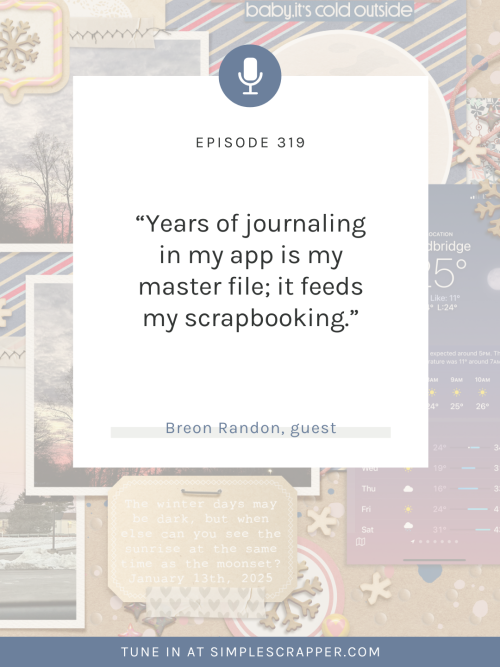
How to Subscribe
The best way to listen to Scrapbook Your Way is with a podcast player on your mobile device or with iTunes on your computer. You can subscribe via Apple Podcasts, Google Podcasts, or by searching for “Scrapbook Your Way” in your favorite podcast app.
0 Comments