How do you scrapbook, really? I’ve identified six distinct phases of the scrapbooking process that collectively influence your joy and ease with the hobby. In this episode I’m sharing how we’re focusing on process at Simple Scrapper in 2026 and how each phase can highlight opportunities for more aligned decision-making.
Links Mentioned
Jennifer Wilson: [00:00:00] And so this leaves you with clarity, a sense of new possibility, andan overall feeling of just contentedness as we soak in all the facts, good or bad, and then use that to construct what comes next for us.
Welcome to Scrapbook Your Way, the show that explores the breadth of ways to be a memory keeper today. I'm your host, Jennifer Wilson, owner of Simple Scrapper and author of The New Rules of Scrapbooking. This is episode 322. In this episode, I'm sharing a peek at how we're looking at the process of scrapbooking at Simple Scrapper during 2026.
Hey friends, Jennifer here for another episode where it's just you and me chatting about scrapbooking. We'll be back to our [00:01:00] regularly scheduled programming with some prerecorded interviews very soon. But I had this little series that I wanted to put together to help us bridge the holiday season.
Now that we are well into 2026 this year is officially underway. I want to talk a little bit about what we are doing this year at Simple Scrapper, and one of those things is focusing on a theme of process. Now, when we think about process and scrapbooking, usually it's, I have an idea, here are my supplies.
Now I'm going to use the supplies to fulfill my idea. But this is gonna go a bit deeper than that. This is gonna go in the meta layer where it's not just about the tactile, the physical things that we're doing to make something. It's about the full suite of phases in your scrapbooking process.
And I've broken these [00:02:00] down into six distinct phases. So I really want to spend some time this year exploring everything that happens to get you to that end result because we spend so much time focused on just that thing that we're creating and even this, this kind of concept of beginning with the end in mind, there is a lot of value in that, but I also think it encourages us to skip over some of the more reflective parts that can help us make better decisions.
From the starting point, because when you are more aligned with what works well for you and more understanding of your own process, and what aspects of a process are strengths of yours, what aspects are weaknesses, you're able to make better decisions about the types of things that you're working on. So as you're creating throughout this year, I wanna [00:03:00] have these conversations about these six distinct phases of the scrapbooking process.
And we might think that, oh, well, for everything I might wanna create, I go through all these phases and really we're all kind of moving in and out of them all the time. Concurrently, it's very rare that we are. Taking this kind of consecutive journey start to finish. But we're gonna use this opportunity of a year to walk through them and then see how they can layer into your hobby.
And we'll be doing that a little bit here on the podcast. Um, but we'll be doing it even more in depth inside of our community. So this year members can expect exclusive articles in Spark. Our member magazine will have six issues of that this year with the first one coming out January 15th. And then we'll also be having in-depth conversations on specific aspects of each of these six phases of process at our monthly member [00:04:00] meetings.
And so by looking at each of these phases, one by one, you can start to identify opportunities. Of how you can specifically support yourself in that phase. What you need, what you need to tweak, what you need to adjust or hone to make your whole process work a little bit better. And that's not something that happens when you're just looking at process as this thing, as this start to finish.
This is, these are the things that I do. This is what I touch, this is what I cut, and then I have a scrapbook page that's. Very factual, very specific, and we're gonna go beyond the superficial layers of that. So, to kick off this exploration, I wanted to record this episode and perhaps intrigue those who maybe are considering a membership.
So let's run through the six phases.
All right, so first we have intention. This is why you [00:05:00] create what you want this season of life to feel like what's. Motivating you right now to be a scrapbooker? What is the direction in a big picture sense that you're heading and this kind of thinking gives you emotional clarity and allows you to.
Begin every scrapbooking endeavor or activity with a creative why. So again, you're making these great decisions that you're more likely to finish and you're more likely to stay motivated throughout the process. So next we have preparation and you might immediately think of just gathering the stuff we need.
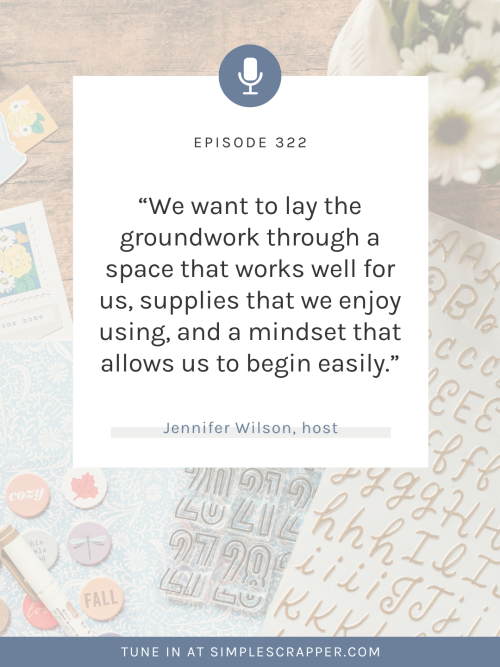
And yes, that is part of it, but this is really about how are we preparing ourselves to create consistently throughout the year. We want to lay the groundwork through a space that works well for us, [00:06:00] supplies that we enjoy using, and don't just keep skipping over or not using. A mindset that allows us to begin easily, feel ready, and have an experience that feels like it doesn't have any friction.
So this element of preparation is really about clearing space for what's next, and always kind of having that space on deck for your hobby.
And next we have inspiration and one might think this is where we would begin the creative process, but really we had two elements before this. These are ones that were laying the groundwork, laying this framework for you to then capture inspiration, to soak it up to kind of mine, all the things that are out there for what you might possibly want to work on.
So this is where you're asking yourself, what is sparking my curiosity? What do I have the energy and the [00:07:00] inclination to explore? How am I keeping track of and staying connected to the stories I want to tell and the creative ideas I have? So it's all of these different aspects of how we're tending our creative spark so that it's always burning and we have the ideas that will serve us best, curated and ready for us to use.
But if we don't know kind of what's important to us, for example, with our intention, we can't even start making those decisions and collecting inspiration that will serve us well.
So that's why this cascade of phases does matter, because as you iterate through it again and again, you will refine your process so that each step is more informed from the ones before it. [00:08:00] And so that takes us through the first half of the year. And I think you can already see how we're always thinking about these things.
We're always thinking about, well, what am I interested in? Do I need to organize my space? Where am I gonna store this, sketch that I wanna use? I have this new interruption, so how's that gonna affect the time that I have? So all of these practicalities are. Leading us to consider these different phases of our process all the time.
Alright, in the second half of the year, we'll tackle the next three. And that number four item is curation. So this is where we are starting to make decisions, choosing what matters most to us. This idea of curation is aligning our decisions with the photos, memories, and materials that light us up, that, have a lasting impact, that feel connected to our heart [00:09:00] and have deeper meaning to us.
And so what this ends up. Leading you towards is a true sense of focus because there will always be more projects. To create more products to use, more stories to tell, more photos to scrapbook than we could ever tackle. And so we have to choose some of them and these layers that we've used so far, intention, preparation, and inspiration, all kind of help us narrow down in the curation is then using that and tapping into what you know about what matters to actually make real decisions about.
The type of scrapbooking you want to do, the format, the size the types of stories such as milestones, connected memories, everyday life stories and even the types of products that you want [00:10:00] to use or use up. 'cause maybe you have a bit of stash that is weighing on you. So this curation element is. An important bridge between all the parts that are going on our head and all the things that we're gonna end up doing with our hands, whether that's in physical life or on our computers.
And so that brings us to phase five, and that is execution. So this is the doing phase. This is where you're making progress. You're maybe encountering some obstacles. You're letting go of perfection. You are figuring out how to move forward and how to do so with ease. You are trying to find momentum where you can, and.
Keep moving towards that finish line with course corrections as needed with leaving breadcrumbs for yourself so that you know where you left off if you do have to step away. And so [00:11:00] this is where we get down to brass tacks in terms of tactics and strategies that we talk about throughout the year, both here on the podcast and inside of our community.
I would say in general, when we're talking about process, we tend to focus on this execution step, but you can see this is just one of six different phases that are so important. And then finally we have reflection. This is where we look back in order to look forward so that it can shape what is next for you.
This is what we do at our annual planning party. You can observe what you learned and loved about this particular year, this particular season of life. You can feel new insights. Gain perspective on what you might want to do the same or differently in the future, as well as feel closure and an opportunity to let go of maybe things that didn't work as well or disappointments and to just move on to the next [00:12:00] thing that does feel more aligned.
And so this leaves you with clarity, a sense of new possibility, andan Overall feeling of just contentedness as we soak in all the facts, good or bad, and then use that to construct what comes next for us, going back to our intentions. As I mentioned this is the heart of what we do in the planning party, and it's also very much a part of what we do every single month at our member meetings.
As part of our journey planning process, we are constantly inviting our members to do that reflection on a smaller scale on the near term from the past week 2, 3, 4, and use that information to move forward. And then at that annual scale, we're thinking bigger picture. What are the trends across time? What kept getting pushed aside? What did you actually spend your time on? And [00:13:00] what can we learn from that and how can we move forward from it?
So I'm super excited to delve into process, to really separate these things from just the act of scrapbooking, because the more that we really, really dig in, the more that we can understand.
Because simple scrapbooking to us is doing what works well for you, doing it your way, and this is how we're gonna peel apart all the different layers to better understand your way in scrapbooking this year. I hope you'll come along for the ride. I can't wait to dig in further.
Thanks for listening, and as always, don't forget that you have permission to Scrapbook Your Way. [00:14:00]
Sign up to receive email updates
Enter your name and email address below and I'll send you periodic updates about the podcast.
How to Subscribe
The best way to listen to Scrapbook Your Way is with a podcast player on your mobile device or with iTunes on your computer. You can subscribe via Apple Podcasts, Google Podcasts, or by searching for “Scrapbook Your Way” in your favorite podcast app.
0 Comments