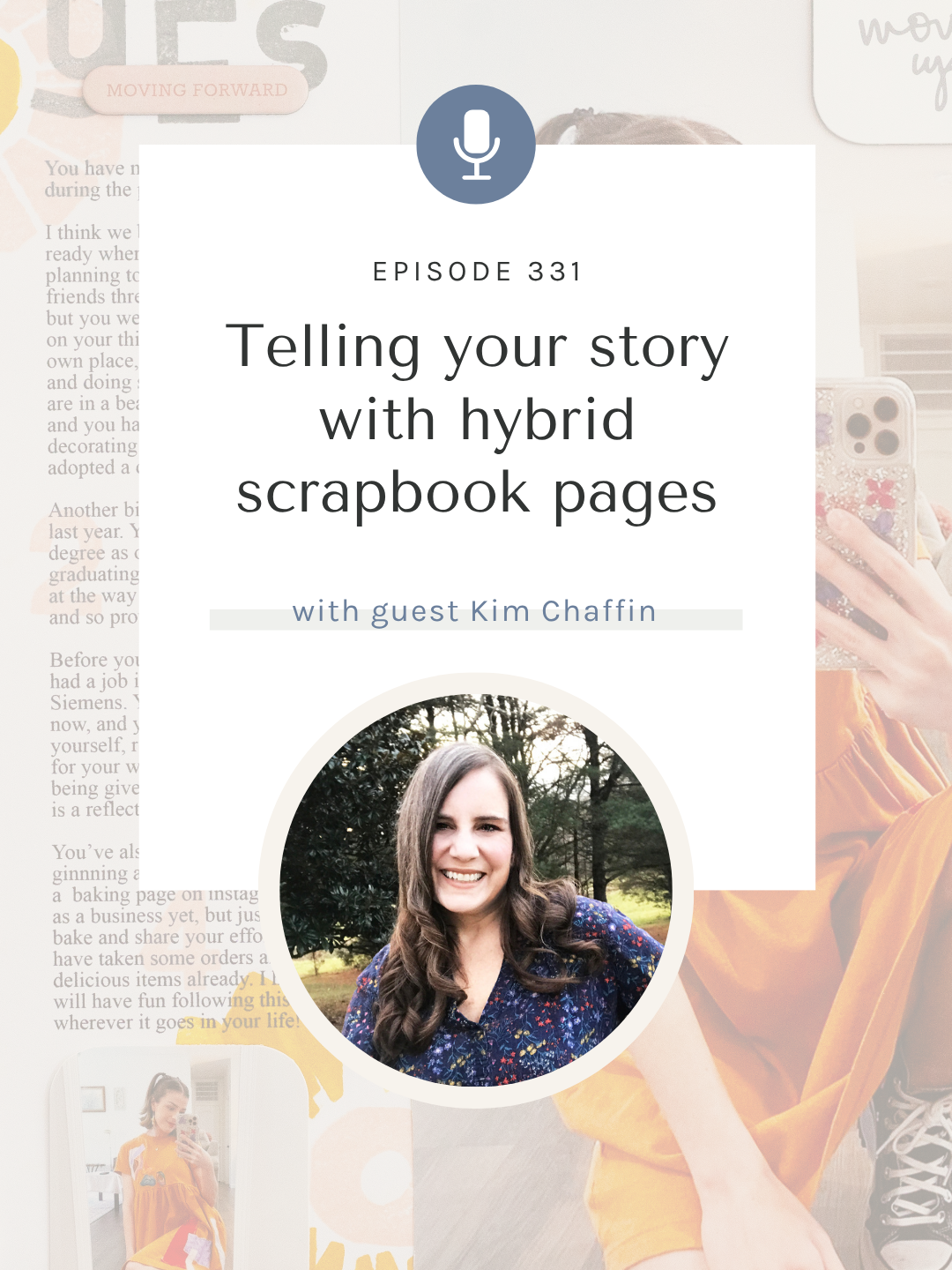
Kim Chaffin has been scrapbooking for nearly 30 years, ever since a friend invited her to a Creative Memories party and she realized the photos she was already taking and the journaling she was already keeping belonged on the same page. She lives in Tennessee, in a town internationally known as the storytelling capital of the world. That passion for story is at the core of why she never gets tired of this hobby.
- She talks honestly about the stack of heritage photos and genealogy research waiting in her craft room, and why those feel more intimidating to tackle than everyday stories.
- Kim describes her hybrid, minimalist, photo-centered approach in detail: she sketches a layout first, then works in Photoshop to size photos and print digital supplies, assembles everything by hand, and adds canvas textures, pop dots, or a coat of gloss where she wants dimension.
- She has shifted this year from weekly Project Life back to story-focused pages and shares why making that change felt right for her practice right now.
- Kim keeps a running notebook of story ideas and has years of notebooks she works through as she creates, a habit that keeps her excited for whatever comes next.
Links Mentioned
- Kim on Instagram: @kimdocumentslife
- Kim’s YouTube Channel
- National Storytelling Festival
- Creative Memories
- Project Life
- December Daily
- Photoshop
- Paislee Press
- Dunia Designs
- Sahin Designs
*Affiliate links help to support the work we do, at no additional cost to you.
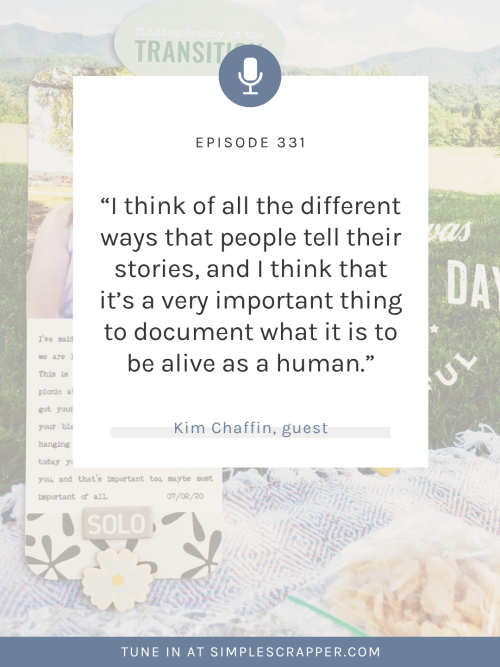
Kim Chaffin: [00:00:00] I think of all the different ways that people tell their stories, like through music or art or whatever. And think that it's a very important thing to document what it is to be alive as a human. And I think that that's the reason that I don't get tired of scrapbooking.
Jennifer Wilson: Welcome to Scrapbook Your Way, the show that explores the breadth of ways to be a memory keeper today. I'm your host, Jennifer Wilson, owner of Simple Scrapper and author of The New Rules of Scrapbooking. This is episode 331. In this episode, I'm interviewing Kim Chaffin for the My Way series. My Way is all about celebrating the unique ways memory keepers get things done.
We're excited to have Kim as the April featured artist at Simple Scrapper.
Hey Kim, welcome to Scrapbook Your Way.
Kim Chaffin: Hi.
Jennifer Wilson: I am looking forward to our conversation today. Can you start by sharing a little bit about yourself?
Kim Chaffin: Yeah, sure. Um, [00:01:00] my name's Kim Chaffin and I live in northeast Tennessee. I'm married, uh, my husband and I have four grown children. We have one grandchild and a beagle and a cat. And we live in a 100-year-old farmhouse, sort of out in the country.
Jennifer Wilson: Oh, very fun. Very cool. We just stayed at this very, very old Victorian house, um, in, in Iowa, on the river. And we decided that we couldn't, we probably don't ever wanna live in a really old house. 'Cause literally everything creaked, every step, everything you do, it creaks.
Kim Chaffin: It does. It does. It's very drafty, but it was always my dream to live in an old house.
Jennifer Wilson: Yeah. Yeah, it's beautiful. I'm sure. So I always like to ask our guests a couple icebreaker questions. So do you have a favorite recent layout or project, and why do you like it?
Kim Chaffin: Well, okay, so we lately, uh, in this area, we don't get much snow anymore. And my kids did get a lot of snow when they were [00:02:00] younger, but it, it makes me kind of sad that my granddaughter doesn't get to see as much snow. But we have been having a little bit of a snowy winter and so I'm really enjoying using some of those like, wintery products that I don't get to to play with very much. So, a recent favorite. Um, my kids each have sent me, they're grown, so they don't all live with me anymore. But they each sent a picture of themselves in the snow. When we, we did have a snowy winter and one of the big storms, they sent me a picture.
And so I did this layout, uh, that featured those pictures and it kind of had some like, um, I don't know, I guess words of advice to them about, you know, enjoying the magic of life and the moment slowing down and the way snow kind of makes you do that. And so that's, that's one of my favorites lately.
Jennifer Wilson: That's really cool. I love that story and I love how you invited your family to participate by taking photos from where they were.
Kim Chaffin: Yeah. I like to do that because they're not, I can't be the one, you know, taking all the pictures [00:03:00] anymore. So I love it that they share with me.
Jennifer Wilson: Yeah. Yeah, it's lovely. So is there something that you're excited to do, use or try so something new inside of scrapbooking or in your everyday life?
Kim Chaffin: Yeah. Yeah, scrapbooking wise, I've been kind of collecting more stamps lately. I'm, I'm kind of perfectionist, and so I've kind of gravitated toward digital things. Because I can control it a little more. And stamping to me is, I don't know, it's a little imprecise and messy. But I've been having a little fun with like, just trying to lean into that and not be so perfectionist. So I've been collecting some stamps lately, and I hope to, to play with those more in the future.
Jennifer Wilson: It's very cool. Yeah, I hear that a lot. 'Cause there's, they're so beautiful and I think, I feel like stamp sets are getting bigger and bigger too. Now we have the six by eight ones and so we just, that's just that many more stamps that we have to play with and yeah, I can't wait to see what you do.
Kim Chaffin: Yeah. It's really fun, I think. But yeah, I just have to learn not to be so, you know, so control oriented. If it gets a little messy, it's okay.
Jennifer Wilson: I [00:04:00] totally get that for sure. So this is our My Way episode because you're one of our featured artists this year at Simple Scrapper. Um, what would you say to a non scrapbooker about why you love this hobby?
Kim Chaffin: Well, yeah, I've been scrapbooking a really long time, so it's something that I really do love a lot. And I'd say probably at first it was just a creative outlet for me. But I think now that I've had a lot of years to think about that and why I do keep coming back to it is, um, the storytelling aspect of it. Um, I, I think that's really important. I live in Jonesboro, Tennessee, which, it's a really small town, and if you, if anybody has heard of it, it's probably because you, it's known as the international storytelling capital of the world.
Jennifer Wilson: Oh wow.
Kim Chaffin: Yeah, even though it's a really small town, we have a festival every year where it draws more than 10,000 people that that come and they listen to [00:05:00] just oral storytelling. I just, for me, I think that's what scrapbooking is. I mean, I think of all the different ways that people tell their stories, like through music or art or, or whatever. And think that it's a very important thing to document what it is to be alive as a human. And I think that that's the reason that I don't get tired of scrapbooking. And go on to some, you know, there's a lot of creative outlets.
Jennifer Wilson: Oh, for sure.
Kim Chaffin: But for me its the storytelling, I think.
Jennifer Wilson: Do you do any storytelling that's outside of scrapbooking?
Kim Chaffin: Not, not like officially like.
Jennifer Wilson: Yeah.
Kim Chaffin: Storytellers do in the, in the festival, but I kind of think we all do in the ways.
Jennifer Wilson: Certainly,
Kim Chaffin: That we share our, I I don't know, like, you know, anytime you get up in front of a group and talk about your life to people. That's sort of storytelling. And then just the things that you choose to share. I don't know. I think we all do it in various ways if you pay attention, but not professionally. No.
Jennifer Wilson: Oh yeah. The paying [00:06:00] attention part, that's, that's so important. And the more that you kind of embrace the different identities that we have. Like whether it's being creative or being a memory keeper, being, you know, a family legacy keeper. What, whatever it is that you feel in your connection is to this hobby.
When you embrace that, the more that it just, I don't know, permeates your life, I guess.
Kim Chaffin: Yeah. Yeah.
Jennifer Wilson: So tell us about how you got started scrapbooking.
Kim Chaffin: So, um, I was invited to a Home Creative Memories party, uh, by a friend, like, I don't know, 28 years ago, I think. And I had no idea what it was. She told me to bring photos along and that's all I knew. And that was, that was it. I was just kind of immediately hooked. Because, well, she knew that I, that I took a lot of pictures of my kids and my family. And I also kept a journal at the time, so it was just, I don't know, it was kind of a perfect fit for the things that I loved already.
Jennifer Wilson: And where were you in your [00:07:00] like life stage in terms of your kids and and your marriage and that at 28 years ago?
Kim Chaffin: Gosh. Yeah, I was, I was young. Uh, yeah. My, my, my kids were young. I was very busy. I really barely had time to scrapbook back then. All my kids hadn't been born yet. They, some of them came later. So yeah, I was just in the middle of young parenthood.
Jennifer Wilson: How has your scrapbooking changed since that time? Are you still scrapbooking exactly the same way as you did 28 years ago?
Kim Chaffin: No, no, no. Yeah, no. Back then it was like cut the photos into stop sign shapes, and I don't know if you've been with it long enough to remember all of that or not.
Jennifer Wilson: Yeah, I started with a Coluzzle cutting photos into circles. So not quite.
Kim Chaffin: I remember that.
Jennifer Wilson: More, let's see, like 21 years I think was my first layout. So
Kim Chaffin: You're, close to close.
Jennifer Wilson: Yeah.
Kim Chaffin: Uh, yeah. No, it's, it's style has changed a lot. My love of it hasn't changed, but yeah, [00:08:00] I'd say I'm a lot more like simplistic.
Jennifer Wilson: Uhhuh.
Kim Chaffin: And clean in my style. Then I was like, you know, cut out the photo into a shape, write some things on the page and slap some Mrs. Grossman stickers on it, and that was it.
Jennifer Wilson: Yes, yes, yes.
Kim Chaffin: But It's evolved a lot since then.
Jennifer Wilson: So tell us about the sizes and formats you're typically working in these days.
Kim Chaffin: So yeah, um, I mixed it up a little bit. But over the years with, with Creative Memories, I started with 12 by 12. And that's probably kind of been my go-to over the years. But, um, not all, you know, I, I do mix it up this year. I'm working nine by 12 just because I think sometimes it helps spark creativity to change up the size a little bit.
Um, within each album though, I usually will insert smaller pages occasionally too. So it's kind of a mix. But I do usually keep it pretty big. I kind of need a, I don't know, I feel like I need a lot of real estate to work with, so, so [00:09:00] yeah, I gravitate toward the bigger sizes.
Jennifer Wilson: Now you, you do a lot of hybrid work, right?
Kim Chaffin: I do. Yeah.
Jennifer Wilson: How has incorporating more of that impacted the size or not at all? Like do you, do you do more like six by eight or the 10 by eight, that type of size? Um, because you're doing more of the hybrid things or.
Kim Chaffin: I don't, I don't know if that really makes, I have a large format printer, so it doesn't, I don't know that that really makes a difference. So I just, yeah, do whatever size I want to. But kinda like the bigger, because it gives me more room to put a lot on the page.
Jennifer Wilson: Yes. And has switching to nine by 12 like is the rectangular canvas. How does that, how does that work with your brain versus the square? Has it been a challenge or.
Kim Chaffin: I. No, I think I liked the change because I think I always did find the six to six by eight appealing.
Jennifer Wilson: Uh,
Kim Chaffin: But it was kind of too small. for me. Like I felt like I couldn't squeeze everything in. And like I do have the focus [00:10:00] on storytelling, so I usually have a lot of words. So the nine by 12 is the same, you know, ratio as the six by eight. So I think I enjoy that, that change. Um, since I've done some, I did 12 by 12 for a lot of years.
Jennifer Wilson: Nice. Nice. So, what kind of projects or recurring activities or one-time activities, uh, will be part of your repertoire on your plate this year? Or are you just making one layout at a time about your stories?
Kim Chaffin: Yeah, I, I've been doing more story. But last year I kind of did the week to week Project Life and. So that's another change I made this year is to get a little back into more story focused. So I'm not doing the week to week anymore, and I'm enjoying that change also. Um, I'm still trying to finish up my December Daily album, so I'm a little, I don't know.
I'm trying not to see it as behind. I'm just, it'll get done when it gets done. But yeah, I'm, I'm doing story focus pages. And then something I'd like to get into before the year's up. I have a lot of, of, um, like heritage type [00:11:00] things.
Jennifer Wilson: Mm.
Kim Chaffin: Old family pictures from my grandparents and my parents. And their stories before I was born.
I've interviewed some family members and I've done some like research tracing genealogy. So I'd really like to get into getting some more of that into albums too this year.
Jennifer Wilson: Yes. I think that's like a, a back burner project or maybe even front burner for a lot of people. But I know it's one of mine too. Like I have boxes and boxes of things that I'd like to tackle.
Kim Chaffin: Yeah. I think I'm intimidated.
Jennifer Wilson: Yes.
Kim Chaffin: I'm afraid I won't do it justice. It feels more precious somehow than, than just the everyday stuff that I'm doing for myself.
Jennifer Wilson: Totally. I see that a lot. How do you store your layouts? Do you store use categories chronologically as you make them? What does that look like?
Kim Chaffin: Roughly chronologically, it's kind of a mess really. So I don't keep up to date chronologically. 'Cause it, um, there's years that I haven't done anything with. So I have all of these [00:12:00] open albums in my scrapbook room. And I've got little post-it notes on them with what year it is. And so roughly chronologically I'll insert layouts sort of where they go. And it'll, it'll come together somewhat chronologically in the end, but precisely. So it's not like. I would be upset if a layout that happened more recently appeared in the album.
Jennifer Wilson: Sure.
Kim Chaffin: Know, earlier it's, I'm not, not real picky about that, but yeah.
Rough. I don't scrapbook chronologically. Not at all, but, but roughly It'll be chronologically in the end.
Jennifer Wilson: Sure, sure. I think that works for a, a lot of people to have the freedom to, to work with whatever story they want to, and then file things in a way that maybe feels the most comfortable.
Kim Chaffin: Yeah. Yeah.
Jennifer Wilson: So let's talk about your style. How would you describe it, um, in, in three words, if you could?
Kim Chaffin: Okay. Um, well, you used one of the words already, hybrid, I would say for sure.
Jennifer Wilson: Yes.
Kim Chaffin: Um, minimalist and [00:13:00] maybe photo centered. Because I, typically have very large photos somewhere in the layout.
Jennifer Wilson: What would your process look like? Do, are you typically working from a story idea, a product you wanna use, a design inspiration, or could it just be any of those any day?
Kim Chaffin: It, it can be any of those. I rarely, well, no, I will, I was gonna say, I rarely start with product inspiration, but that's not true. Yeah. Any of, I would say any of those, it can be, I think I'm more often starting from the story or photos.
Jennifer Wilson: Mm-hmm.
Kim Chaffin: That I want to use, but, but yeah, I've definitely been inspired by a product and found ways to make it work.
And yeah, any, any of those can be a starting point.
Jennifer Wilson: Are there any particular products, tools, or techniques that we would see really often in your scrapbooking? Like some sort of like a technique through line that defines your style?
Kim Chaffin: Um, I, I think I, I'm pretty, uh, I really just need the basics. I think I'm pretty.
Jennifer Wilson: Uh.
Kim Chaffin: I [00:14:00] have my computer, my printer, some card stock, photo paper, adhesive, and trimmer, I could probably be happy scrapbooking with, with just that alone. But I, you know, I do like the other fun stuff too. But, but I think most of mine is more computer fo I do a lot of the putting together the layout in Photoshop on my computer first. And then I print out the parts as and put them together. So, so it's definitely very computer oriented.
Jennifer Wilson: Let's dive a little more into that. So what, what parts of your pages are typically hybrid and which are you using physical supplies for?
Kim Chaffin: Hmm, that, that varies. But, um, so some of it can be completely printed from the computer and some, some of it will be, you know, like physical product that I add afterward. Um, typically though I will print, I, I usually sketch out a design prior to getting on the computer. And then once I'm on the computer I will print. I will figure [00:15:00] out the size of photo that I need, and usually it will have the title, so maybe the title might be a digital thing on the photo. And then I'll print that. The background could be plain white card stock, or it could be patterned paper that I have already. But, more often it's, I use a lot of digital, so more often it's some digital pattern paper. And then I print it out and the embellishments might be digital also, or sometimes I draw from physical things that I have, so, so that varies a little bit.
Jennifer Wilson: And so when you are using like digital embellishments and digital pattern paper, you're typically printing those out as separate items.
Kim Chaffin: Yeah. Yeah.
Jennifer Wilson: Okay. Very cool.
Kim Chaffin: The nice thing too is you, I can resize them.
Jennifer Wilson: Yeah.
Kim Chaffin: Or sometimes even change color if I need to.
Jennifer Wilson: Fun. Fun. Is there a trend that you are loving right now?
Kim Chaffin: Hmm. I, I, I struggle with that question a little because I don't know whether I'm very [00:16:00] trendy. Um. I do think I've seen like a shift in the pages used to be that you saw, you know, people sharing and publishing were a lot more white card stock and not a lot of color. I'm seeing more color and pattern paper and I think, I think lately I'm a little into that too. Like enjoying putting more color back on my layouts than I did for a while.
So. Maybe, I don't think I'm really trendy in terms of like. necessarily keeping up with what the latest thing is in scrapbooking. But I, I do think there's a trend toward more color, and I think I am kind of on that band bandwagon a little bit.
Jennifer Wilson: Well, I think it's such an interesting thing because the, the paper world is typically pretty slow. And the digital world tends to be much faster, but they're, they're not always kind of in sync with trends. But what you described though, actually seems to mirror what, what's happening in fashion. We've, we're going from minimalism to maximalism.
Kim Chaffin: Yeah.
Jennifer Wilson: [00:17:00] Um, that's, I don't know, kind of interesting. Yeah, I, this question stumps me too, because I'm not even sure where I would go to figure out what is trendy. Like we all, especially with, you know, my philosophy and scrapbooking your way, I hope everyone is doing just what they want. You know, what, what they like, what they enjoy.
Kim Chaffin: Exactly. Yeah. Yeah.
Jennifer Wilson: So is there something in our hobby that you've decided is just not for you? You've tried it and you're like, Nope. Or maybe you haven't even tried it because, you know, uh, this isn't gonna be work for me.
Kim Chaffin: Um, yeah, that's, that's another difficult question. And I don't, don't know that I have a great answer. Because, even when I look at things that aren't really, um, my kind of thing, I, I kind of think of it as a little bit of a fun challenge to try to at least once try to, to find a way that I could make it work. Um, I will say that back, I don't know, maybe 10 years or so ago I was putting like heavier, bulky things on the page. Metal even, you know, gluing metal [00:18:00] frames and things like that. And I've kind of like never again with that. Because I found that over time they kind of, uh, the pressure in the book, it, it makes indentions on the facing page and I just. Yeah, I don't, I don't like the damage that that can cause to other pages in the book, so probably really bulky embellishments I'm done with. I wouldn't do that anymore, I don't think.
Jennifer Wilson: Yeah, those little like round buttons were popular for a while. I think I got so many of those in various kits and I, I did use them, but you're right, they do make quite an indention. On the pages around them, so.
Kim Chaffin: Exactly. Yeah. I used a lot of that. And even like, just big like stones and.
Jennifer Wilson: Mm-hmm.
Kim Chaffin: Things like that. And now I open 'em up and they've kind of like, they're, they're not doing nice things to the other pages in the book. So I, I don't think I would do that again.
Jennifer Wilson: So where do you typically scrapbook and like, how does that fit into your week?
Kim Chaffin: So being creative is kind of an important thing to me. So it's a little bit of a goal to, uh, be creative at least for a [00:19:00] small period of time every day if I can. That doesn't always work out 'cause you have busy days. You're not even in town some days. But I try, if nothing else, just to print a few pictures or type out some journaling on my computer, even if I don't have time to sit down and do a whole lot. I do have a scrapbooking room now, which is really nice because. For a lot of years when my children were younger, I didn't have the space to do that. So it was on the dining room table or even spreading out on the floor sometimes.
Jennifer Wilson: Mm-hmm.
Kim Chaffin: That made it a lot more prohibitive, you know, because you have to get everything out and put everything away.
So now that I can leave things out, I do try to do just a little something creative every day. And if I have time, it's usually in the afternoon. Um, sometimes I'll find free time before the family comes home to really dig in and, and get a lot done.
Jennifer Wilson: Now talk to me a little bit about organization. Are you a like neat and tidy? Everyone has, its, everything has its place, person, or are you a like this is, it's all chaos and I love it kind of person.[00:20:00]
Kim Chaffin: I want, I want to be neat and tidy, but it's a little bit chaos. Um, I wish I had someone to come and like help me, help me organize things. That's not my strong point.
Jennifer Wilson: Mm-hmm.
Kim Chaffin: Uh, I do have like baskets and bins and I try to keep everything labeled so I can find things. But, I'm maybe a little bit with scrapbooking,
I might be a little bit of a hoarder too.. So I have things here that are decades old and it piles up after a while. And so, yeah, I'm not, not the greatest with organization. But, um, I, I do pretty much know where everything is, but it's a lot sometimes.
Jennifer Wilson: So with that, do you have any particular strategies, either for photos, supplies, or tools that has worked well?
Kim Chaffin: Um, well, okay. Digitally, I'm a little better.
Jennifer Wilson: Uh.
Kim Chaffin: With photos. I do, I do keep those organized so that I, I can pretty much find a picture anytime I want to. Every year, I, I make a, a folder for that year, and then within the folder, each month [00:21:00] and at the end of every month, I upload all the photos that go in that folder. So that my, my pictures are pretty organized and easy to find, but it's just, yeah, my supplies that, that, that could use some help.
Jennifer Wilson: And so your photos, are they, they're living in a folder structure. Are you using software? 'Cause you mentioned you use Photoshop for your scrapbooking.
Kim Chaffin: Yeah, yeah, yeah, yeah. Well, so my, my actual computer hard drive probably couldn't hold a lot.
Jennifer Wilson: Mm-hmm.
Kim Chaffin: I, I keep them backed up on, I keep them backed up on hard drives. But, um, and then, yeah, I pull 'em in, pull them into Photoshop when I'm ready to use them.
Jennifer Wilson: Great.
Kim Chaffin: And then my, my digital supplies are fairly organized.
They are by collection and designer. So yeah, I guess I do okay organizing digitally. It's just the physical stuff that I'm overwhelmed by.
Jennifer Wilson: I understand. I understand for sure. Are there any products that you're like eager to work with next?
Kim Chaffin: I, I don't know that I have an answer for that.
Jennifer Wilson: Oh, That's okay. Or a story that you're, they're wanting to tell, [00:22:00] so.
Kim Chaffin: I'm, I'm sorry. I think you, I think you stumped me.
Jennifer Wilson: That's okay.
Kim Chaffin: I have a lot of stories, but nothing, nothing's jumping out at
Jennifer Wilson: no, that's okay. It's okay. I think we're always in progress on lots of things. Particularly with, with you, it's like the creative fulfillment part of it is a priority, and so as long as you're touching it and moving things forward, you're staying connected and you're moving things forward. So that's, that's what really matters.
Kim Chaffin: Yeah, and I just, I kind of get excited about all of it. So I don't have anything, like I've got this whole list that I keep going, you know? That's, that's what I work on. And so, yeah, each new project is exciting for me. And the products I use will kind of be dictated by what the project is. So it's, yeah, nothing in particular, but, but I'm always excited for the next story.
Jennifer Wilson: Where do you keep that list?
Kim Chaffin: Um, I have a, a notebook actually that I just, um, keep adding to, and when it gets filled up, I start a new one. So that I have kind of years and years of notebooks and I work through them as I make my pages then.
Jennifer Wilson: That's really cool.
Kim Chaffin: [00:23:00] I'm like that. I'm a paper person. I do most.
Jennifer Wilson: Yeah.
Kim Chaffin: Of my organizing of ideas on paper.
Jennifer Wilson: Very fun.
Are there any particular hybrid tips that you would share? Because I think, like, I see your pages and, and I have some Photoshop experience, and so I'm like, oh yeah, that'd be, I would love to create some things like this. And I know how to do it, but I also know how intimidating it is for someone who doesn't have as much experience or any with Photoshop, but wants to have that minimalist kind of clean look and feel that, that you create.
Kim Chaffin: Yeah. Um, well, the one thing I would say is that you don't have to use a lot at once. You know you can look, I look at magazine pages for ideas. You can look at things like that and that can give you design ideas. And then with a lot of the digital products, all you gotta do is print them. You don't really have to even know how to use Photoshop or any kind of photo editing software. 'Cause you don't, unless you want to change size and.
Jennifer Wilson: Mm-hmm.
Kim Chaffin: [00:24:00] Color and things like that. But um, and the thing I would say too, in terms of hybrid is that you can, even though you're printing these things onto flat card stock and paper, you can have a lot of play with how they look in terms of physical products. Because, there's canvas you can print on canvas and make fabric embellishments. Or you can put like a layer of um, oh, like, like cardboard or something underneath the card stock to give it some dimension or pop dots or anything like that. So things can have dimension. You can even, like, there are like glossy you could paint, um, like Mod Podge or something glossy if you wanted to give it a little bit of shine.
So there's lots of ways that even though you're just printing on paper and, and using it that you can still make it look like, you know, other physical product. It doesn't have to look just flat.
Jennifer Wilson: I remember the first time I did something like that, this was, oh gosh, like [00:25:00] 2010, 2011 and I, my, my brain was just like, oh, wow. I didn't even realize. So I'd, it was a circle embellishment. And so I punched the circle out of the card stock, and then I punched the circle out of the cardboard. I adheared them together, and then I just like simple, clear embossed on top and I'm like, oh my gosh, I have a dimensional embellishment now.
This is amazing.
Kim Chaffin: Yeah. You, you do. Yeah. And it doesn't look that different in the end.
Jennifer Wilson: It looks like what's, you know, what you would buy at the store.
Kim Chaffin: Yeah.
Jennifer Wilson: So, Kim, where would you like your scrapbooking to be 10 years from now?
Kim Chaffin: Well, so I've already been doing this for, for more than a couple of decades and, and I'm still, you know, not finding that my passion for it dwindles any. So I hope that that continues. Um, as far as style goes, it's really hard to say because 10 years ago I probably never could have envisioned the way I do things now.
So I don't know for that. I'm just kind of along for the ride. I just hope that I continue to have fun [00:26:00] with it and that that's what matters most to me.
Jennifer Wilson: Yes, yes, yes. I love that. And what has being a scrapbooker taught you?
Kim Chaffin: I, I think the most important thing that being a scrapbooker has taught me is, um, to pay attention to be present in my life. I think that early on I noticed that, that when I was scrapbooking, that I paid more attention and focused on, um, being there with my kids and the stories that I wanted to tell about our life. Because I knew that I had a place where it was going to go, and so it made me pay more attention. And so I think scrapbooking has increased my presence, my being present. And that that's, I think, an important life lesson, whether you scrapbook or not.
Jennifer Wilson: I love that wonderful perspective. Kim. Thank you so much for spending time with me on the podcast. Can you share where our listeners can find you online and anything new or exciting you might have coming up later this year?
Kim Chaffin: Yeah, mostly with scrapbooking wise. I am on [00:27:00] Instagram @kimdocumentslife. I do a little bit, but under the same name on YouTube. I post videos once in a while, but I'm much more present on Instagram. As far as exciting this year, um, I am working on or creating on design teams for Paislee Press, Dunia Designs and Sahin Designs. Which I would say all three are excellent sources of digital supplies if you want to, to get into more hybrid scrapbooking.
And so yeah, I'll be be producing pages or creating pages for those designers monthly. So we can look for those on Instagram.
Jennifer Wilson: Oh, wonderful. Yes, those are fabulous designers for sure. Again, thanks for spending time with me.
Kim Chaffin: Thank you. Thank you so much.
Jennifer Wilson: And to all of our listeners, please remember that you have permission to Scrapbook Your Way. [00:28:00]
Sign up to receive email updates
Enter your name and email address below and I'll send you periodic updates about the podcast.
How to Subscribe
The best way to listen to Scrapbook Your Way is with a podcast player on your mobile device or with iTunes on your computer. You can subscribe via Apple Podcasts, Google Podcasts, or by searching for “Scrapbook Your Way” in your favorite podcast app.
0 Comments