I’ve had the opportunity to review hundreds of scrapbooking plans created by members through our annual Planning Party events. In this episode I’m distilling my observations and advice into ten points for you to consider. I’m covering common pitfalls as well as suggestions for gentle, realistic planning for your hobby.
Links Mentioned
Jennifer Wilson: [00:00:00] We just want to feel like we're using our time well, most of the time. We're having a good time most of the time, and we're able to feel resilient when things inevitably don't go as planned.
Welcome to Scrapbook Your Way, the show that explores the breadth of ways to be a memory keeper today. I'm your host, Jennifer Wilson, owner of Simple Scrapper and author of The New Rules of Scrapbooking. This is episode 321. In this episode, I'm sharing insights on what makes a scrapbooking plan truly sustainable and pitfalls to avoid as you embark on another creative year.
Hey friends, let's chat a bit for this final episode of 2025. I wanted to share some takeaways from [00:01:00] reviewing a big pile of 2026 workbooks from our members. So this was something that I offered to members, an opportunity to send in their completed workbook from the planning party held in November, and I would offer any kind of insights, advice that I could, based on what I saw.
And so I have distilled all those observations into. 10 points that really apply to many scrapbookers to most of those plans. And so I really think they're gonna be helpful to you as well. These will give you a stronger foundation for heading into the new year.
And thinking about how you want to fill your creative plate, how you want to use your leisure time, with more intention and with an aim [00:02:00] towards greater overall satisfaction. 'cause this isn't. Isn't that what we all want? We just want to feel like we're using our time well, most of the time. We're having a good time most of the time, and we're able to feel resilient when things inevitably don't go as planned.
And so I'm gonna dive into these 10 different takeaways and how I think they can apply to your scrapbooking and even planning beyond that. So I want you to kind of keep both of these ideas in your head in terms of. These points can be applied to your hobby and how you're thinking about what projects you wanna focus on.
Maybe where you wanna lean in terms of using your stash, telling different stories, starting new creative endeavors
as well as using these concepts to inform the planning you're [00:03:00] doing throughout the rest of your life and the things that you're hoping to achieve in 2026. So before I dive in, I just wanna step back for a second and talk about. Our general planning approach we're gonna say this starts in November because that's when we host our annual planning party.
But really this is just kind of the running headstart for the year. An opportunity to reflect back on the previous 12 months how our hobby is working for us, how maybe it's not working as well, we can adjust going forward to have a better experience, but perhaps even more importantly. Inside of our community, we invite you to create a new plan every single month.
Now we break the year into six creative journeys so that the creative journey coming up on January 1st is our [00:04:00] habits journey for January and February, and we have these series of questions, this kind of inventory that we ask our members to do at the beginning of every journey to take a look at whatever they know about their hobby.
And actually decide what it is that they want to work on. And then halfway through that journey, so at the beginning of February, we'll invite them to check in with their plan and find out how's it going, what's working well, what's not working well? What adjustments do you need to make? Are these things still important to you?
Are you still excited about it? And. What shifts do we need to make to continue to have a plan that works with our lives the way they are right now? And what this approach does is it allows us to take. Everything that we know we think we might wanna work on are overarching priorities for certain photos to work [00:05:00] with, or stories to tell, or products to use, and then create a plan that evolves with us throughout the year.
So you're never really. Behind on your plan, you, your plan never gets off track because you're constantly updating it to what is realistic for you in the moment based on what you've already achieved and what you want and think you can do next. And so what happens is every year that you do this, the easier it gets because you understand yourself better.
You are more able to. Be realistic about what's possible for you. You're more able to understand how you respond and recover from disruptions, whether they're like creative disruptions that we create for ourselves by taking on something new or all those other things in life that pull us away from our hobby.
The more that you work through this [00:06:00] process, the easier it gets and the better, stronger, more informed your plans become.
And so I share this context for the. Recurring nature of our planning process, as well as the iterative nature of it so that as you think through these different ideas, I can underscore that you don't need to make these changes or implement them all at once. I want you to be going into this thinking about.
What is resonating with me? What stands out the most? When you're done listening, what is the key takeaway, the thing you wanna write down, the thing you want to try first, or the action you know you need to take, or the behavior that you need to change. And then this episode will be there for you in the future when you want to revisit it and adjust your plan accordingly.
Okay? All that context. [00:07:00] Let's jump into these takeaways from the 2026 planning workbooks that I reviewed. So first point here is I noticed that self-awareness was very, very high. From within. Our community members are understanding their season of life, their current limits, their motivations, but their confidence is still catching up to that understanding.
They're still hesitating to trust that awareness when making decisions,
so what this can look like is still maybe putting a little too much on your plate because even though intellectually you can understand, I might not be able to do all of this, or I'm really being pulled in this creative direction.
I should tell this story because it might be important to someone else. All those things that pile up on us, they can be a pretty loud [00:08:00] voice that can overwhelm that personal awareness. So this is something that takes practice to. Try starting to make those decisions to make them slowly and intentionally, and as you practice it, that's when the confidence will catch up, that you know what you're doing, that you can create a realistic plate for yourself, or one that is close enough that you can follow along, evaluate, and then update for the month to come.
The idea is never about perfection. It's about. Aiming just a little bit better. All right. Number two here is a really big one, and that photo management is a bottleneck behind almost everything in our hobbies. Sometimes this is very. Top of [00:09:00] mind. This is very loud to us, and sometimes it's kind of a quiet undercurrent that we might not be really kind of drawing all the connections to, but eventually it comes out.
Having your photos managed in a good enough way is something that really can enable or stall your progress. And it's not because you don't care or even that you don't know how, but it, it takes a lot of. Time and mental effort to make decisions about our photos, whether it's decisions about keeping or deleting a photo, decisions about maybe how you wanna edit the photo.
Narrowing photos down from large batches to make them more manageable is challenging and it's not always fun. Even though we love our photos and we love that we have them. The process of photo management can have a lot of this weight that's carried with it. And [00:10:00] that's not even to consider the additional emotional weight that might be there from certain stories that have happened in your life.
Certain, experiences, the trials and tribulations that we have. So that adds a whole additional layer. So what I want you to take away from this point here is to. Assess where you're at and if photo management's already a priority for you, you know, you want to focus on this to think about what is the simplest version of that that is sustainable, that's going to help you scrapbook more of your stories.
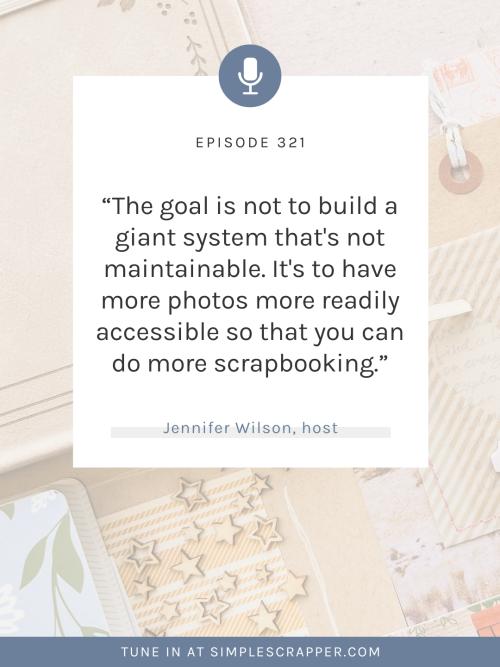
Because again, the goal is not perfection. The goal is not to build a giant system that's not maintainable. It's to have more photos, more readily accessible so that you can do more scrapbooking. And then at the same time, if photo management, isn't at kind of top of mind for you, [00:11:00] but you do feel this underlying sense of frustration.
That's where you might want to look at your overall process and see if it might be a bottleneck that you haven't recognized. All right, let's jump into number three. Again, this is another big one, and this is also one that. Bleeds over into so many other areas of life, particularly things we might be thinking about at the beginning of the year.
And that's that I noticed that community and accountability are doing the heavy lifting. They're doing more work than the underlying motivation. Motivation can be so fickle, depending on what's going on in our lives, what's going on in the world, how we're feeling, like physically, mentally, emotionally.
So we can't always count on that. But we can count on the calendar, we [00:12:00] can count on our peers. And so weekly crop times showing up again and again, becoming a regular, at certain events, whether it is joining us on Zoom or posting in the comments, doing this repeatedly. Those are the real drivers of consistency, far more than a sense of willpower and that I have to stick with this, or I am consistently inspired.
It's the fact that in the end, it is the action that often leads to the inspiration, it leads to the results. We can't just wait to feel motivated. We have to actually start taking action for that to build up and snowball into something more and more real. And so no matter where you are in terms of consistency in your habit, leaning on others and leaning on accountability systems, [00:13:00] both internally for yourself and with others, goes a long way towards.
Being more consistent and not having to rely on keeping your own inspiration high along the way.
All right, number four, and this is a hard one. Our plans are often still reflecting our ambition more than our capacity, and that's not,
and that's not necessarily a bad thing. The purpose of having a plan is to have an aim. We have a direction that we are going
so that we can even try, but it is important to understand what our capacity is and adjust our plans and to start thinking about them. So even when members are saying that they're planning, realistically, their goals often still assume best case [00:14:00] scenarios of energy, focus and time. And we know those all don't line up at the same time very often.
And so it's important to kind of think about different scenarios. I think the most important one is what is like, the bare minimum is that if everything kind of, barring catastrophe and really challenging unknowns, but a normal year of up and down, a normal year of waxing and waning motivation, a normal year of shifting interests and priorities.
What is the most realistic thing that you can get done that should be the foundation of your plan? And for some it looks like photo management and maybe one kind of project. It could be creating a certain number of layouts. It could be an everyday life type project. It could be a lot of different [00:15:00] things, but it often looks like a smaller number of things than many scrapbookers try to put on their list.
And from there you can then build a set of options so that. In those worst case scenarios, in the kind of the lowest common denominator situations, you know, you can get those things done and then when things. Go better than that. When you can ride the wave of momentum from accomplishing those starting points, you can then choose additional things to add to your plate, to build skills, to tackle other story priority, to have some fun with others, whatever it is that you wanna work on.
Part of having this plan, again, is the aim, but then we have to know what is that, what is that foundation that we're starting with?
And so with this, number five [00:16:00] is an observation that Scrapbookers are craving rails, structure, boundaries, not rigidity. They want to understand their purpose and again, the baseline goals, like I was just talking about, they want to be able to connect, their habits to certain points of in time with stacked habits, with triggers with recurring appointments on the calendar.
But on the whole, and this includes myself as well, we often react poorly to over-engineered systems and overly rigid schedules. We find those things fall apart way too quickly the important point is to kind of understand as you're planning for the future, particularly I think in this critical point of starting the new year, [00:17:00] this is where we like, oh well I can add that in.
And, oh, I wanna do this little listing thing in my planner. Oh, I could I think I do wanna tackle this project. But wait, we already kind of thought about. What your goals were for the year and now you're kind of all of a sudden kind of overcommitting as part of the pressure of turning over a new leaf.
There's a little bit of FOMO in there, fear of missing out. We have this sense of optimism for the future, but then we can put ourselves in this place of having this complicated system that we've derived that we can't actually. Use, maintain, sustain
throughout the year. And so what I want to recommend is that with every plan that you make,
Make sure that this plan is giving you rails and that it is [00:18:00] not overly rigid. Now, I do understand this is going to vary broadly from person to person. It doesn't mean that you might not need a very detailed checklist, but you might not want to put. Dates on that checklist for every single item.
Maybe a date for the next item on the checklist, and then when that's done, you can set a date for the subsequent item on the list. So this is another one of those things that does take practice, but even just the observation of what have I really created for myself? Have I created an overly complex, rigid system for myself that.
I won't be able to follow through on or am I giving myself this container of purpose and direction that is gonna continue to support me.
All right, this next one, number [00:19:00] six, it pairs with the last point and that I noticed that over planning is a far bigger risk than under planning. So if, particularly if you're feeling like you haven't done enough to get ready for the new year, I don't want you to get into this trap of.
Creating a planning system, a planning process, a planning, vehicle, particularly those physical vehicles or even our digital tools that become another thing to maintain in themselves. You do not want planning to be the project you want it to be something that supports you in accomplishing and, accomplishing your projects and working towards your goals.
This can become especially the case with a creative hub, which is a centralized location for all of your scrapbooking plans and ideas, any kind of tracking that you're doing, whether it's, you know, habit tracking, numerical tracking, and any [00:20:00] kind of systems that feel heavier or complicated instead of supportive.
So I just really want you to think about. This meta layer of how you are approaching your hobby and thinking about planning for the future, and have you created something that becomes its own endeavor to maintain, or do you have something that's.
Just enough to store information to be a reference to support you in going forward. And we strive so hard inside of the community with our journey planning process to keep it to a small number of questions to use that, the power of kind of iterative thinking over time so that you can create kind of new grooves and you understand, how to answer these questions.
So that it's not overly mentally burdensome, it's not cumbersome, it's not difficult, it's not really another thing. It's a [00:21:00] quick little exercise to reset to get you into the mindset of what's next and then let's go make some things. So I just, I want you to definitely keep that in mind along with not being too rigid is not becoming, or.
Continuing to be someone who, over plans and makes planning systems more complicated than they need to be. I know how hard this is and I've had to pull back way, way too much. My first creative hub was way too complicated.
I was not going to be able to maintain all this different information. And that's why in the class I teach now, we help you identify. What are the most important things that I need to keep track of and start building a system for that, and then adding onto that over time. We don't need to have this magical everything system [00:22:00] and for anyone who's ever tried a brand new planner or planning system, we all think that we're gonna be able to use it for absolutely everything.
And I'm gonna do this in this space and this in this space, and in the end you don't quite get there. We have to start with what is the right amount of planning that supports us in working towards our goals? Because that's the whole point. The point is not to be a planner. I'm talking about planning systems that are guiding you towards what you want to do and when you wanna do it. Alright? Kind shifting gears here to our last four items. The next one is not a new concept, and I'm sure I've talked about it many times here on the podcast as well as every single year, inside of the community.
But when you can pair what's exciting with [00:23:00] what's important, you. Can feel like your plan is more livable, it's more motivating. And so this often looks like intentionally pairing fun with responsibility, and sometimes that's your creative, fun with your personal responsibility. And sometimes it's pairing.
Creative playtime, making something just for the fun of it with the administrative parts of our hobby, like photo management, like, working with your memorabilia, like cleaning up your space. Those things that support us in being able to have that fun and enjoy the process. It also looks like intentionally maybe babbling between or using some of both of our new and old supplies because it's exciting to us to use the new thing, but it's often important to us to continue to use our older stash so that we're getting our money's worth and we're not just,
amassing supply [00:24:00] more and more supplies that we have to find ways to store. And so the more that you can find these pairs it's another way of kind of gamifying the process and giving yourself a little bit of incentive to tackle more of the things that are both interesting and exciting as well as those that are important to you.
So number seven is more of a delicate topic, and it's not that it's controversial or anything, but we all have a different relationship with our desire and innate need to finish things. Some of you who have no problems finishing things. You sometimes you may not resonate with the conversations we have here about that, but you probably know someone who does, even if that's not you,
this desire we have to get something done, yet constantly feel pulled to start something new, to feel stuck in the middle of it, to [00:25:00] feel pulled away by non-creative activities to just not feel like you can get started. And so having a more gentle, permission and forgiveness and grace-filled approach to finishing is really, really important because you want the satisfaction, but it can be paralyzing to have this pressure to finish everything and.
What I think this ends up looking like is this permission to focus on finishing. What you've determined is that those baseline goals, what is that bare minimum for the year, and then when you can, when you choose electively to add another idea from your big. Treasure chest of ideas to the plate. You're choosing then to add that on and to work towards finishing that.
It's when we look at our brainstorms and our lists of all the things we would like to do, put them all on our plate, [00:26:00] then all of a sudden we feel like I can't possibly do all of this, so why am I even trying? Overly ambitious doesn't reflect our capacity. It's sometimes too rigid, and so then that's when we need to pull back and work towards finding momentum from finishing something and then choosing the next thing to finish.
So this is one of the reasons we often focus on, our victories list throughout the year. This is any step forward that you take layout, finish a cropped a crop, attended an item checked off your list. It could be super tiny. The smallest win forward to the biggest completion, the biggest milestone that you've reached, because that creates more and more momentum to keep moving forward.
So on this point, I want you to take away, an invitation to think about your relationship with finishing. Does it feel good? [00:27:00] Does it feel a little fraught? And do you need to then maybe make some adjustments? To your plan to better reflect how you feel and how much you need to finish, and how much that weighs on you when you don't.
Because we're all, as I said, we're all kind of in different places on this. We're all gonna feel differently about it, but we can make adjustments to what we decide is on our plate so that we can kind of achieve our, each individual, finishing desires.
All right, number nine here. We're getting almost done. I hope this has been helpful for you. It's always helpful for me to talk through some of these things, particularly trying to explain them further and give some examples.
When the plans are focused on doing the big thing, those are less likely to be achieved fully [00:28:00] than small repeatable actions. So you've probably come across this before, when thinking about.
Inputs versus outcomes, for example. So you know that you can dedicate 15 minutes to something, anything. You don't always know what's gonna come from that 15 minutes, whether it's a completed layout, a room fully cleaned or not. But we know we can input the 15 minutes.
And so the more we focus on plans that are centered on the inputs we can control, the more we see progress towards those bigger goals, those targets. So then the, some of the best plans, some of the best goals say I want to dedicate 15 minutes a day to my hobby because it will help me tell [00:29:00] more of the stories about my spouse, for example.
Or it will help me fill another annual album, whatever it is that your bigger desire is, but to then put that. Frame that desire with specific actions that you can take, that you can control, that you can say, I did this or I didn't do this. Because we all know that saying work on the project and putting that on our list isn't productive, but we can say.
Create a title page for section two of that album. That is something that's very, very specific,
so in summary, the strongest plans lean on. Tiny benchmarks, tiny objectives, tiny actions that are repeatable
and [00:30:00] connecting them to the bigger goals.
And finally, this is a big one and this is something that I need to continue to remind myself of, and it takes practice and patience and that's most scrapbookers need permission to choose. Less to put less on our plate, to perhaps buy fewer supplies to know that we can't possibly tell every story that's important to us, but we can tell some of them.
We can't accomplish all the things we would like to do in a given year. So therefore, we have to decide what's not going to happen. And when we do that, when we make those decisions about what's not going to happen. We create that space for choosing what will happen. We create that opportunity to bring delight, to bring fulfillment into our lives rather than guilt paralysis [00:31:00] from not being able to move forward.
Overwhelm, frustration when you choose less intentionally when you.
When you look at a plan and say, what would be the 50% version of this or the 25% version of this? When I say, okay, if all of this didn't happen, what would it look like just to do this? How would that feel when we can really think about our objectives with that kind of permission and acceptance? We can't do everything, but we can do some things.
You will find more momentum, more creative inspiration because everything suddenly feels that much more possible when we are looking at a smaller set of objectives of goals, of tasks and actions in front of us. All right. I hope that was helpful for [00:32:00] you.
Plans don't fall apart because you don't care. You're lazy. You're not focused enough. You don't have the willpower to stick with it. They become a struggle when you're not. Really trusting your own judgment and your own reality and your capacity in this season of life. In the end, the most sustainable plans are not the most detailed.
They are not the most rigid and structured and automated. They're the ones that are the kindest to yourself that. Reflect a baseline of what's most important to you and honor what you love about scrapbooking and your stories. I can't wait to spend more time talking about scrapbooking with you in 2026.
As always, please remember that you have permission [00:33:00] to Scrapbook Your Way.
Sign up to receive email updates
Enter your name and email address below and I'll send you periodic updates about the podcast.
How to Subscribe
The best way to listen to Scrapbook Your Way is with a podcast player on your mobile device or with iTunes on your computer. You can subscribe via Apple Podcasts, Google Podcasts, or by searching for “Scrapbook Your Way” in your favorite podcast app.
0 Comments